Showing posts with label arabic. Show all posts

Saturday, August 27, 2022

WITMonth Day 27 | A Bed for the King's Daughter by Shahla Ujayli

Note: This is another one I actually read (and reviewed) last year (in 2021), but hesitated to publish this critical review, seeing as the book is published by a small publisher and has largely flown under the radar. As I said previously: This year, I've decided to let my blog go back to being just that - MY blog. Anyways. Here's a not-so-thrilled review of a book that I didn't really get.

Confession: I didn't like this collection. It surprised me a bit, truly, but I just couldn't connect with the work. I didn't like the writing, I didn't like the supposed experimental nature/"surrealism", and I didn't like most of the stories themselves, which seemed to wash over me without leaving any sort of imprint. I actually read A Bed for the King's Daughter (translated from Arabic by Sawad Hussain) in two bursts, but forgot to set a bookmark and found myself rereading some of the stories, without even realizing it until I got to the story's end and went "wait, I read this already". This happened with three consecutive stories... rarely a good sign.

A Bed for the King's Daughter is a slip of a collection, a tiny book along the lines of Thirteen Months of Sunrise or a poetry collection. The fascinating translator's note addresses this rather bluntly, opening with quotes of "Too short. Too experimental. Not enough sense of place. Not Arab enough." that encompass the sorts of supposed limitations that prevented the collection from being published, per different editors. Hussain's note is extremely successful at showcasing Ujayli as a unique, talented voice, whose experimental short works are important reading for anyone trying to break free of ingrained expectations and assumptions. But this same (understandably glowing) endorsement ended up making me feel all the worse for not enjoying the collection. I didn't think that Ujayli's collection was any one of those quoted critiques, but I also just... didn't get it. 

There's certainly something special in Ujayli's writing, a little sing-songiness to how these stories flow, something that makes them a little ethereal and fairy tale-like (and indeed, a few of them directly reference or play with fairy tale tropes). I can see how this might be a very unique book, but that doesn't mean I enjoyed it; the writing grated on me within one story, and the tendency to end the stories on some sort of half-conclusion largely left me irritated. Short story collections often struggle in needing to find the balance between having a strong overall style, while also maintaining clear individual boundaries for each story (that is - individual stories ought to be memorable enough on their own). A Bed for the King's Daughter did reasonably well at having a unified tone without stories fully bleeding into each other, but none stood out either. I can remember only fragments from different stories, less than I might take away from a poetry collection of a similar length. 

Obviously not all books will click with all readers, but the briefness of A Bed for the King's Daughter made me all the more baffled by the collection. Some of the stories are barely a full page in length; they must want to say something, but they don't always seem to do something with their ideas. Or if they have a good message, they don't seem to have a particularly smooth wrapping for it. Take "An Incident in Town". Under a slightly different layout, this story would probably span just one page. It utilizes beautifully poetic language in its opening paragraphs, setting the stage for the town in question with eloquent descriptions of storefronts and children. And then... there are two additional paragraphs, one of which details what I can only describe as the story's "plot" in similarly poetic terms and the latter of which provides an almost whimsical/dry explanation for the previous paragraph. The conclusion is meant to draw together the different pieces of the story to a message about corruption, but it ends up ringing hollow. There's a tonal shift that is probably meant to invoke a wry understanding of the absurdity of the situation, but instead just left me scratching my head as to what the story wanted to do versus what it did.

Other stories left me similarly bemused. There are all sorts of topics in this collection - xenophobia, racism, war, violence, corruption, sexism - but they all feel a little empty. The closest I felt like I got Ujayli's style was in the extremely short "Lilith" (basically one paragraph long), which felt like it would have been at home in a poetry collection rather than a short story one. And maybe that's the point? Maybe Ujayli's greatest experimental contribution is her tendency to play around with form and stylistic expectations. But the moment I didn't particularly like the writing, it was inevitable that I wouldn't really enjoy the collection as a whole.

I can't especially recommend this collection, but I wanted to. I wanted to appreciate Ujayli's tricks and stylistic quirks. I wanted to appreciate the topics raised. I wanted to come away with something that I could hold onto from the collection, but I didn't. And so I sign this review with an uncomfortable shrug and handwave. I cannot say I liked this book, but maybe you will? Maybe you can even better explain to me what it is that I'm missing.

Sunday, August 9, 2020

WITMonth Day 9 | The War Works Hard by Dunya Mikhail

In brief: Dunya Mikhail's The War Works Hard  (translated from Arabic by Elizabeth Winslow) is a good book that was one of the more inconsistent works I read this past year. It's tough to say that, especially when I'm excited to read an author and fall in love with her words, but ultimately The War Works Hard felt very much like a collection, for good and for bad. There were some works here that I really loved, there were some works here that I didn't like very much, and there a few that I was thoroughly ambivalent about. Overall, I came away with a mostly positive view of the book, but I won't pretend that I loved it. Instead, I can say that I liked it.


I say this basically every time I need to review a poetry collection, but it's very hard for me to properly "judge" poetry. Poetry is and always will be about how it makes me feel. A good poetry book (or collection) is one that manages to wreck me, one way or the other. Maybe it's because I have to hold my breath to the rhythm of the words or maybe it's because the thoughts and descriptions are so resonant or maybe it's because there's something deeply personal about how emotions are conveyed... It doesn't really matter what the reason is. I'm not usually the sort of reader who lingers on specific phrases or quotes (in poetry or in fiction, for that matter), which really means that either the writing techniques/gimmicks have to be extraordinary to get my attention (see: Inger Christensen's crystal clear alphabet) or the text has to hum with an emotional understanding that lingers beyond the last page (see: Mary Oliver, Tanella Boni, Sulochana Manandhar).

The War Works Hard doesn't quite fulfill either fully, but it also doesn't really disregard it either. Part of the problem, I think, is that it collects poems from three different collections, but in backwards order (i.e. the first poems in the collection are the newest, the last are the oldest). The style and tone shifts in Mikhail's writing end up feeling like they degrade or fold in on themselves, rather than grow. And it's especially odd given the seismic political shifts that take place in the gaps between the original publications. "The War Works Hard" collection was originally written in 2004 (this translation overall was published in 2005), with the previous poems mostly written in the 1990s. Mikhail is an Iraqi writer whose writing is wholly rooted in Iraq's turbulent history between 1990 and 2004. War appears not only in the modern, US-influenced context of 2003, it also appears in her very oldest poems. It's not the only theme in this collection, but it's prevalent enough that the backwards order feels like it misses the point of how much of a constant this really is.

And relevantly, I'm left with my own confused questions. As always, I have to wonder about the politics of translation: Are Mikhail's political/war-related poems more likely to be translated because it fits a "Western" narrative of an Iraqi asylum-seeking poet, or is this her focus of choice? Am I unfairly reading a political context into poems that are actually just about childhood, or is this subtext that I'm supposed to understand? What biases are rooted into how the book is marketed and presented (rather than what the poems themselves offer) and how does this affect my interpretation of the text?

Mikhail's poetry draws circles around themes of death and life (sometimes literally!), with some of the best poems capturing a single instant in a sharp and memorable way. Mikhail's observations about children and old age are particularly nice, especially in shorter poems, though these also often lead back to conclusions about war or violence more explicitly. There is life, of course, and the way many poems end up reframing themselves to focus on children's voices is especially reminiscent of this, but I was still left with the feeling that the book overall focuses on the death side of the coin more than life. Is this my own projection?

This is what I mean by The War Works Hard as inconsistent. Poetry collections are almost always inconsistent in terms of liking some poems more than others, that part is fine, but the problem here was that the whole flow of the book felt a little weird. Like I said at the beginning - this is a good book overall. It's definitely made me want to read more of Mikhail's writing (though probably in a more strictly structured context, if I'm being honest). But I also didn't like the book as a whole in the way I expected to and I'm curious to know how each original poetry book holds up relative to this collection mashup.

Friday, August 23, 2019

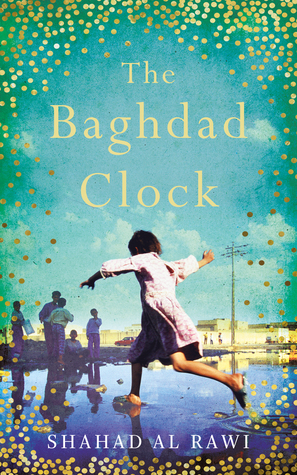
WITMonth Day 23 | The Baghdad Clock by Shahad Al Rawi | Review

The Baghdad Clock's cover and marketing is both exactly what it seems like and not quite what it's sold as. With a blurb that seems to set the story predominantly during the Gulf War, the book surprises somewhat in how quickly it moves past that war and focuses on the remainder of life in the aftermath (...within scant pages, to be honest). Yet it also hints at the type of story this is - my hardcover edition comes with shiny gold print and dots circling the edges of the cover. These make The Baghdad Clock feel a little... ethereal.

It's hard for me to describe The Baghdad Clock, written by Shahad Al Rawi and translated from Arabic by Luke Leafgren. Generally speaking, I liked the novel. It's not the sort of book that necessarily excels at every technical beat, but it does a reasonable job at enough different things that the end result is a good book. The writing style is very straightforward, though sometimes a little old-fashioned in a combination that didn't always work for my taste. Pretty much everything about the book is solid, but that's also a little bit of what made me a little cooler toward it in the end; it didn't spark particularly strong emotions in me in one way or the other.

At its core, The Baghdad Clock is a coming-of-age story. This is the part that felt undersold in the marketing - it felt at times like The Baghdad Clock was being framed as more political/about war than it actually is. Which is not to say that the book isn't political (it covers some serious ground), rather that my initial reading of the blurb leaned more towards a "war story" than "girlhood" story. It ends up being a little bit of both. While there is little of the Gulf War in the book itself, its shock-waves clearly felt throughout the narrator's childhood. Moreover, the back half of the book settles into more recent Iraqi wars and turbulence. It's still not an explicit war story, but it lives in themes of war, sanctions, and uneasy peace.

Even so, the coming-of-age narrative remains dominant. Like many books of this sort, the book skips along through childhood relatively quickly, slowing down for the narrator's teenage years and early adulthood. It's important to note that while the narrator is unnamed, she is very much our guide within this story. Not only does she filter her best friend Nadia's stories through her own experiences, the narrator also tells of her neighborhood at large. As the story progresses, she humanizes her neighborhood more and more, almost as though it itself is a living character in her story. 

By the novel's end, we definitely feel that we've encountered the world through the eyes of a specific girl (our unnamed narrator), but also that we've met her friends and neighbors. She remains somewhat elusive, though. The narrator shares bits of her budding romance with a neighborhood boy, but we learn little about her family life or even much about her personal aspirations. This too may have influenced how I felt about the book overall; I felt like the narrator was someone I just spent hours with, without really knowing who she was. A huge part of reading for me lies within the personal connection. Here, The Baghdad Clock almost explicitly sought to keep some distance between reader and main character. It's something I imagine won't bother most readers as it did me, but it still affected how I read the book.

But like I said: Pretty much everything about the book is... solid. The pacing is good. The way Al Rawi builds and populates her neighborhood is good. The way the story sometimes feels entirely real and sometimes just a little bit otherworldly is good. (This was actually one of my favorite touches and I would have been happy to have some more almost-fantasy in the story.) The story is interesting, the characters are solid, and the writing is fine. It's the sort of book I'd passively recommend, if it comes up. It might not make my "favorites" list any time soon, but I think readers are largely in for a good read.

Thursday, August 15, 2019

WITMonth Day 15 | "Lives of Three Generations of Bedouin Women" by Nuzha Allassad-Alhuzail | Review

You know how I often say that I feel "unqualified" to write reviews of certain books? Sometimes that's because a book just isn't to my taste and I don't feel that I can adequately speak for readers to whom the book is geared. Sometimes it's because the book involves literary references that I'll never be able to place. Sometimes it's because the book is on a topic that is far beyond my scope of experiences/knowledge, and I just have to trust the writer.

This review falls into this latter category.

The book I'm reviewing is not actually called "Lives of Three Generations of Bedouin Women"; for starters, it was written in Hebrew and this is simply the translation of the subtitle, and also not quite. In Hebrew, the full title translates to When the Shadow is Big, It's a Sign that the Sun is Going Down: The Lives of Bedouin Women through the Lens of Change (כשהצל גדול סימן שהשמש שוקעת: חייהן של נשים בדואיות בראי השינויים). But what it really is, at its core, is the lives of three generations of Bedouin women, a sociological case study looking at grandmothers, mothers, and daughters, each of whom reflects a generation in flux and a changing culture. For convenience's sake, I'll be referring to the book from here on out as Lives.

I picked this up entirely randomly. I almost never read nonfiction in Hebrew, and even the nonfiction I read in English is rarely sociological or academic in nature. (At least... academic in fields beyond my own scientific ones.) But somehow I did spot this on the shelf, and somehow I did decide to read the back cover, and as I did, I realized that I have never read anything by any Bedouin writer. Given that my familiarity with Bedouin culture is fairly limited and mostly secondhand, I decided I needed to read this book. I began it that evening and finished reading it the following day.

Lives is very much an academic work. In it, Dr. Nuzha Allassad-Alhuzail tracks various pieces of Bedouin culture changes through interviews of 10 Bedouin women, per generation. She selected 10 sets of grandmothers, mothers, and granddaughters who were willing to sit for extensive interviews. Most issues, she notes, were unguided - Allassad-Alhuzail frequently points to topics that each generation of women raised themselves. The study is fascinating from a lot of perspectives, giving voice to a community that is practically invisible in Israeli culture. Allassad-Alhuzail covers issues from polygamy, women's education, women's freedom, domestic violence, and more. She further places Bedouin societal changes within the context of greater social changes in the Western, Israeli, and Arab worlds overall. One of the more fascinating observations she includes in the book is the degree to which the shift from nomadic tents to fixed buildings frequently stripped women of long-held freedom; women-only spaces often entirely disappeared from Bedouin settlements. Thus, her research seems to suggest that the "mothers" generation faced greater struggles in terms of gender dynamics than their more traditional mothers had.

There's a lot I find fascinating about Lives. The book is written in Hebrew and is thus geared primarily for an Israeli audience, which obviously frames a lot of how it's written and meant to be interpreted. But while Allassad-Alhuzail certainly gives her readers a basic primer on Bedouin culture, she still focuses on very specifically Bedouin matters. She discusses the cultural shock that Bedouin culture has gone through, since effectively being forced into government-approved settlements. She discusses changes to religious traditions, that have shifted and changed over time. She discusses sexism through a variety of lenses, and this in particular is fascinating as a feminist reader, being reminded yet again that feminism can mean very different things in different cultural contexts.

For example, Allassad-Alhuzail points to an increase in young Bedouin women wearing more religious/covered clothing, but that this does not appear to reflect a greater religious fervor among these women. Instead, Allassad-Alhuzail notes that this clothing (which is tellingly not traditional Bedouin dress, but Muslim Palestinian-Arab) reflects a sort of armor. A young woman who is deemed conservative, well-covered, and modest will be allowed to leave the house and continue her studies. This observation struck me for a lot of reasons, but it also put a lot of personal interactions into a specific context that I had never really thought of before.

In one field, however, Allassad-Alhuzail frequently frustrated me. She spends quite a bit of time discussing Bedouin's status as indigenous peoples and comparing the fight for Bedouin rights to those of other indigenous peoples around the world, which was obviously enlightening, interesting, and very important. Yet she then attempts to draw parallels to European colonialism that simply don't apply, while also pointing to that sort of Palestinian-ification of Bedouin culture... without addressing how much Palestinian culture itself has changed in the same time period. Or that Palestinian culture itself is no longer quite as homogenous as she presents. Or the way pan-Arabism imposes certain cultural norms in a distinctly colonial fashion as well. (At no point does she acknowledge the plethora of Christian Palestinians mostly found in the north of Israel; Palestinian refers to Muslim Palestinian and glosses over modern, significant cultural distinctions between Israel, the West Bank, and Gaza with a casual broadness that is simply not reflective of reality.) Nor does Allassad-Alhuzail much address Bedouin status in other countries. It comes up in the discussion of the Bedouin indigenous status with some references to Egypt, but goes entirely ignored when specifically addressing government policy as regards Bedouins. It seemed like an odd omission in a book that is... all about changes in Bedouin society.

Yet even this frustration only emphasized how interesting I found Lives and how important I think it is. This is a book that does exactly what I often seek from the women in translation project - it introduced me to a thoroughly unfamiliar cultural context, demanded I truly involve myself in it, and then challenged me. The fact that the book is nonfiction only made it more enjoyable, in this case; I can (and will!) argue about how Allassad-Alhuzail attempts to frame pieces of her work in a broader cultural climate (hey, neither of us are experts on that!), but I have no interest or right whatsoever to argue with her about the facts of Bedouin culture. And these, Allassad-Alhuzail conveys clearly, cleanly, and intelligently. The book is informative and interesting, explanatory and engaging.

This is the sort of book I genuinely can't imagine ever getting translated, but it should (even if, again, I think that Allassad-Alhuzail takes some liberty in expanding her thesis to other fields). It's a cultural study from within that culture. It's an honest examination of good and bad; Allassad-Alhuzail writes of her own struggles as being the oh-so-rare-almost-unheard-of woman Bedouin PhD candidate. She explores her own status within the community, both as an academic and a social worker, and also how this shaped her study. She notes places in which her own experience aligns with those described by the other women of her generation; she frequently reminds the reader that she is writing from within, though the presentation is pointedly for without. I would love to see this reach more readers, whether in Hebrew, Arabic (the original interview language, albeit not of the book itself), or any other language.

Monday, August 5, 2019

WITMonth Day 5 | Celestial Bodies by Jokha Alharthi | Review

Jokha Alharthi's Man Booker International winner Celestial Bodies (tr. Marilyn Booth) is an odd and special book, made odder by my own expectations of it. Not that these expectations came out of nowhere - this is another example of a book with a thoroughly misleading book cover blurb and marketing effort from almost all readers. From the marketing, the book casts itself as the story of three sisters whose love lives reflect societal changes in Oman over the 20th century. It's quite simple/standard, isn't it?

As interesting a summary as that may be, it sorely undersells the modernist, vaguely experimental, extremely nonlinear techniques that Celestial Bodies utilizes to tell its story. Little about this book is particularly standard, nor does it play to reader expectations all that much, despite how the marketing may spin it. (And what I've found fascinating is also how many other readers seem to have embraced this interpretation of the text, even though the book is... really not that.)

I've struggled to write my own summary of Celestial Bodies that doesn't feel similarly inaccurate. Is this truly a cultural history, or is it simply a story that encompasses within it 2-3 generations? Does describing societal changes really make it a book about society? Is it a family epic simply because it is largely focused on one family (and its offshoots)? None of the traditional phrases used to describe books feel entirely right. The best I could come up with was "a story told in a nonlinear style, tracking deep emotional divides of its characters". Ah yes, that's helpful! (Not.)

Part of the problem is that Celestial Bodies just doesn't follow the traditional, expected norms of "first woman writer from [insert country] to be translated into English"... which of course is not its fault at all. We've (wrongly) grown to assume that "firsts" serve as encompassing cultural introductions, plus the very concept of "first"s is fraught with issues. While Celestial Bodies can certainly teach quite a bit and sell itself on that front, that's just not what it's doing on a literary level. The story isn't straight-forward and designed to be easy reading; it switches narrators, perspective, and focus easily and quickly. Moreover, its nonlinear storytelling plays with memory and perspective in ways that constantly challenge the reader. The book feels thoroughly modernist in parts, with its contrast between the very structured narration of some characters versus the loose style of others. It's a novel that feels like it carries within it so much more than appears on the surface, even as it remains accessible to most readers. Thus it emerges an odd novel for its simultaneously standard story (...no, but really... is it, though?) and its very non-standard storytelling style.

From a plot/story perspective, Celestial Bodies doesn't have all that much. It's not the sort of book that will leave you feeling wholly satisfied upon its ending. The story feels more like layers peeling back than anything direct. It's also very imbalanced in terms of characters and narration; not all characters are equal in the novel. And to take it a step further, it turns out the story is less women-focused than its framing suggests. The stories are heavily reliant on each other and feed into each other in unique ways in terms of character interactions, but the most consistent narrator turns out to be Abdallah (the second narrator in the book, who even gets his own font in the Sandstone Press edition), with a loose, out-of-time story that seems to connect most of the other stories. So there's another point against the marketing.

On top of that, the three sisters touted as the main characters? We don't actually get to know all three to the same degree. We end up learning far more about the oldest, Mayya, than either Asma or Khawla; Khawla in particular is relegated to the margins of the story and never develops into her own whole character. Asma's story begins fairly strongly, but essentially gets cut off the moment she starts to have children, effectively finishing within the space of a few lines and never getting full closure. It was a startling decision - clever, perhaps from a storytelling perspective, but ultimately disconcerting.

These all added to the odd feeling that the book left me with. Nonlinear... sure. I liked that. But the fact that some characters get totally rushed conclusions (or have sidelined arcs to begin with) left me fairly cold. It's hard to feel for a character that just exists in the background. Unfortunately, Celestial Bodies occasionally feels like it wants to be more far-reaching than it is, as such forgetting the characters that it already has. It sprawls in a way that seems more suited to a book three times its size, on the one hand making me want more and technically appreciating the novel, and on the other hand... deeply frustrating me.

But there's a lot more to Celestial Bodies. Again, to counter some of the marketing, while it very much exists in the context of Oman's history and cultural shifts, it's not really about that. It's not written to exoticize or perform changes in Oman's society, they simply are. (Which is a nice change from many Western perspectives on "exotic"/unfamiliar countries and goodness do I dislike those sorts of stories...) This means that on the one hand, the book doesn't explain a lot of background/context (and shouldn't have to!), but on the other hand... it also feels like there are nuances I will never quite understand. Which is definitely neither a point against the book nor in favor of it, simply an observation.

Which leaves me with this review. I realize that until now, I have mostly focused on the things that bothered me. This review sounds like I didn't like the book, and that's really not the case - I enjoyed Celestial Bodies overall, found it interesting, and can easily recommend it to a lot of readers. That said. false advertising is obviously not the fault of the novel itself, but it's hard to shake off the effect that it had on my reading. I actually liked a lot about the book, whether the unique style, the way it challenged my expectations, its intelligence, and its clear-sighted approach to writing about cultural changes. I also liked many of the characters and the way that the story felt like it flowed between them. And yet I came away from the book feeling somewhat... cheated is maybe too strong a word, but I'm not sure what else works. Again, it's not the novel's fault, but I came into the story with certain expectations (from the publishers and marketing, specifically) that were not met. And within the novel itself, I felt like there just wasn't enough - at just under 250 pages, this isn't a particularly long book. It left me wanting more, both in terms of those underdeveloped characters and in terms of fully understanding how the stories that did exist fit together.

Wanting more isn't necessarily a bad thing. Here, it mostly washed for me: I was already somewhat dissatisfied by the framing, which meant that I was ready to be disappointed by something else. Ultimately, I wish I could read Celestial Bodies again with fresh eyes. I wish I could erase the perception that the misleading back cover blurb instilled in me and just enjoy the book for it is - a clever, intelligent story that does a lot of brilliant work within its pages. It doesn't have to be more than that. For most readers, the experience was just those positives and I totally understand that. I find myself maybe a little cooler on the book itself than some other readers, but also able to give a warm recommendation: This is very much a book worth reading. But it might help to know what you're (not) getting.

Saturday, August 5, 2017

WITMonth Day 5 | The Queue by Basma Abdel Aziz

You know those books that you almost don't want to read because of how they suddenly seem to represent everything that's going on in your life? Like when you were a child and suddenly the protagonist of the book you were reading was struggling in school like you were, or finding a book about losing a parent just as your close friend was dealing with her grief. Sometimes books just seem too real, and goodness if Basma Abdel Aziz's The Queue (tr. Elisabeth Jaquette) didn't feel exactly that.

It's been a few months since I read The Queue, a few months in which it's remained an itchy little reminder in the back of my mind. This is unsurprising, of course - the political climate of late has been so turbulent, so virulent, so baffling that it's hard not to strongly relate to a novel that details the pervasive, insistent, cancerous growth of authoritarianism. The Queue does so from a very specific angle, taking place in a not-entirely-unfamiliar version of Egypt with its own unique struggles (including explicit references to questions of religious purity and specific Islamic values).

And yet somehow, in April of 2017, the novel felt eerily familiar to this reader.

The Queue is not an especially long, heavy, or complex read. Rich with characters as it may be, the story remains focused on a few specific individuals who effectively reside in "the queue" - a long, indeed stagnant and eternal line that is waiting for The Gate to open. The Gate represents the new, authoritarian regime. Unsurprisingly, it remains closed to the public. Even as it demands that citizens acquire specific approvals, documents, and certificates from the Gate in order to conduct normal lives (in some cases, in order to live at all), it remains steadfastly closed, even as it hands down more decrees.

The Gate has remained closed since the Disgraceful Events, when protests against the state erupted. These protests represent both the strength and weakness of the Gate: its strength in eliminating the protesters and convincing the public that these Events didn't occur as witnesses clearly show they did, while also forcing its bunkered retreat. Among the victims of the Events is Yehya, who was shot by government forces. Since the official narrative rejects that the government even needed to use live weapons, the bullet that remains lodged in Yehya cannot exist and thus Yehya's declining health is fictional as well. Yehya's health forms a sort of frame story, guided by the surgeon who initially saw Yehya and identified the bullet that remained within.

Alongside Yehya's story, The Queue introduces additional characters who need the Gate's approval for various issues. One man seeks to reclaim his family's honor, a woman tries to stay afloat as her son suffers from illness, a journalist wanders the queue in a quest to understand their stories... Each story introduces one more small angle of the Gate's authority, from control of the media to control of basic businesses (like the state-run cell-phone provider that doesn't really provide service) to the gradual - and then avalanche-scale - erosion of freedom.

And here was the point at which things began to hit close to home.

A major theme in The Queue is the reliability of truth itself. The truth of the truth. Do you believe what you are told so very reasonably? Do you believe what your own eyes have seen, even if it contradicts what you're being told? At what point is the demand of the state truly too much? At what point is it obvious that you are being truly and thoroughly oppressed? These are not trivial questions, and The Queue doesn't pretend to answer them. It's not about having an answer, it's about the route taken. A small lie enables outright, blatant denials of the truth. This not only echoes the new political climate in the US - a world of "fake news" and alternative facts - but Israel, where journalists are often (quite frankly) so shallow that it is almost impossible to identify truth from propaganda. True, both countries are still democracies (if each severely flawed in its own way...), but it felt like that iceberg tip. Just a little more and things might collapse.

The Queue is a good book. Powerful, cleanly written, thought-provoking. Both Yehya's core story and Tarek's frame are emotionally engaging, while the additional fragments from the side-characters build this world in a remarkable way. Pieces of the plot felt a little thick at times, but the relatively short length of the story keeps the book as a whole from getting bogged down. It is, ultimately, a cool-headed dystopian tale of a world that is actually far too real.

Here, at least, we have one truth...

Thursday, June 15, 2017

When you can't review impartially | Maryam: Keeper of Stories by Alawiya Sobh

This review is one of the hardest I've had to write in a very long time. It's a review tinged with disappointment, discomfort, and uncertainty. I spent a long time wondering whether I should even write a review of Alawiya Sobh's Maryam: Keeper of Stories (translated by Nirvana Tanoukhi). I wondered if I could write an impartial review.

I can't write an impartial review, perhaps, so I will write an emotional one.

I was fine with Maryam for the first 100 pages. By which I mean I was engaged with these mostly tragic-sometimes-sweet fragments about the lives of mostly-Muslim Lebanese women. Maryam is a book comprised of pieces of stories, told ramblingly and often vaguely. The stories seem to overlap, with characters almost interchangeable. It's a book about women, often delving into the rougher sides of things too. Women are explicitly raped (not "hurt" by men; the text is blunt in this truth), women give birth, women befriend women, women fall in love, women are hurt, and so on. It's bleak, but there's a power to it, I suppose.

Except... something happened around 100 pages into the book. Specifically, an anecdote entered the narrative for no discernible reason. A deeply antisemitic, what-the-f***, unnecessary story.

This page-long anecdote is about the "grandfather", who goes to America to find his fortune. While there, the greedy Jew that he works with cheats the business's owner. The owner asks the grandfather to kill the Jew, which the grandfather does by... throwing "the Jew" into the oven. The grandfather is rewarded with gold, because now that the cheating Jew is gone, the bakery will make much more money. An alternative version to this story exists as well, in which it is actually the bakery owner who is Jewish and the American coworker who is burned. But this version is told in a paragraph as the alternative, rather than the page and a half devoted to the version that ends with the greedy Jew being burned in the oven.

I literally had to stop reading at this point. Sitting out on the balcony with my feet soaking up the sun, hands shaking, mouth open, utterly aghast, I set the book aside. I couldn't keep reading for several more hours. I wondered if I was being overly sensitive. I wondered if I was being unfair. I wondered if it was totally unintentional. Perhaps the Holocaust imagery was a coincidence? Perhaps the linkage between "Jew" and "money thieving" was random? Perhaps I was imaging things...

I couldn't read the book in the same way after that.

I started noticing the way Christian characters hardly existed in Sobh's Lebanon. Despite the fact that almost half of the country is Christian or Druze, the novel doesn't seem to see them the same way it sees its Muslim characters, even if it occasionally references the sectarian differences in the country that fuel so many of its conflicts. I started noticing that the narrative frequently references atrocities from Lebanon's wars with Israel (justifiably enough, though it ignores the triggers that led to these wars), but does not even mention Syrian interference in the country's civil war. The book started to feel like a smokescreen, telling one important story perhaps about the struggles of some Muslim women growing up during wars and atrocities and misogyny, but almost deliberately ignoring anything else around it.

Of course, this reading is heavily biased. I'm not going to pretend it isn't. The above feelings were always framed by that one moment, around page 100, with the Jewish worker being burned in the oven. Every time I tried to set it aside, I found myself coming back to it. Why would the narrative include it? What possible purpose did it serve? It had nothing to do with any of our main characters, provided little emotional depth, and served no purpose to the plot. Why was it there? Why was it translated so uncritically? Why should I read a book that has such a blatantly antisemitic reference and not be upset by it? Why shouldn't it color how I read the rest of the book?

I don't have any good answers to these questions.

Maryam has an interesting concept at its core. I loved the idea of telling women's stories in this muddled way. I loved that the focus really was on the struggles many women face, simply for being born female. The writing is dreamy and lovely, befitting a story that encompasses so large a time span with such a vaguely distant style. On a technical level, I can see that Maryam has a lot going for it. But does that excuse the rest? Does that excuse the dropped stories or aimless frame story? Does it excuse the smokescreen and evasion? Does it excuse a totally unnecessary antisemitic scene that is inexplicable and inexcusable and yet... included?

I was ultimately left disappointed and upset by Maryam. Triggered by personal experiences? Sure. Yes. Antisemitism is likely to hurt me more than others, fine. It meant that I couldn't read the story the way that I had wanted to. It meant that I had to reframe the entire story based on identity politics of the ugliest sort. It meant that I had to question whether lovely prose made up for ugly content. It meant I had to challenge my own definitions of ugliness, wondering if perhaps I could set aside my own emotions for the sake of other important aspects. I guess in the end I just couldn't, and I am left with a bitter taste in my mouth. Perhaps other readers will be able to look past what I could not; I remain disappointed, uncomfortable, and uncertain. What a shame.

Saturday, August 13, 2016

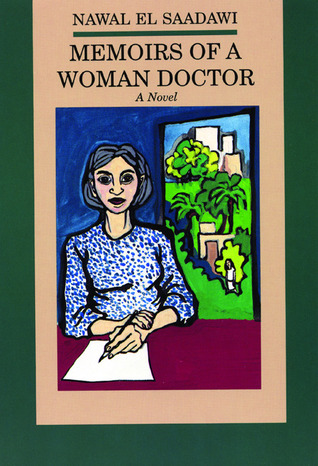
WITMonth Day 13 | Memoirs of a Woman Doctor by Nawal el-Saadawi | Review

If I had to give Memoirs of a Woman Doctor by Nawal el-Saadawi (translated by Catherine Cobham) a one-line review, I'd probably say that it was an interesting (if forgettable) book that didn't really move me much in any direction.

That makes writing a review a bit difficult, particularly in light of the long gap between when I read it and the time of writing this review. I recall the feminist message of Memoirs of a Woman Doctor fairly clearly (particularly the fact that it doesn't always resemble "Western" feminism), as well as the relationship the narrator had with her brother. But that's about it. It's only by browsing now that I recall the narrator's failed marriage, the struggles she has in establishing her practice. The way the role of a woman within Egyptian culture is central to the plot. Even the narrator's musings on the failings of modern medicine in relation to her own desires.

This sort of amnesia doesn't bode very well for this novella. Truthfully, it's not all that good on a technical level. That is... conceptually, it's a powerful, interesting narrative, with a strong message about women's roles and feminism in an at-times unyielding world, alongside a central theme of mother-daughter relationships. But the writing is awkward, the story is that weird balance of not-fully-fleshed and poorly-padded. Parts of it felt like they were written too directly, thoughts to page without any literary adjustments along the way.

Memoirs of a Woman Doctor is a great example of a book that is improved by its context. Under normal conditions, there is little to recommend here (especially since the book is extremely slight, and the font surprisingly large...), yet the content - and the complex world this content lives within - is almost important enough to justify giving the book a second glance. No, it's not particularly well written (though there are a handful of beautiful lines and images), nor is it an inherently moving text. But its position as a frank literary piece chronicling a somewhat unique position alongside a rarely heard feminist worldview makes it interesting. And also, yes, important. Its voice may wobble, but it has something to tell.

Sunday, August 16, 2015

WITMonth Day 16 - Spotlight on Northern Africa

Jumping around continents a bit, but it's definitely time to broaden our horizons a bit. Let's see what Northern Africa's women have to offer, shall we? Note: This list contains books translated from several different languages, as befits such a broad and diverse geographic region.

  • Leila Abouzeid (Morocco)
  • Rita El Khayat (Morocco)
  • Mririda n’Ait Attik (Morocco)
  • Malika Oufkir (Morocco)
  • Amina Said (Tunisia)
  • Nawal El Saadawi (Egypt)
  • Radwa Ashour (Egypt)
  • Hala El Badry (Egypt)
  • Mansoura Ez-Eldin (Egypt)
  • Alifa Rifaat (Egypt)
  • Maïssa Bey (Algeria)
  • Assia Djebar (Algeria)
  • Malika Mokeddem (Algeria)
  • Ahlam Mosteghanemi (Algeria)
  • Leïla Sebbar (Algeria)
As always, this list is woefully incomplete and narrow. As always, compiling this list made me realize how many writers are not translated (and I'll talk about this a bit more in depth later in the month). But once again I find myself thinking, "Well, at least it's a place to start." So... onward we march.