- I don't remember the last time a book had a declaration of love quite so early on. And so randomly. And so not related to the actual plot of the book...? Still too early to tell.
- Margaret's dad is kind of despicable. I know I'm not supposed to dislike him, but it's rare for me to want to slap a character in a book. I want to slap Mr. Hale. Really, really hard.
- This book is kind of slow, but my interest is piqued. Let's hope it stays that way.

Sunday, August 22, 2010
Up and down
Some unrelated, stupid thoughts on North and South from the first couple of chapters:


Sunday, August 15, 2010
Novels and short stories
 One of the sub-genres I've recently discovered (knowing full well that this has existed for a while) is that of the "novel in stories". I have to admit that I love the idea. Short stories and I have a tentative relationship for the simple reason that I like watching characters develop. I like a long, in-depth introduction to a character, not a simple snapshot and then moving onto a whole new set. But I also love the wholeness in short stories, the way a really good short story can stand on its own and that's that.
So a novel in stories should be perfect for me. Some of them are. The White King, which I wrote about last year, was one such book - essentially a novel, watching the development of one central character, but written in such a way that it felt as though I was reading short stories. Enough characters stayed constant that these days I would define it as closer to a novel than a "novel in stories", but it still has that atmosphere. Olive Kitteridge, which I started and finished reading yesterday, is another such book. But my thoughts on it are far less positive. Despite the mountains of praise heaped upon the 2009 Pulitzer Winner (and I absolutely understand why this book won, but more on that later), there were things I learned about "novels in stories" from Olive Kitteridge. Things I will need to keep in mind for the future.
The first thing I realized about Olive Kitteridge was that whereas The White King was more of a novel, Elizabeth Strout's book is much more a short story collection, in the sense that it was at once broader - more characters, not just one story progression, and the wonderful quality of transitioning between worlds, rather than almost always knowing what kind of story you'll fall into - and at once suffering from many of the short story collection downfalls that I'm used to.
There is much to praise in Olive Kitteridge. The cleanness of the writing, the clarity of the characters' voices, the fluid way each story leads into the next while presenting completely different worlds - all these make Olive Kitteridge a nice book. That's the perfect word for it - nice. Not good, because that's too strong. Not fine, because that's too bland. Nice.
And disappointments as well. I had hoped and expected a novel in stories to take the best of both worlds. Long term character development, but small, complete stories. None of the messiness found in constructing complex novels, none of the padding to make a novel "novel sized". Much in the way that Strout's writing is clean, I had hoped the stories would be like this as well. This is not the case. The book is uneven. Not more than the typical short story collection, but still. Some stories are whole on their own and are really good stories. Others are absolutely pointless. Others still are so closely tied to what seems like a larger novel that with the random stories thrown in, they actually seem out of place even if this is precisely where they should be. It makes sense that these problems should arise. On the copyright information page, part of the history of Olive Kitteridge is revealed. Some of the stories were published almost two decades ago, others more recently. It is hard to fault an author for developing with time, but in a collection, it's hard not to notice the different styles and qualities.
As for the matter of the overall story itself, I find myself confused. The book is titled Olive Kitteridge - the book would appear, therefore, to be about her. It is, frankly, not (this is not a spoiler...). Olive stars in 7 out of 13 of the stories, sometimes in more of a supporting role but more often than not as the lead. In the remaining 6, she is a character mentioned casually or a side character - either way, not really worthy of recognition. But that we know her already makes it a strange cameo - not quite a random name drop of an unknown person, but reference to someone we're slowly getting to know.
Maybe it's just that I didn't like this style. I'm not certain, but ultimately I didn't enjoy the way characters couldn't grow, or the way that I liked Olive's character (despite being expected, I suspect, to find her somewhat frustratingly endearing, which was not at all the case - I sincerely liked her) but didn't care about her. 270 pages and I really didn't care about a single character mentioned. That should not be the case.
Again: Olive Kitteridge is nice. That word keeps coming to mind, as well as the description clean, which fits the writing and the clarity of the book perfectly. It's enjoyable to read writing of this kind, and the book does an excellent job of presenting a very different aspect of American life than is typically presented (there lies the absolutely perfect justification for the Pulitzer). I suppose Olive Kitteridge has made me realize that "novels in stories" can be tricky - much in the way that they can take my favorite aspects from novels and my favorite aspects from short stories, they can take good and bad as well. I don't regret reading it and know that many will go on enjoying it despite my relative apathy (relative, I say), but I would have to think carefully about who I recommend it to.
Sunday, August 8, 2010
Seriously?
I just searched for "A Pigeon and a Boy" on Amazon (great book, by the way - more on that another time) and discovered that the Kindle version is more expensive than the paperback by almost $2.
Seriously, consumers? You're actually okay with this?
Seriously, consumers? You're actually okay with this?
Saturday, August 7, 2010
Publishing - an exercise in disappointment
After finding and reading Nico Vreeland's great post over at Chamber Four about publishing (at a bit of a delay, perhaps...), I had to add a few words and a couple of personal numbers. Vreeland writes about the "real" death of publishing - not eBooks, not consumers demanding lower prices... not us, but them.
My main problem with this issue is what Vreeland looks at as well - the amount of crap that comes out every year. Publishers are meant to be kind of a buffer zone between readers and books. Sure, I can access tons of free writing online written by amateurs, but I'll most likely find amateur-level writing. Every once in a while, a self-published book can be good, and then what happens? It gets picked up by publishers. Why? For publicity, for sales. To make money. Okay, legit. Those are meant to be rare cases. And for the most part they are, so I'd like to set this matter aside. But publishing seems to forget it's other task, that of keeping the junk away from us. Theoretically, books rejected by publishers are supposed to be the bad ones (more on this in a moment). This means that books publishers do spend money on should be pretty effing good. So why aren't they?
First is the fact that some of the books rejected by publishers actually are good. So why are they rejected? Sales. Publishing, the giant business that it is, aims to sell and make money. A good business model, yes, but ultimately bad for readers. Readers who ultimately drive the book market. So it's a little stupid by this point.
Not every book is always going to be to everyone's tastes. This isn't new. I'm pretty known for disliking a lot of the books everyone else seems to love - whether they're classics that history has deemed worthy, or just plain ol' books-of-the-moment award winners (I'm thinking of "Catcher in the Rye", "Let the Great World Spin" and some others here). That's understandable, that's expected. But to publish books that are almost unquestioningly bad because they'll make you a couple bucks... there's something off to that.
In the past three years, I've read 91 Anglo-centricly published novels published from 2005 and on. Like Vreeland, I decided to run some numbers. Turns out I needed a different scale than the simple "bad okay good great" scale. Mine was "terrible bad mediocre nice good great amazing". 6 books were amazing, 11 great, 11 good, 17 nice, 27 mediocre, 14 bad, and 5 terrible. That's somewhere around 50% books not worth reading, 30% books that were pleasant and had merit, but didn't really blow me away, and 20% worth keeping on the shelves, worth recommending, worth gushing about, worth reading.
Call me selfish, but I want 100% of books I read to be amazing.
No, that's wrong. Life would be so boring without the guilty pleasure books that fell into the bad category. And a terrible ride is wonderful every once in a while. So essentially I want somewhere around 80% of books to be awesome, 15% to be enjoyably bad (or not my style), and a small 5% to be "I'm gonna punch the author in the face for even writing this, and the publishers for making me spend money/time on this". And you know what? I'm sick of it.
I'm sick of being told by publishers that I'm asking for unreasonably low prices for things that are worth less (eBooks!!!). I'm sick of feeling bad for writing bad reviews online when books are bad and don't deserve to be read (and then getting surprised reactions of "how could you not love this? You must be stupid" or things to that extent). I'm sick of suggestions that libraries are bad for publishing or bookselling. I'm sick of feeling like I have to search for good books, that I'm on some crazy holy-grail-esque quest for a novel that doesn't suck. And I'm sick of books that do suck. And guess what? Most of them do. 50% of the contemporary books I read in the last three years were disappointing and not worth my time. What kind of statistic is that?
This week I intend to read good books, like I decide every week. Chances are that won't be the case. More than anything else, that disappoints.
[Publishing is] not a victim, period. Publishing is slowly strangling itself by myopically hard-selling each and every title it cranks out, instead of nurturing the readers who sustain it. [...] It seems, in short, like publishers aren’t culling bad novels like they should be, and then readers have to do it, which means sifting through dozens or hundreds of published novels to find just the few worth reading. And that gets old.I recommend reading the entire piece. Vreeland raises a lot of really good points, ones I could only hope to verbalize. But I'll take a stab anyways.
My main problem with this issue is what Vreeland looks at as well - the amount of crap that comes out every year. Publishers are meant to be kind of a buffer zone between readers and books. Sure, I can access tons of free writing online written by amateurs, but I'll most likely find amateur-level writing. Every once in a while, a self-published book can be good, and then what happens? It gets picked up by publishers. Why? For publicity, for sales. To make money. Okay, legit. Those are meant to be rare cases. And for the most part they are, so I'd like to set this matter aside. But publishing seems to forget it's other task, that of keeping the junk away from us. Theoretically, books rejected by publishers are supposed to be the bad ones (more on this in a moment). This means that books publishers do spend money on should be pretty effing good. So why aren't they?
First is the fact that some of the books rejected by publishers actually are good. So why are they rejected? Sales. Publishing, the giant business that it is, aims to sell and make money. A good business model, yes, but ultimately bad for readers. Readers who ultimately drive the book market. So it's a little stupid by this point.
Not every book is always going to be to everyone's tastes. This isn't new. I'm pretty known for disliking a lot of the books everyone else seems to love - whether they're classics that history has deemed worthy, or just plain ol' books-of-the-moment award winners (I'm thinking of "Catcher in the Rye", "Let the Great World Spin" and some others here). That's understandable, that's expected. But to publish books that are almost unquestioningly bad because they'll make you a couple bucks... there's something off to that.
In the past three years, I've read 91 Anglo-centricly published novels published from 2005 and on. Like Vreeland, I decided to run some numbers. Turns out I needed a different scale than the simple "bad okay good great" scale. Mine was "terrible bad mediocre nice good great amazing". 6 books were amazing, 11 great, 11 good, 17 nice, 27 mediocre, 14 bad, and 5 terrible. That's somewhere around 50% books not worth reading, 30% books that were pleasant and had merit, but didn't really blow me away, and 20% worth keeping on the shelves, worth recommending, worth gushing about, worth reading.
Call me selfish, but I want 100% of books I read to be amazing.
No, that's wrong. Life would be so boring without the guilty pleasure books that fell into the bad category. And a terrible ride is wonderful every once in a while. So essentially I want somewhere around 80% of books to be awesome, 15% to be enjoyably bad (or not my style), and a small 5% to be "I'm gonna punch the author in the face for even writing this, and the publishers for making me spend money/time on this". And you know what? I'm sick of it.
I'm sick of being told by publishers that I'm asking for unreasonably low prices for things that are worth less (eBooks!!!). I'm sick of feeling bad for writing bad reviews online when books are bad and don't deserve to be read (and then getting surprised reactions of "how could you not love this? You must be stupid" or things to that extent). I'm sick of suggestions that libraries are bad for publishing or bookselling. I'm sick of feeling like I have to search for good books, that I'm on some crazy holy-grail-esque quest for a novel that doesn't suck. And I'm sick of books that do suck. And guess what? Most of them do. 50% of the contemporary books I read in the last three years were disappointing and not worth my time. What kind of statistic is that?
This week I intend to read good books, like I decide every week. Chances are that won't be the case. More than anything else, that disappoints.
Sunday, August 1, 2010
Charge!
This is interesting. Over at Survival of the Book, Christopher raises the idea of instating subscription fees for local libraries.
Two or three years ago, a library I tend to frequent (not in the U.S.) revoked its subscription fee (which I had been paying). For many years (indeed, as long as this library had existed), subscription fees were part of the package. Children got cheaper deals, while adults were forced to dole out quite a bit of money in exchange for books and resources. Then a law passed to end this practice. Residents have free access to any library in their city. Meanwhile, if you want access to a bigger, better library one town over... no problem. Pay up.
The fact of the matter is that having subscription fees did not really keep most people from using library resources. Checking books out may have been impossible without a card, but people still used the libraries. On the other hand, they had no other choice and the policies were unfair towards those with fewer means. Ultimately, I don't know if libraries have seen significant changes in patronage or funds since the policy was revoked. It's probably too soon to tell. And, keep in mind, this was all abroad.
Still, to imagine now that the opposite would happen in the U.S. disturbs me. I am lucky to have had many library cards throughout my youth - I have seen good libraries, better libraries, and libraries that were... shall we say... bad. For the most part, though, the libraries I encountered all had one thing in common. They all always had lots of people. Lots of kids checking out books. Lots of teens working in study rooms. Lots of unemployed or retired adults looking for various forms of entertainment (or jobs). These people come in, check books, music, movies, knowledge out and then they return it. That's what a library is - the government funding free access to knowledge for its people. Is there anything more democratic than that? Sure, it may not have started as that originally, but that's what libraries are today.
It always makes me a little sad to see things that seem like regression. While there may be a lot of cold logic behind the idea of charging for libraries, as someone who has stood on the other end of it I have to say that it's not recommended. Paying for libraries feels like someone is keeping knowledge from me. And in today's economy, libraries are more important than ever before: keeping kids well educated and entertained after school, allowing adults to learn, and making sure that knowledge is provided equally to everyone. This is not the time to cut back on library budgets. It's also not the time to start charging people for subscriptions.
For now, I understand the value of the free public library system but sometime in the not too distant future there will be a reason to start instituting a yearly membership fee to guarantee the survival of these institutions. The notion of government support-from local to national-is under siege and it is not out of the realm of possibility that one day libraries won't be supported by the municipalities in which they are located.Christopher's right that libraries are facing serious budget setbacks and issues. There's also a point to the idea that volunteering to pay off fines (raised earlier in the post) will help libraries immensely. But I wanted to add a few thoughts to this idea, ones that may seem in favor and also vehemently against.
Two or three years ago, a library I tend to frequent (not in the U.S.) revoked its subscription fee (which I had been paying). For many years (indeed, as long as this library had existed), subscription fees were part of the package. Children got cheaper deals, while adults were forced to dole out quite a bit of money in exchange for books and resources. Then a law passed to end this practice. Residents have free access to any library in their city. Meanwhile, if you want access to a bigger, better library one town over... no problem. Pay up.
The fact of the matter is that having subscription fees did not really keep most people from using library resources. Checking books out may have been impossible without a card, but people still used the libraries. On the other hand, they had no other choice and the policies were unfair towards those with fewer means. Ultimately, I don't know if libraries have seen significant changes in patronage or funds since the policy was revoked. It's probably too soon to tell. And, keep in mind, this was all abroad.
Still, to imagine now that the opposite would happen in the U.S. disturbs me. I am lucky to have had many library cards throughout my youth - I have seen good libraries, better libraries, and libraries that were... shall we say... bad. For the most part, though, the libraries I encountered all had one thing in common. They all always had lots of people. Lots of kids checking out books. Lots of teens working in study rooms. Lots of unemployed or retired adults looking for various forms of entertainment (or jobs). These people come in, check books, music, movies, knowledge out and then they return it. That's what a library is - the government funding free access to knowledge for its people. Is there anything more democratic than that? Sure, it may not have started as that originally, but that's what libraries are today.
It always makes me a little sad to see things that seem like regression. While there may be a lot of cold logic behind the idea of charging for libraries, as someone who has stood on the other end of it I have to say that it's not recommended. Paying for libraries feels like someone is keeping knowledge from me. And in today's economy, libraries are more important than ever before: keeping kids well educated and entertained after school, allowing adults to learn, and making sure that knowledge is provided equally to everyone. This is not the time to cut back on library budgets. It's also not the time to start charging people for subscriptions.
Wednesday, July 28, 2010
We should be discussing more than the blurb
Something that recently made the rounds is the blurb author Nicole Krauss attached to David Grossman's forthcoming novel, "To the End of the Land", first published in Israel in 2008. Bloggers and readers find the quote over-done, and even the Guardian finds the whole situation rather ludicrous, making a game out of it (or, as they call it, an "outblurb" challenge).
But we should be discussing more than the blurb. We should be discussing the book.
"To the End of the Land" doesn't really deserve this bad press. When first published in Israel, it was more than just a bestseller - it was a fairly monumental part of the daily culture. Popular books in Israel are split according to origin - abroad and home-grown. Here was a home-grown author, though, that went beyond simple bestseller. Grossman is known for more than just his books. He's known for his politics, and even for the fact that his son was killed in the 2006 Israel-Lebanon conflict. "To the End of the Land", contrary to popular belief, was not written following the death of Grossman's son. Though it looks at many subjects through a lens that fits this theory, Grossman even discusses in interviews the fact that the book was conceived long before his son was killed. And, he adds in the interview, the manuscript wasn't edited afterward either. The book itself is complex and difficult to describe, even more so when taking into account culture differences between Israel and the rest of the world. And all this without getting into stylistic issues (or topics, to be more diplomatic).
Reading "To the End of the Land" is a bit like cheating at all times, because you can't, can't disconnect yourself from Grossman's reality. It's hard to read this book without looking at Grossman's personal story and taking something from it. This works well for some people. For others, less so. For me, reading Grossman's book was a little like an attempt at rock-climbing, trying to swallow this tome in large gulps, when really it should have been treated with more care. It was letting Grossman slide with stylistic things (like an incredibly abrupt, teetering-at-the-edge-of-a-cliff-seconds-before-falling ending), accepting things that might normally seem a little "out there". It was suspending belief for 600 pages, and coming down to earth feeling like something really had changed.
I would not define "To the End of the Land" as a book entirely built on one clear story. It's built of small stories that define characters, these little vague entries in a larger story that make up life. Easily split into two parts (the first presents youthful characters, while the second revisits these children middle-aged), the bridge between the two parts is, again, abrupt. Even awkward. It's hard to shift gears so suddenly in the midst of a story, but once passing that hurdle... the book is good. Good like most of Grossman's writing is. Good like you'd expect from literature. Just... good.
When Krauss writes that the book touches your essence, she's taking a serious point too far. "To the End of the Land" did affect me. Reading it caused me to shift my point of view just a little, to look at certain subjects from a slightly different angle. It made me appreciate aspects of my life, educated me a bit more about Israeli history (though rather subtly), and got me so into the lives of these characters. That's what a book is supposed to do, and Grossman does it well.
I wasn't thrilled with the translation of Grossman's "Someone to Run With" (a good book in its own right, but translated somewhat sloppily), but Jessica Cohen's work flows in a manner that seems much closer to the original (and is altogether more satisfactory). It's a book that's hard to classify. On the one hand, I didn't exactly love it: it has flaws such as the abruptness, such as vagueness, such as the occasional awkwardness... On the other hand, it's not a book I see myself getting rid of so easily. I have grown quite attached to it and someday when I revisit it, I suspect I shall learn quite a bit.
Don't judge this book by its bland, rather ugly cover. And don't judge it by the "over-wrought" quote. Judge it by Grossman's incredible writing talent, by the cultural importance, the historical context regarding Israel, and by the wonderful way Grossman builds a world out of a small cast of characters. This is not a cheerful romp through flowered fields (as the current Amazon cover indicates) - it's a rather bleak view of life.
"To the End of the Land" does not deserve ridicule for a poorly picked blurb, but rather deserves serious discussion for its literary merit. I hope this has helped.
But we should be discussing more than the blurb. We should be discussing the book.
"To the End of the Land" doesn't really deserve this bad press. When first published in Israel, it was more than just a bestseller - it was a fairly monumental part of the daily culture. Popular books in Israel are split according to origin - abroad and home-grown. Here was a home-grown author, though, that went beyond simple bestseller. Grossman is known for more than just his books. He's known for his politics, and even for the fact that his son was killed in the 2006 Israel-Lebanon conflict. "To the End of the Land", contrary to popular belief, was not written following the death of Grossman's son. Though it looks at many subjects through a lens that fits this theory, Grossman even discusses in interviews the fact that the book was conceived long before his son was killed. And, he adds in the interview, the manuscript wasn't edited afterward either. The book itself is complex and difficult to describe, even more so when taking into account culture differences between Israel and the rest of the world. And all this without getting into stylistic issues (or topics, to be more diplomatic).
Reading "To the End of the Land" is a bit like cheating at all times, because you can't, can't disconnect yourself from Grossman's reality. It's hard to read this book without looking at Grossman's personal story and taking something from it. This works well for some people. For others, less so. For me, reading Grossman's book was a little like an attempt at rock-climbing, trying to swallow this tome in large gulps, when really it should have been treated with more care. It was letting Grossman slide with stylistic things (like an incredibly abrupt, teetering-at-the-edge-of-a-cliff-seconds-before-falling ending), accepting things that might normally seem a little "out there". It was suspending belief for 600 pages, and coming down to earth feeling like something really had changed.
I would not define "To the End of the Land" as a book entirely built on one clear story. It's built of small stories that define characters, these little vague entries in a larger story that make up life. Easily split into two parts (the first presents youthful characters, while the second revisits these children middle-aged), the bridge between the two parts is, again, abrupt. Even awkward. It's hard to shift gears so suddenly in the midst of a story, but once passing that hurdle... the book is good. Good like most of Grossman's writing is. Good like you'd expect from literature. Just... good.
When Krauss writes that the book touches your essence, she's taking a serious point too far. "To the End of the Land" did affect me. Reading it caused me to shift my point of view just a little, to look at certain subjects from a slightly different angle. It made me appreciate aspects of my life, educated me a bit more about Israeli history (though rather subtly), and got me so into the lives of these characters. That's what a book is supposed to do, and Grossman does it well.
I wasn't thrilled with the translation of Grossman's "Someone to Run With" (a good book in its own right, but translated somewhat sloppily), but Jessica Cohen's work flows in a manner that seems much closer to the original (and is altogether more satisfactory). It's a book that's hard to classify. On the one hand, I didn't exactly love it: it has flaws such as the abruptness, such as vagueness, such as the occasional awkwardness... On the other hand, it's not a book I see myself getting rid of so easily. I have grown quite attached to it and someday when I revisit it, I suspect I shall learn quite a bit.
Don't judge this book by its bland, rather ugly cover. And don't judge it by the "over-wrought" quote. Judge it by Grossman's incredible writing talent, by the cultural importance, the historical context regarding Israel, and by the wonderful way Grossman builds a world out of a small cast of characters. This is not a cheerful romp through flowered fields (as the current Amazon cover indicates) - it's a rather bleak view of life.
"To the End of the Land" does not deserve ridicule for a poorly picked blurb, but rather deserves serious discussion for its literary merit. I hope this has helped.
Thursday, July 22, 2010
Amazon review of the week
This one is entertaining with no additional comment. Reviewer "Mao Ze Dong" writes a review for "The Amulet of Samarkand":
London needs more communism in that book. In other words, the book really sucked.
Friday, July 16, 2010
...but you have
I firstly want to thank all readers who commented on my recent post about "The Passage" - a book I have not read, but apparently, the vast majority of readers have. The responses are varied and fascinating, and I feel this subject deserves further discussion.
Most of you don't think "The Passage" is sci-fi. A few examples of other "non sci-fi" comparison books were offered, books like "The Road" or "The Stand", books that are described as "post-apocalyptic" or "horror". While horror may fall into its own category, post-apocalyptic or dystopian novels do, in my mind, fall under the vast science fiction genre. This explains why I keep seeing people explicitly excluding science-fiction from the description of "The Passage" - we have different definitions of science fiction. This makes a lot more sense now.
Another somewhat recurring sentiment is that the book can be split into sections with different genres. This is really interesting to me, mostly because I never think to divide books like this. And, again, it further explains the gap between my mentality and the majority. By dividing the book into sections, readers see parts without any obvious science fiction as purely "literary" or horror, or romance, therefore explaining the fact that this book is many genres in one.
And a lot more fascinating thoughts you raised. Thanks to all who commented - though I'm not fully convinced that "The Passage" does not technically belong to the sci-fi genre, I do realize that everyone looks at things differently, and ultimately the genre shouldn't be defining the book quite as much as I assumed it to be. I do, however, get the impression, that "The Passage" is a good book. That should probably be enough.
Most of you don't think "The Passage" is sci-fi. A few examples of other "non sci-fi" comparison books were offered, books like "The Road" or "The Stand", books that are described as "post-apocalyptic" or "horror". While horror may fall into its own category, post-apocalyptic or dystopian novels do, in my mind, fall under the vast science fiction genre. This explains why I keep seeing people explicitly excluding science-fiction from the description of "The Passage" - we have different definitions of science fiction. This makes a lot more sense now.
Another somewhat recurring sentiment is that the book can be split into sections with different genres. This is really interesting to me, mostly because I never think to divide books like this. And, again, it further explains the gap between my mentality and the majority. By dividing the book into sections, readers see parts without any obvious science fiction as purely "literary" or horror, or romance, therefore explaining the fact that this book is many genres in one.
And a lot more fascinating thoughts you raised. Thanks to all who commented - though I'm not fully convinced that "The Passage" does not technically belong to the sci-fi genre, I do realize that everyone looks at things differently, and ultimately the genre shouldn't be defining the book quite as much as I assumed it to be. I do, however, get the impression, that "The Passage" is a good book. That should probably be enough.
Sunday, July 11, 2010
Vintage, California
I read "The Grapes of Wrath" on a summer visit to an Eastern European country, an apt setting for this novel. Alongside the grim stories are beautifully written chapters about nature and land. The book went well with the corn fields flying by.
I reread it perhaps a month or two later. I was worried that my impression of the book had been altered by the way I'd read it, something not unheard of. The experience was, indeed, quite different, but actually more positive. Since then, I've only ever reread two very specific parts of Steinbeck's novel and have largely ignored the rest.
The first revisited part is, unsurprisingly, the end. At the risk of spoiling the book for those who haven't read it, I won't go into what exactly it is about the ending that called me back again and again. Just know that it's a good ending. At first I didn't like it. Even before I reread the whole novel, this one scene, these last few pages kept pulling me back in, first in annoyance, and later, growing respect and appreciation. Each revisit explained something new and made me like the book a little more.
The other part is at once more complicated and simpler. As I mentioned earlier, "The Grapes of Wrath" has descriptive chapters amidst the meat of the book. These are beautiful "literary" chapters, ignoring real characters and looking at nature and at the land. These are chapters to build the world, adding a level of descriptive depth to it.
Chapter 25 epitomizes this. This chapter lends the book its name and stands as some of the single greatest writing I've ever read. From its pure, idyllic opening ("The spring is beautiful in California."), to the title-giving final line ("In the souls of the people the grapes of wrath are filling and growing heavy, growing heavy for the vintage."), it travels the state and sums up much of the story indirectly.
These two snapshots don't make up the book. In fact, they paint a picture of a completely different type of novel, one that focuses too much, perhaps, on the aesthetic qualities of words and less their meaning. Now, a few years later, they serve as an excellent reminder that I liked this book, and this (coupled with how well "The Grapes of Wrath" grew on me) proves that I must revisit it. Preferably soon.
I reread it perhaps a month or two later. I was worried that my impression of the book had been altered by the way I'd read it, something not unheard of. The experience was, indeed, quite different, but actually more positive. Since then, I've only ever reread two very specific parts of Steinbeck's novel and have largely ignored the rest.
The first revisited part is, unsurprisingly, the end. At the risk of spoiling the book for those who haven't read it, I won't go into what exactly it is about the ending that called me back again and again. Just know that it's a good ending. At first I didn't like it. Even before I reread the whole novel, this one scene, these last few pages kept pulling me back in, first in annoyance, and later, growing respect and appreciation. Each revisit explained something new and made me like the book a little more.
The other part is at once more complicated and simpler. As I mentioned earlier, "The Grapes of Wrath" has descriptive chapters amidst the meat of the book. These are beautiful "literary" chapters, ignoring real characters and looking at nature and at the land. These are chapters to build the world, adding a level of descriptive depth to it.
Chapter 25 epitomizes this. This chapter lends the book its name and stands as some of the single greatest writing I've ever read. From its pure, idyllic opening ("The spring is beautiful in California."), to the title-giving final line ("In the souls of the people the grapes of wrath are filling and growing heavy, growing heavy for the vintage."), it travels the state and sums up much of the story indirectly.
These two snapshots don't make up the book. In fact, they paint a picture of a completely different type of novel, one that focuses too much, perhaps, on the aesthetic qualities of words and less their meaning. Now, a few years later, they serve as an excellent reminder that I liked this book, and this (coupled with how well "The Grapes of Wrath" grew on me) proves that I must revisit it. Preferably soon.
Sunday, July 4, 2010
I have not read this book
Following the massive buzz surrounding South African stadiums--er, Justin Cronin's incredibly well-publicized book "The Passage"-- I have found myself reading many, many reviews of the book. Most are positive. Some are not. But one book blogger sentiment that seems to crop up again and again is that the book has an "undefined" genre, that it's a difficult book to classify. Finally curious to know a reader's take on the matter, I posed to the question to Rachel of "A home between the pages", who kindly responded in full. The response:
Elements of romance, "literary" fiction, etc. - these things do not disqualify a book from being science fiction. There is no contradiction. Depth to characters and writing... also not contradictory to the genre science fiction. And as I discovered in Sci-Fi Month, the science fiction genre covers just about everything.
I can't really discuss the book because I haven't read it, but something about this response seems to come from the wrong angle. It's as though (and I interject here to invite any and all other interpretations, especially those of the author) to justify the popularity, one has to distance the book from the "standard" sci-fi genre. Yet what exactly does that mean? Elements of horror, romance, deep characters... this all still sounds strictly sci-fi, but as though to detract me from ignoring the book (because the label "sci-fi" is still something bad to many readers...), readers who themselves would have otherwise ignored the book find themselves calling it genre-bending. And of course, I may be entirely wrong.
But I can't shake this feeling that the reason this book defies genre isn't really because it's actually falls into multiple genres (very possibly because I've grown to believe that most genres blend together and are virtually indistinguishable - a different topic for another day), but because publicists (and subsequently, bloggers, readers, reviewers, etc.) do not want it defined. The term "science fiction" doesn't do much for the intended audience, especially when it has grown to mean much more than its official, you know, genre.
Rachel's response indicates this as well. There is an impression that once labeled "sci-fi", "The Passage" will also be labeled as "not for general public", as though describing the book as precisely what it is will deter readers. I am curious to hear more views on the matter from readers of the book, and from those like me who have only read numerous reviews. There are so many reviews and thoughts on this book that it's hard to keep track, but it could be that I'm wrong in my impression, and that I entirely misunderstood Rachel's response. I open the floor for discussion.
It’s difficult to understand why I would say that it doesn’t fall into a category if you haven’t read it, and I can see how, with the plot synopses out there, why it would be easy to say it’s strictly sci-fi. The problem with that is that, yes, it does have elements of sci-fi or paranormal, but there are elements of literary fiction, romance, fantasy, scientific drama (think Michael Crichton), history, horror and many more. I think because Cronin’s background is in literary fiction, there’s depth to the writing and to the characters that’s unexpected and unusual for a straight sci-fi novel. There are things about it on the surface that would place it in sci-fi, but it bends that genre so drastically that it’s hard to keep it with two feet planted under just that umbrella.However.I understand that not every buzzy book is going to be a hit for everyone. But I caution people from staying away from a book just because of the buzz. Everyone will read the same book differently, and this is certainly outside my normal comfort realm, but for me, it paid off. Even going by the official definitions of sci-fi — good sci-fi — I still think it’s a good book. I loved it, and that doesn’t change just because of the genre it may or may not fall into.
Elements of romance, "literary" fiction, etc. - these things do not disqualify a book from being science fiction. There is no contradiction. Depth to characters and writing... also not contradictory to the genre science fiction. And as I discovered in Sci-Fi Month, the science fiction genre covers just about everything.
I can't really discuss the book because I haven't read it, but something about this response seems to come from the wrong angle. It's as though (and I interject here to invite any and all other interpretations, especially those of the author) to justify the popularity, one has to distance the book from the "standard" sci-fi genre. Yet what exactly does that mean? Elements of horror, romance, deep characters... this all still sounds strictly sci-fi, but as though to detract me from ignoring the book (because the label "sci-fi" is still something bad to many readers...), readers who themselves would have otherwise ignored the book find themselves calling it genre-bending. And of course, I may be entirely wrong.
But I can't shake this feeling that the reason this book defies genre isn't really because it's actually falls into multiple genres (very possibly because I've grown to believe that most genres blend together and are virtually indistinguishable - a different topic for another day), but because publicists (and subsequently, bloggers, readers, reviewers, etc.) do not want it defined. The term "science fiction" doesn't do much for the intended audience, especially when it has grown to mean much more than its official, you know, genre.
Rachel's response indicates this as well. There is an impression that once labeled "sci-fi", "The Passage" will also be labeled as "not for general public", as though describing the book as precisely what it is will deter readers. I am curious to hear more views on the matter from readers of the book, and from those like me who have only read numerous reviews. There are so many reviews and thoughts on this book that it's hard to keep track, but it could be that I'm wrong in my impression, and that I entirely misunderstood Rachel's response. I open the floor for discussion.
Wednesday, June 30, 2010
Downhill
One of the more commonly used methods to figure out if an unknown book is for you is the first page test. Or first chapter. Or, occasionally, the first sentence test. It's this little bit of security before buying a book - can I even read a little of it without puking? It works pretty well, for the most part. I'm a fan. But sometimes... sometimes it goes wrong.
I'm reading a book now that passed the preliminary test. And it was on sale. An unheard-of publisher (possibly independent or self-published?), a book I'd never heard of before, a strong opening chapter, and an interesting synopsis... I bought it and immediately dove in. The thing is, for the first two or three chapters, I was really into it. The topic is something very relevant to my life right now, but from a different angle - at once something I know nothing about and something that consumes my day-to-day life. In other words, a seemingly perfect combination for a novel that is clearly very much based in fact.
But the book, like so many others, began to go downhill. Whether or not it will ultimately disappoint, I don't know - I have another quarter left to read out of this fairly small book. Another evening or two, I expect to be done. But now, approaching the end without approaching the feeling of an ending (there is no sense in the writing that a climax is to come), I find myself angry at the author. Because when you start out so strong, it's infinitely more disappointing to see the inevitable downfall.
Sometimes books go bad because of their characters. The characters are flat and don't evolve throughout the book. Sometimes it's the plotting that kills a book, just going nowhere. And sometimes, a few sad, painful times, it's the writing. And not all the writing, just small parts. Take the above example - the writing is good when describing situations and actions. Characters are believable, easy to imagine. Two problems:
1. The characters all, with a single exception, speak in the same overly fancy, unrealistic voice. They speak unnaturally, using stiff phrases and drama to emphasize their emotions. Ultimately hard to swallow. Only one character (a friend of the narrator) sounds different, most likely because he fits a common stereotype - humorous, casually charming, loyal, kind. He sounds like one would expect him to sound. The narrator, and every subsequent character, sound like they're having too much fun using vocab words.
2. Plot points and scenes that serve no purpose in furthering the story. Intentionally explicit scenes are clearly meant to spice up the story, but the impression is one of awkwardness and sensitive subjects are completely ignored for in-your-face sexual style story-telling.
Two examples for one specific book, but every book that finds itself going downhill has different frustrating points. Most books have it, but sometimes it really jumps out - the small things that turn a book from great to simply mediocre. On rare occasions, you can set aside the downsides, chalk them up to style or say they pale in comparison to the glaring positives, but sometimes there's just a downfall and every time I find myself disappointed like new.
I'm reading a book now that passed the preliminary test. And it was on sale. An unheard-of publisher (possibly independent or self-published?), a book I'd never heard of before, a strong opening chapter, and an interesting synopsis... I bought it and immediately dove in. The thing is, for the first two or three chapters, I was really into it. The topic is something very relevant to my life right now, but from a different angle - at once something I know nothing about and something that consumes my day-to-day life. In other words, a seemingly perfect combination for a novel that is clearly very much based in fact.
But the book, like so many others, began to go downhill. Whether or not it will ultimately disappoint, I don't know - I have another quarter left to read out of this fairly small book. Another evening or two, I expect to be done. But now, approaching the end without approaching the feeling of an ending (there is no sense in the writing that a climax is to come), I find myself angry at the author. Because when you start out so strong, it's infinitely more disappointing to see the inevitable downfall.
Sometimes books go bad because of their characters. The characters are flat and don't evolve throughout the book. Sometimes it's the plotting that kills a book, just going nowhere. And sometimes, a few sad, painful times, it's the writing. And not all the writing, just small parts. Take the above example - the writing is good when describing situations and actions. Characters are believable, easy to imagine. Two problems:
1. The characters all, with a single exception, speak in the same overly fancy, unrealistic voice. They speak unnaturally, using stiff phrases and drama to emphasize their emotions. Ultimately hard to swallow. Only one character (a friend of the narrator) sounds different, most likely because he fits a common stereotype - humorous, casually charming, loyal, kind. He sounds like one would expect him to sound. The narrator, and every subsequent character, sound like they're having too much fun using vocab words.
2. Plot points and scenes that serve no purpose in furthering the story. Intentionally explicit scenes are clearly meant to spice up the story, but the impression is one of awkwardness and sensitive subjects are completely ignored for in-your-face sexual style story-telling.
Two examples for one specific book, but every book that finds itself going downhill has different frustrating points. Most books have it, but sometimes it really jumps out - the small things that turn a book from great to simply mediocre. On rare occasions, you can set aside the downsides, chalk them up to style or say they pale in comparison to the glaring positives, but sometimes there's just a downfall and every time I find myself disappointed like new.
Sunday, June 27, 2010
Young folk
The last couple of weeks have seen the rise of two lists that have been making the rounds, two lists not of books but rather of authors: the New Yorker's 20 Under 40, which was promptly followed by a Telegraph British equivalent.
One of the main differences between the two lists is the issue of "origin", a reflection of the respective country and culture. The New Yorker, for instance, feels the need to point out just how diverse the origins of its authors are:
The Telegraph, meanwhile, downplays its own efforts at creating such a list, assuming because it does not resemble the American counterpart, it is less effective:
One of the main differences between the two lists is the issue of "origin", a reflection of the respective country and culture. The New Yorker, for instance, feels the need to point out just how diverse the origins of its authors are:
The fiction being written in this country today is not necessarily fiction set in this country, or fiction by writers who were born in this country. Although all the non-native writers on our list have made a home for themselves in North America—some moved here as children, some as adults—the diversity of origins is striking: Nigeria (Adichie), Peru (Alarcón), Latvia (Bezmozgis), China (Li), Ethiopia (Mengestu), Yugoslavia (Obreht), and Russia (Shteyngart).These authors write of their diversity from a very American viewpoint, at once a huge plus and equally limiting. Much in the same way, it's written to an American audience (though the list includes Canadian authors). Nonetheless, they're doing what literature needs more of - diversity. It is worth noting the New Yorker's particular insistence to emphasize this notion - a magazine choosing to highlight the fact that their top American 20 Under 40 authors are from varying backgrounds (though all are, essentially American).
The Telegraph, meanwhile, downplays its own efforts at creating such a list, assuming because it does not resemble the American counterpart, it is less effective:
So with these potential problems in mind and in the hope of unleashing a debate similar in ferocity to the one triggered by the New Yorker, we are pleased to unveil our list of writers. We have used the same selection criteria as the New Yorker – all these writers are under 40 and all, with two exceptions, live in Britain – at least most of the time. But we haven’t controlled the types of writing, or worried about whether writers stand in some way for different experiences of Britishness. And we have frankly failed, if it matters, to achieve a gender balance – 13 out of the 20 are men – and most of these writers are white. But in other ways we have striven to be diverse, refusing to overlook excellent science fiction and genuinely good thrillers.
And yet that last sentence is key. The Telegraph includes authors that aren't just "genre-bending" (as the New Yorker puts it), but authors that do not strictly write in the so-called "literary fiction" category. Or perhaps it's just China Miéville who doesn't strictly fall into this category (or any category, for that matter...), but even the presence of this 100% not "literary fiction" writer makes the Telegraph's list diverse in a way that the New Yorker's just... isn't. The Telegraph offers the possibility that true talent might lie beyond the established novel and "literary" format. It's an important distinction.
The next difference is raised by the Telegraph itself:
The lists generated by the New Yorker and Granta are interesting as much for what they reveal about a country’s fiction as about the concerns of a writing generation. Though creative writing courses such as the pioneering one at the University of East Anglia have taken off in Britain, their presence is nothing like as pervasive as that of institutions such as the Iowa Writers’ Workshop in the States. [...] It is notable that most of the writers on the New Yorker list came though a creative writing programme – and many now teach on one.The question of creative writing courses is a fairly interesting one in itself and deserves individual attention. Still, the notion that creative writing courses are far more established in the U.S. doesn't actually show a difference in the writers, but in the culture and the accepted writing style. Again, this deserves its own discussion, but the rise of widespread creative writing courses, degrees, workshops, programs, etc. is clearly reflected in the style of books represented by the New Yorker as opposed to the Telegraph.
There are smaller, finer issues to be found in each list. Ultimately, these are two lists that paint a fairly broad picture of North American and U.K. authors. The authors' youth is both a help and hindrance to them - while some of these authors are established, their reputations are far from set in stone. Both lists are have merit, and while I don't take to heart too much of what is said (I will not be surprised if some of these authors publish, shall we say, bad books), I recognize some great names already. For that, kudos.
Tuesday, June 22, 2010
Bookmarking 17 - Kokopelli
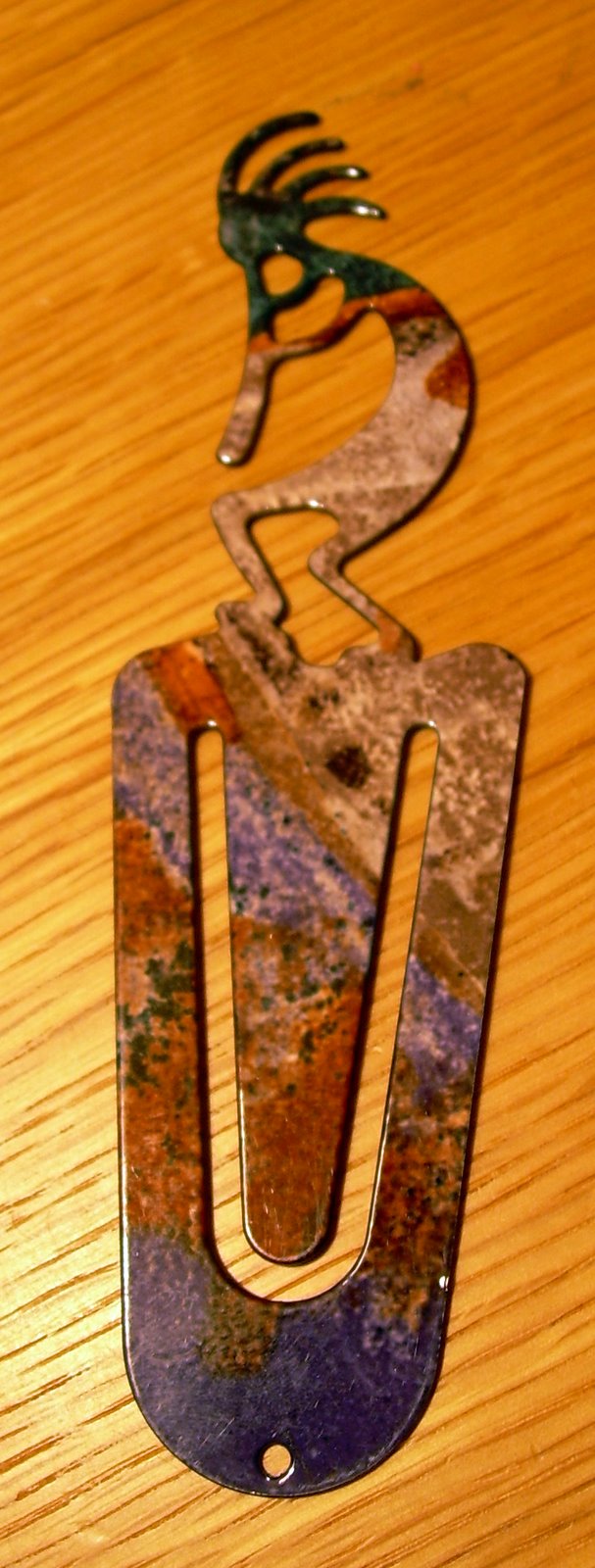 Kokopelli is not a very old god, but he's quickly grown to be one of the most special and beloved bookmarks I have in my collection.
The myth of Kokopelli has followed me since childhood, when my 3rd grade class was taught the myth and a teacher I quite admired came dressed in funny clothes tooting away (terribly) on a cheap plastic recorder. The myth reemerged later that year, as I delved deeper into Native American mythology, and once again in later years when I found myself getting into music.
Last summer, crossing the U.S. from coast to coast, I found Kokopelli in the Mount Rushmore gift shop. Like all items in said store, Kokepelli was not... economical. Still, the beautiful colors, the texture, the sturdiness, the comfortable design, and even the informative accompanying description made splurging almost necessary.
Kokopelli has since gone on to reside in several interesting (good and bad) reads including a serious stint with Blood Meridian. He is currently on an enjoyable ride with a young adult adventure epic.
Friday, June 18, 2010
Explain this
 Explain this to me, please. In the past couple of months, I have heard endlessly of the battle between the iPad and the Kindle, Apple and Amazon, the death of eReaders, the survival of eReaders, the Kobo, the Libre... everything. And yet this surprising piece of news somehow eluded me: Sony Readers have dropped in price. Quite significantly. Sure, there's a sale going on making each Reader $50 cheaper than even the lowered price, but until it ends (tomorrow, if I'm not mistaken), that's a $100 drop from the still quoted numbers of $300 for the Touch Edition and $400 for the Daily Edition. It's possible, of course, that I simply haven't noticed this change, but once again I find it strange that everywhere I turn I see articles about the iPad and Amazon, yet a pretty relevant piece of news like this has been glossed over...
It's been this way for months, essentially. Even long before the iPad came out, there was always buzz surrounding "New! Exciting! Kindle-Killer! Apple-Eater!" eReaders. Buzz that almost immediately faded. Recall the initial glow surrounding the release of the Nook. There's still some buzz, yes, but it's subdued, gentle now. And the COOL-ER? Do you hear of that one any more? Same for Sony Readers, almost always ignored because they don't seem to mesh well with views on where eReaders will go (which always leads back to... Apple!).
I've complained about this in the past, and I realize that the free market/press is as it is, but there's something so grossly unfair that every little blip written by any random journalist about the future of eReaders (whether positive or negative) gets blown way out of proportion, but legitimate eReader news - price updates, actual market changes (not just speculation) - just isn't published...
And for the record, I found out about the price drops by visiting the Sony website. I've yet to find any news links to it.
Saturday, June 12, 2010
Dry Results, part 2: The Blog (continued)
The first half of part 2 can be found here, and a compiled list of results is located here!
Book clubs:
 Truth be told, I really didn't expect these numbers. Only 31% of bloggers were part of a book club in the past year, while 68% were not (and 1 participant declined to state). My impression had always been that, despite my disinterest in the field, most book bloggers actively participated in book clubs. Perhaps a distinction was made between online book clubs and the flesh-and-blood variety? Or perhaps book clubs simply aren't ubiquitously popular. 31% is a respectable sum, after all.
Book giveaways:
 A not so surprising set of numbers, on its own. 34% of book bloggers never give book away on their blogs, 37% have the rare, yearly giveaway, 19% conduct once or twice a month giveaways, 6% have giveaways 3-5 times a month, and 1% are frequent book giveaway-ers at 6+ giveaways a month. 3% declined to state.
Giveaway types:
 Another set of fairly balanced results, with the possibility of multiple answers - 31% give no books away, 35% give away ARCs (advance reading copies), 49% give away personal copies of books, 48% host publisher giveaways, 5% listed other and 2% declined to state. Interestingly enough, the number of those who give no books away did not exactly match the previous result - 31% as opposed to 34%.
Receiving ARCs (advance reading copies):
 There were a few interesting freehand responses to this question, a rather surprising occurrence. 16% of survey participants receive no ARCs, 21% receive the rare advanced reader's copy while 17% receive 5-10 books a year. An additional 17% get 11-20 ARCs, and a solid 26% get at least 21 ARCs a year. 4% declined to state. Comments left, however, indicated that there was a slight problem with the phrasing of this question - more on that later.
Social networking:
 And now for something a little different. First off, 8% of respondents are not registered in any kind of book-oriented social networking sites, clearly a book blogger minority. In the bookstore/exchange sites, the numbers are mostly expected: 45% of survey participants are registered at Amazon, 24% at BookMooch, a small at IndieBound, and an additional 18% at Paperback Swap. Meanwhile, in the more social networking area, 24% of respondents are members of Shelfari, 65% at Goodreads, 57% at LibraryThing, and 40% at Book Blogs Ning. 7% filled in "Other", offering sites such as Bookblips, Twitter and Facebook, including many others (more on this later). 1% declined to state. The fun thing about this question is that it became something of a race as more and more book bloggers filled out the survey. What exactly was the race? Stay tuned!
eReaders:
 Guess what, fellow book bloggers? You know all those "eReaders are taking over!" articles? Book bloggers are pretty serious readers, and yet a clear majority of 71% do not own any kind of eReader. Meanwhile, among those who do, there is a fairly obvious leader, though not by as large a margin as one might expect: Amazon's Kindle 2 leads the pack with 8% of respondents owning one. Meanwhile, 4% own the Kindle 1 and 2% own the Kindle DX. iPhone eReader apps seem pretty popular too: 5% have the Kindle app. 5% have different eReader apps. In Sony land, the PRS-500, PRS-505, and PRS-300 all received 2% ownership. The PRS-700 and PRS-600 both received 1% popularity. 1 respondent owns a Sony PRS-900. 1%, meanwhile, own the Barnes & Noble Nook. 3% own other eReaders, listing examples like Aluratek's Libre or Elonex's eBooks, two eReaders I personally had never heard of. It's important to keep in mind a few points which will be developed further in later posts: 1. The survey was pre-iPad, so results might be a little different today, 2. People upgrade eReaders and in several cases, people who had one eReader also had another (this applies for apps as well), and 3. Many, many participants felt the need to comment on their desire (or lack thereof) of purchasing eReaders. But more on these topics later.
This, meanwhile, concludes the official "Dry Results" part of the book blogger statistics. Apologies for the delay - results may be slow to come out, but they will all eventually be published. Once again, feel free to link and discuss these numbers. Tune in in the next couple of weeks for the next rounds of stats.
Book clubs:
 Truth be told, I really didn't expect these numbers. Only 31% of bloggers were part of a book club in the past year, while 68% were not (and 1 participant declined to state). My impression had always been that, despite my disinterest in the field, most book bloggers actively participated in book clubs. Perhaps a distinction was made between online book clubs and the flesh-and-blood variety? Or perhaps book clubs simply aren't ubiquitously popular. 31% is a respectable sum, after all.
Book giveaways:
 A not so surprising set of numbers, on its own. 34% of book bloggers never give book away on their blogs, 37% have the rare, yearly giveaway, 19% conduct once or twice a month giveaways, 6% have giveaways 3-5 times a month, and 1% are frequent book giveaway-ers at 6+ giveaways a month. 3% declined to state.
Giveaway types:
 Another set of fairly balanced results, with the possibility of multiple answers - 31% give no books away, 35% give away ARCs (advance reading copies), 49% give away personal copies of books, 48% host publisher giveaways, 5% listed other and 2% declined to state. Interestingly enough, the number of those who give no books away did not exactly match the previous result - 31% as opposed to 34%.
Receiving ARCs (advance reading copies):
 There were a few interesting freehand responses to this question, a rather surprising occurrence. 16% of survey participants receive no ARCs, 21% receive the rare advanced reader's copy while 17% receive 5-10 books a year. An additional 17% get 11-20 ARCs, and a solid 26% get at least 21 ARCs a year. 4% declined to state. Comments left, however, indicated that there was a slight problem with the phrasing of this question - more on that later.
Social networking:
 And now for something a little different. First off, 8% of respondents are not registered in any kind of book-oriented social networking sites, clearly a book blogger minority. In the bookstore/exchange sites, the numbers are mostly expected: 45% of survey participants are registered at Amazon, 24% at BookMooch, a small at IndieBound, and an additional 18% at Paperback Swap. Meanwhile, in the more social networking area, 24% of respondents are members of Shelfari, 65% at Goodreads, 57% at LibraryThing, and 40% at Book Blogs Ning. 7% filled in "Other", offering sites such as Bookblips, Twitter and Facebook, including many others (more on this later). 1% declined to state. The fun thing about this question is that it became something of a race as more and more book bloggers filled out the survey. What exactly was the race? Stay tuned!
eReaders:
 Guess what, fellow book bloggers? You know all those "eReaders are taking over!" articles? Book bloggers are pretty serious readers, and yet a clear majority of 71% do not own any kind of eReader. Meanwhile, among those who do, there is a fairly obvious leader, though not by as large a margin as one might expect: Amazon's Kindle 2 leads the pack with 8% of respondents owning one. Meanwhile, 4% own the Kindle 1 and 2% own the Kindle DX. iPhone eReader apps seem pretty popular too: 5% have the Kindle app. 5% have different eReader apps. In Sony land, the PRS-500, PRS-505, and PRS-300 all received 2% ownership. The PRS-700 and PRS-600 both received 1% popularity. 1 respondent owns a Sony PRS-900. 1%, meanwhile, own the Barnes & Noble Nook. 3% own other eReaders, listing examples like Aluratek's Libre or Elonex's eBooks, two eReaders I personally had never heard of. It's important to keep in mind a few points which will be developed further in later posts: 1. The survey was pre-iPad, so results might be a little different today, 2. People upgrade eReaders and in several cases, people who had one eReader also had another (this applies for apps as well), and 3. Many, many participants felt the need to comment on their desire (or lack thereof) of purchasing eReaders. But more on these topics later.
This, meanwhile, concludes the official "Dry Results" part of the book blogger statistics. Apologies for the delay - results may be slow to come out, but they will all eventually be published. Once again, feel free to link and discuss these numbers. Tune in in the next couple of weeks for the next rounds of stats.
Thursday, June 10, 2010
Disappointed now
I'm reading much slower these days than ever before. Someone once told me that the way to truly enjoy and appreciate literature is to take it in slowly and that there's no way someone can appreciate a book when speed reading, a point I have tried to take to heart ever since. But slow reading doesn't always translate into better appreciation of the written word. Sometimes it's just a boring book that's a struggle to get through.
Yesterday, I found myself asked about my current read. I commented vaguely that it was merely "okay", not an excellent book but not terrible. And suddenly I realized why earlier that day, when a colleague asked for a book recommendation, I was stuck. Because in the last six months, I have read around 30 books and only 3 of these have been truly worth mentioning. It's not that the books are all terrible, exactly. In fact, only one book was purely bad, while a few others were just disappointing. There's a fine line, though, between good and excellent. A line that recently, no one has crossed.
Last year was rich in terms of book quality. I read some excellent books. But suddenly finding myself not in a reading slump, but in a bit of a reading flatline, I have to wonder what's changed. Is it that I'm picking books differently? I've started going based on very specific recommendations and reviews - perhaps my opinions don't mesh so well with these reviewers? Or perhaps it's all just bad luck. It's mostly been the random finds that have disappointed.
This last week has seen windfall book-buying, stories from all across the globe. Almost all purchases are essentially long-shots and random buys. In some cases I knew of the author or heard of the book, but for the most part, I went with my gut. Adventurous reading. After I finish this somewhat boring book, I'll start on the fresh buys. Because out of so many new books, one of them has to get me excited. And isn't that what good literature is all about?
Yesterday, I found myself asked about my current read. I commented vaguely that it was merely "okay", not an excellent book but not terrible. And suddenly I realized why earlier that day, when a colleague asked for a book recommendation, I was stuck. Because in the last six months, I have read around 30 books and only 3 of these have been truly worth mentioning. It's not that the books are all terrible, exactly. In fact, only one book was purely bad, while a few others were just disappointing. There's a fine line, though, between good and excellent. A line that recently, no one has crossed.
Last year was rich in terms of book quality. I read some excellent books. But suddenly finding myself not in a reading slump, but in a bit of a reading flatline, I have to wonder what's changed. Is it that I'm picking books differently? I've started going based on very specific recommendations and reviews - perhaps my opinions don't mesh so well with these reviewers? Or perhaps it's all just bad luck. It's mostly been the random finds that have disappointed.
This last week has seen windfall book-buying, stories from all across the globe. Almost all purchases are essentially long-shots and random buys. In some cases I knew of the author or heard of the book, but for the most part, I went with my gut. Adventurous reading. After I finish this somewhat boring book, I'll start on the fresh buys. Because out of so many new books, one of them has to get me excited. And isn't that what good literature is all about?
Tuesday, June 8, 2010

Monday, June 7, 2010
Amazon review of the week
Though originally found as a review of Meir Shalev's "A Pigeon and a Boy", this review could essentially fit in anywhere:
I read this for a book club.I felt like a school kid who had to read an assigned book they otherwise would'nt choose.It was different.Not terrible but odd.I found out at the club meeting the final third was even odder than the two thirds I'd had time to read. I didn't finish.The comparison between book club choices and school reads is interesting, and quite unlike any book club philosophy I've ever encountered until now. "Buckeye book lover" implies that there's a similar effort problem - you don't always read something good, but you feel compelled (or are required) to finish the book. It's an interesting comparison, worthy of further analysis.
Tuesday, June 1, 2010
Bookmarking 15 - History
If I remembered the story behind this bookmark, this post would sound a little different. But I don't remember that, and the stories behind this bookmark have nothing to do with the long-forgotten day I got this clip. But there are other stories, quiet and almost insignificant, but they build a small history.
 There's the story of the time I left this bookmark sideways in a book, keeping tab of the exact line I was at. The book ended up forgotten at the bottom of a bag, tossed around for several weeks until I found it. The page with the clipped on bookmark had a fine tear and the line I had so wanted to preserve was suddenly the most difficult to read, crumpled and ruined.
There's the story of how this used to serve as the "long-term" bookmark - books that I expected would take a while got this one because it was least embarrassing and, with its fairly sturdy plastic, didn't run as high a risk as breaking or getting ruined such as most of the other bookmarks.
And then there's the story of how this bookmark used to be part of an unofficial set - I owned several bookmarks with similar black clip bottoms, and yet years later I find that only this one has remained in my collection. The others have disappeared with time.
Monday, May 31, 2010
One big, wrong family
Isaac Bashevis Singer received the Nobel for his writings about Jewish life, for the "Polish-Jewish roots" in his writing. "The Family Moskat" picks apart life in Poland from before WWI until the German invasion in 1939. The purpose is similar to that of many "great" novels - view the changes and details of a society or group of people. Here, the Moskats represent Hassidic Judaism as a whole, with each member of the new generation breaking off in a different way.
"The Family Moskat" is a book that, I presume, will mean something different to everyone who reads it - Jew vs. non-Jew, religious vs. secular, conservative vs. liberal, etc. The moral dilemmas reach out to the reader in that everyone is always wrong. Every character is incredibly real in that sense - they all have their glaring faults. It is difficult to find the character with the moral high ground; if one is not doing the right thing, he is saying something else that's terrible.
This made "The Family Moskat" both a fascinating read and a difficult one. It's hard to swallow some of the downfalls, like the amount of adultery committed, or the thefts, or the lies, or even the religious twists and turns. On the other hand, nothing is quite as thought-provoking as poor decisions. So many aspects of the book can be discussed. Like the world he's writing about, Singer's story can be broken down into all its little parts.
One thread continues to hit me. One of the Moskat cousins at some point coverts to Christianity. This puts her in the mind of her family (some of it, at least) as dead. In Judaism, little is as terrible as leaving the faith. Soon, it becomes clear that the conversion does little to help her in the eyes of others (including the husband for whom she converted). On the Hassidic side of things, modern education is blamed for this travesty. Looking at this story from a Jewish perspective reveals wrongs, while looking at this from a culturally liberal viewpoint will highlight wrongs on the other side. Each direction provides the reader with enough food for thought to last several months. "The Family Moskat" is rich in that sense. But like dark chocolate, too much can be a bad thing too.
This is a minuscule epic and an incredible view into the drama of the time. Singer's writing, it seems, developed with his later stories. Perhaps, but this one holds its own.
"The Family Moskat" is a book that, I presume, will mean something different to everyone who reads it - Jew vs. non-Jew, religious vs. secular, conservative vs. liberal, etc. The moral dilemmas reach out to the reader in that everyone is always wrong. Every character is incredibly real in that sense - they all have their glaring faults. It is difficult to find the character with the moral high ground; if one is not doing the right thing, he is saying something else that's terrible.
This made "The Family Moskat" both a fascinating read and a difficult one. It's hard to swallow some of the downfalls, like the amount of adultery committed, or the thefts, or the lies, or even the religious twists and turns. On the other hand, nothing is quite as thought-provoking as poor decisions. So many aspects of the book can be discussed. Like the world he's writing about, Singer's story can be broken down into all its little parts.
One thread continues to hit me. One of the Moskat cousins at some point coverts to Christianity. This puts her in the mind of her family (some of it, at least) as dead. In Judaism, little is as terrible as leaving the faith. Soon, it becomes clear that the conversion does little to help her in the eyes of others (including the husband for whom she converted). On the Hassidic side of things, modern education is blamed for this travesty. Looking at this story from a Jewish perspective reveals wrongs, while looking at this from a culturally liberal viewpoint will highlight wrongs on the other side. Each direction provides the reader with enough food for thought to last several months. "The Family Moskat" is rich in that sense. But like dark chocolate, too much can be a bad thing too.
This is a minuscule epic and an incredible view into the drama of the time. Singer's writing, it seems, developed with his later stories. Perhaps, but this one holds its own.
Subscribe to:
Posts (Atom)