If there's a question I've always hated, it's "What books would take you with you to a desert island?". Particularly since I've always been certain that the meaning of "desert" in that sentence meant hot sand, the occasional oasis and guaranteed sunburns.
Here's the question: would the answer be different? Would I bring different books to a desert island as opposed to one that's simply deserted? I mean, if I'm on a deserted island, I'd probably want a really fat, fascinating book with lots of stories, characters and situations. Something dense and epic. On a desert island, I'd kind of want a survival guide. You know. Something that teaches me how to keep myself well-hydrated, how to avoid getting sand in my eyes, etc. Or Dune.
As for a dessert island book... I'd probably want a weight-loss guide.
Tuesday, March 29, 2011
Thursday, March 24, 2011
Teens, in the library
![]() |
| Click to enlarge (link) |
Unshelved offers a humorous but actually rather upsetting take on budget cuts for libraries. This week's strip (which essentially begins here) looks at the possibility of budget cuts to various library programs (originally mistakenly assumed to be storytime). While obviously not delving into the true problems behind budget cuts, today's strip does display the difficulties in cutting programs.
My middle school was located right by one of my public libraries. In the afternoons after school, my friends and I would all head over to the library, park our bikes outside and descend on the stacks. There we would find many of our classmates already situated in their favorite couches and seats. Some would sit at the three tables outside, the low benches and the sliding glass door giving the feeling to those sitting there that they were still within the library but allowing them the luxury of laughing as loud as they wanted to. My friends and I would typically sit at the designated "study" tables inside - round tables by the "New Arrivals" shelves - where we'd pull out our oversized history textbooks, the latest book we were reading (swapping copies, just to see what the other was into these days) and our often messily organized binders.
Sometimes we'd see our friends going into the teen section, sitting down with an adult or high school student, poring over a notebook or textbook. Many of the students took advantage of the library's teen study programs in order to catch up on subjects they struggled with. In the meantime, the rest of us would sit and study together, using the library computers to do research, carting around about fifty different reference books in order to find the answer to a single bonus question on a homework assignment and checking out dozens of books between us (which we'd then have to find some way to carry on our bike rides home).
Last time I visited this library two years ago, a big sign hung next to the entrance. It showed plans for rebuilding the library, including adding a large media center, a specifically for-teens study center, adding another two or three rooms for quiet study and adding significant room to the stacks. Next to this poster, the library had posted a plea to taxpayers, asking them to vote for a city bond that would pay for this project.
Though the measure passed in this one town, I know that in similar situations around the U.S. (and the world), the outcome is very different. It's hard to convince a taxpayer that spending money on a library will actually benefit the entire community. Though it's true, from the youngest children enjoying storytime, to moody teens gaining a wonderful place to learn and study with the help and support of a well-educated and dedicated staff, to the unemployed seeking computers and resources to find a job or write a resume and to the elderly, simply enjoying an afternoon discussing a good book (or getting the opportunity to read again, thanks to audio or large-print books).
So if someone asked me to cut programs from the library, I'd struggle. Local libraries do so very much for the communities around them... it'd be almost impossible to decide which program isn't "worth it". But I know one program I would never cut. Teens may not be the favored demographic when it comes to library budgets, but in the long-run I believe that by putting your money there, you really are putting your money in the future. My classmates and I benefited immensely from our local library - I'm sometimes saddened to think of the fact that most other kids didn't get that opportunity.
Sunday, March 20, 2011
Nothing to say yet, call back soon
Rather without planning to, I found myself reading the slim Netanya by not-yet-known to the English speaking world Dror Burstein. I've barely dipped into this small (both in page count and in paper size) book, one of those random spur-of-the-moment buys from several months ago and though I wouldn't be able to make any conclusions about its quality, style or point (I'm not even on page 30 yet...), I've found myself noticing small things.
For instance, Burstein writes with that mix of higher and lower class Hebrew that I've recently noticed is fairly common but done a little differently - instead of side-by-side high-brow and street-level language, Burstein opts for a casual mentality mixed with complex sentences and carefully chosen words. It's not even that the vocabulary level is higher than the average book, rather that Burstein seems to weigh the importance of every word before using it.
More interesting, though, is the presence of science in these scant pages. Netanya belongs to the weird class of memoirs that don't seem to have an underlying story, but are built on the idea of stories as a whole. So far, Burstein has told one or two anecdotes, most of them revolving around his youthful obsession with astronomy. Not something familiar in the pages of most literature. It's a bizarre way to tell a story, if this is in fact what Burstein intends to do. So far, the point of the book isn't very clear.
I don't actually have anything to say about this book, having only barely started it. Truthfully, I'm just surprised at how it threw itself at me. I was reaching for the book that was next to it on the shelf and instead I picked up this little volume. Opened it. Started reading. Sat down. Continued reading. Isn't that the magic of literature? I know next to nothing about this book. I suspect that will change within the coming days.
For instance, Burstein writes with that mix of higher and lower class Hebrew that I've recently noticed is fairly common but done a little differently - instead of side-by-side high-brow and street-level language, Burstein opts for a casual mentality mixed with complex sentences and carefully chosen words. It's not even that the vocabulary level is higher than the average book, rather that Burstein seems to weigh the importance of every word before using it.
More interesting, though, is the presence of science in these scant pages. Netanya belongs to the weird class of memoirs that don't seem to have an underlying story, but are built on the idea of stories as a whole. So far, Burstein has told one or two anecdotes, most of them revolving around his youthful obsession with astronomy. Not something familiar in the pages of most literature. It's a bizarre way to tell a story, if this is in fact what Burstein intends to do. So far, the point of the book isn't very clear.
I don't actually have anything to say about this book, having only barely started it. Truthfully, I'm just surprised at how it threw itself at me. I was reaching for the book that was next to it on the shelf and instead I picked up this little volume. Opened it. Started reading. Sat down. Continued reading. Isn't that the magic of literature? I know next to nothing about this book. I suspect that will change within the coming days.
Thursday, March 17, 2011
4. Childhood's End - One of those classics
To say that I loved Childhood's End by Arthur C. Clarke would be putting it a bit strongly. I liked the book. It was interesting, it was confusing and it has hovered in my mind since I first read it. I will certainly read it again one day.
But part of the reason that I'll read it again is because I don't remember it very well. Scenes - yes. I remember a few scenes particularly well and in a very positive light, but I feel like I'm missing part of the point of the book. Childhood's End contained within it a lot of complexities and I feel like only a year and a bit later, I don't quite have the grasp on them.
Why, then, am I recommending this as a SAFL title? If this isn't one of my all-time favorite sci-fi books, why place it on the list at all?
Because "literature" (that nasty word) often includes titles that may not be every reader's favorite. Literature takes into account a lot more than my own difficulties in understanding what is no doubt an excellent example of quality science fiction and storytelling. It takes into account the voices of many readers and critics. It looks at the history of the book, the overall reception and the impact it has had on the world - not just readers, but the books that may have followed it.
Childhood's End is a classic of sci-fi, a book that comes well-recommended (rightly so) and serves as a wonderful example of alien sci-fi. It's well-written, it's interesting and it isn't of the rambling school of science fiction. And I did really like it. It's a great book - a classic and is certainly worth reading.
Why, then, am I recommending this as a SAFL title? If this isn't one of my all-time favorite sci-fi books, why place it on the list at all?
Because "literature" (that nasty word) often includes titles that may not be every reader's favorite. Literature takes into account a lot more than my own difficulties in understanding what is no doubt an excellent example of quality science fiction and storytelling. It takes into account the voices of many readers and critics. It looks at the history of the book, the overall reception and the impact it has had on the world - not just readers, but the books that may have followed it.
Childhood's End is a classic of sci-fi, a book that comes well-recommended (rightly so) and serves as a wonderful example of alien sci-fi. It's well-written, it's interesting and it isn't of the rambling school of science fiction. And I did really like it. It's a great book - a classic and is certainly worth reading.
Saturday, March 12, 2011
Breaking the habit?
| The Stacks |
Here's the thing: most new books that get hyped and sell well have short-term success. I don't mean that they're bad books, nor do I mean that they aren't successful. Most, though, just aren't worthy of particular mention a few years down the line. By stocking up on current hits, I'm not allowing time to tell me just how "eternal" and "classic" these books really are.
| The "oldies" |
I have always managed to keep my stacks under triple digits, but of late I've been straying dangerously close (and am way over if eBooks count... which they don't!). I didn't buy all of the books for no reason - continuously hoarding will only mean that at some point I'll entirely forsake books that I truly wanted to read. So now I visit books that have long been on the shelves - I'm currently reading The Day Lasts More Than a Hundred Years by Chingiz Aitmatov and am finding that it's actually rather good (and not at all what I expected). I finally got around to reading Solzhenitsyn and completing anything by Thomas Mann. I'm making headway in the stacks (with a few library stops along the way) and the conclusion is simple: while new books may be flashy, I have plenty at home to keep me busy for a while. No reason to go book buying within the next two years.
Okay. Maybe more like two months. But for now, I'm doing okay.
Tuesday, March 8, 2011
A few words about women (and men)
In recognition of International Women's Day, I want to take some time to address an issue that I've long struggled with. The differences between men and women readers has been discussed to death and would gain little insight from anything I'd say. The same can be said of the male-female divide in publishing, writing and reviewing. But I'd like to try. And I'd like to try by myself, without linking to the thousands of excellent articles on these matters. Wish me luck.
IWD isn't about books. It doesn't focus on "soft" issues like "why are there more men writers when more women read?". It's more about raising awareness regarding violence and extreme forms of injustice but most of all it is about equality. Equality in the workplace, equality in education, etc. But each of these can find its small representation in our sheltered book world. Some of these "lighter" issues do rear their heads in Western society, in our so-called forward-thinking culture. Sexism, intended or not, shows up. Often.
Women and men are different. That's a fact. Women are drawn to different things in literature than men, and that's okay. It's not exclusive, though. A few weeks ago I was having a conversation with my family where the idea was raised that men and women - while inherently different in a lot of things - often have exceptions to their gender stereotypes. That means that men can like so-called "womanly" things, just like women can be more interested in traditionally "manly" things.
For some odd reason, we never seem to apply this to literature. In the literary discussion (or perhaps, in all discussions...), views seem to be one-sided. "Review publications are sexist because they mostly employ men!" "Publishing is sexist because it pays women less!" "Readers are sexist because they value male writers more!" etc, etc, etc. We make these outrageous yet often accurate claims and let the broo-hah fade without actually taking a cold, hard look at ourselves. We should stop doing that.
The book blogger survey revealed one particularly strong (and due to my shortcomings, somewhat incomplete) result: women make up the vast majority of book bloggers. Just like statistics have long shown us that women read more, it would appear that on a basic blogging level, women also write more about what they're reading. Why then, with women dominating the book blogging world, does the question of gender equality in book reviewing continue to crop up all the time (as pertaining to the male advantage)?
The thing is, there are genres I view as predominantly female. I don't mean that the books are mostly written by women (though they seem to be) but rather that these are books marketed exclusively for women. When I try to think of similar genres for men, I struggle. Yes, genres like science fiction tend to draw in more guys than gals (same for a certain pulp kind of "dude thrillers"), but they do not entirely ostracize women readers. With the exception of a few sub-genres here and there (like, again, "dude thrillers"), these genres have many women followers. The same cannot be said of a genre like romance.
Or what of the "Women's literature" genre? This perhaps disturbs me most of all, as it wears a cloak of feminism and freedom while in reality falling into a gross publishing trap. I've never quite figured out what it means. Is it literature written by women? About women? For women? Why is this acceptable? Why are we setting these books aside, filing them in a genre that clearly locks men out? Oh, it's obviously a marketing ploy but why is this okay? This is a sexist marketing ploy, both against men and women. It reminds me of the story from a few months back when various women authors complained at the "womanization" their more traditionally "manly" books received. Covers, plot summaries and marketing twisted their stories to be more "feminine", in some cases completely altering the original content. Tough stories got soft, floaty pastel covers. Summaries told of non-existent love instead of war. The books were marketed as "Women's fiction", not just "fiction". Why? To sell more books. And that alienation of men, that shunting of women to a side genre... there is the sexism.
But it's certainly not better on the other side of the aisle. That the label "women's fiction" has almost become synonymous with "trashy" or "sub-par" means that a lot of times quality stuff written by women gets less credit than it deserves. There's weight in the notion that something written by a man will get more attention and prestige than something similar written by a woman. But that's in part because of that "women's fiction" thing again. A woman writes about family life - women writing for women! A man writes about family life - timeless!
It's not really that awards and honors are sexist at their core. Really. It's not pure dismissal, it's just that there's an imbalance*. There are small cracks in our perception of literature by women. We seem to forgive and forget these injustices all too quickly without ever actually meeting them head-on. It's not a matter of publishing more books by women, nor a matter of having more women reviewers. It's a matter of accepting the fact that while men and women are different, their interests aren't mutually exclusive. Sometimes they overlap and sometimes they go further than we think.
* For this eloquent idea from months back (slightly rephrased), I tip my hat to Teresa of Shelf Love (and succumb to this one link)
IWD isn't about books. It doesn't focus on "soft" issues like "why are there more men writers when more women read?". It's more about raising awareness regarding violence and extreme forms of injustice but most of all it is about equality. Equality in the workplace, equality in education, etc. But each of these can find its small representation in our sheltered book world. Some of these "lighter" issues do rear their heads in Western society, in our so-called forward-thinking culture. Sexism, intended or not, shows up. Often.
Women and men are different. That's a fact. Women are drawn to different things in literature than men, and that's okay. It's not exclusive, though. A few weeks ago I was having a conversation with my family where the idea was raised that men and women - while inherently different in a lot of things - often have exceptions to their gender stereotypes. That means that men can like so-called "womanly" things, just like women can be more interested in traditionally "manly" things.For some odd reason, we never seem to apply this to literature. In the literary discussion (or perhaps, in all discussions...), views seem to be one-sided. "Review publications are sexist because they mostly employ men!" "Publishing is sexist because it pays women less!" "Readers are sexist because they value male writers more!" etc, etc, etc. We make these outrageous yet often accurate claims and let the broo-hah fade without actually taking a cold, hard look at ourselves. We should stop doing that.
The book blogger survey revealed one particularly strong (and due to my shortcomings, somewhat incomplete) result: women make up the vast majority of book bloggers. Just like statistics have long shown us that women read more, it would appear that on a basic blogging level, women also write more about what they're reading. Why then, with women dominating the book blogging world, does the question of gender equality in book reviewing continue to crop up all the time (as pertaining to the male advantage)?
The thing is, there are genres I view as predominantly female. I don't mean that the books are mostly written by women (though they seem to be) but rather that these are books marketed exclusively for women. When I try to think of similar genres for men, I struggle. Yes, genres like science fiction tend to draw in more guys than gals (same for a certain pulp kind of "dude thrillers"), but they do not entirely ostracize women readers. With the exception of a few sub-genres here and there (like, again, "dude thrillers"), these genres have many women followers. The same cannot be said of a genre like romance.
Or what of the "Women's literature" genre? This perhaps disturbs me most of all, as it wears a cloak of feminism and freedom while in reality falling into a gross publishing trap. I've never quite figured out what it means. Is it literature written by women? About women? For women? Why is this acceptable? Why are we setting these books aside, filing them in a genre that clearly locks men out? Oh, it's obviously a marketing ploy but why is this okay? This is a sexist marketing ploy, both against men and women. It reminds me of the story from a few months back when various women authors complained at the "womanization" their more traditionally "manly" books received. Covers, plot summaries and marketing twisted their stories to be more "feminine", in some cases completely altering the original content. Tough stories got soft, floaty pastel covers. Summaries told of non-existent love instead of war. The books were marketed as "Women's fiction", not just "fiction". Why? To sell more books. And that alienation of men, that shunting of women to a side genre... there is the sexism.
But it's certainly not better on the other side of the aisle. That the label "women's fiction" has almost become synonymous with "trashy" or "sub-par" means that a lot of times quality stuff written by women gets less credit than it deserves. There's weight in the notion that something written by a man will get more attention and prestige than something similar written by a woman. But that's in part because of that "women's fiction" thing again. A woman writes about family life - women writing for women! A man writes about family life - timeless!
It's not really that awards and honors are sexist at their core. Really. It's not pure dismissal, it's just that there's an imbalance*. There are small cracks in our perception of literature by women. We seem to forgive and forget these injustices all too quickly without ever actually meeting them head-on. It's not a matter of publishing more books by women, nor a matter of having more women reviewers. It's a matter of accepting the fact that while men and women are different, their interests aren't mutually exclusive. Sometimes they overlap and sometimes they go further than we think.
* For this eloquent idea from months back (slightly rephrased), I tip my hat to Teresa of Shelf Love (and succumb to this one link)
Friday, March 4, 2011
Endings and revisions
I was rather hesitant in approaching Ender in Exile. I've read the Ender books one after the other, gradually realizing that while Orson Scott Card has written some of my favorite books (Ender's Game, Ender's Shadow, Speaker for the Dead), he has also written some relative duds (Children of the Mind - a lame conclusion to what could have been a wonderful quartet). I've long known that the more he adds to his stories, the less good they seem to get (the Shadow quartet solidified this idea).
But here was something a little different. Not the book, but the idea: rewriting your own work.
Ender in Exile, as the somewhat stupid cover blurb indicates, takes place in the "lost" years between Ender's victory over the buggers and Speaker for the Dead. Except it also takes place during Ender's Game, and immediately after Shadow of the Giant. Which is a little weird, but surprisingly enough... it works. Almost. You see, if it works (and I'll touch more on this issue in a moment) it's because the reader is, for lack of a better word, forgetful and inattentive to details. And because of Card's afterword.
Card writes in his afterword about the inconsistencies between Ender in Exile and Ender's Game. He writes that the meat of the overlapping chapters is, in essence, correct but that the timeline is not. He tells his readers, "I was careless". He asks for their help in rectifying to problem. All so that he may write this story - what he calls a story about the soldier after the war. He sought out the plot holes, the inconsistencies and referenced them. The afterword is an homage, in a sense, to the original Ender's Game, where Card attempts to "fix" his mistakes, meanwhile tying Exile into the later additions to the Ender universe.
So again the question: does it work? Some readers will say no. Many fans have written that Card simply tried to squeeze more juice out of his bestselling franchise (though, granted, they've said that about all the sequels - good and bad). Those fans particularly devoted to detail, meanwhile, further stressed that Card's rewriting of many scenes in Ender's Game to suit his later books cannot simply be cast off as "careless mistakes". One Amazon reviewer writes: "Ender's game is a classic, you created the universe, but then you unleashed it on your readers...it is ours now too. You don't change the details when it messes with your ability to sell more books. You have to work within the confines in this previously created world."
There's no doubt in my mind that Card attempted to rewrite some of his own history. Ender's Game itself is a rehashing of the original novella (novelette, whatever)... does another change to details in the story really make a difference? To the inattentive reader like myself, no. That Card chose to revisit his previous words actually gave me a little nostalgic thrill. It didn't matter to me that details and small touches were "inaccurate", particularly after Card recognizes this in his afterword. He is not unaware of the changes. If we allow revised editions, recognizing that works can be edited even after publishing, where's the harm? This is precisely what Ender in Exile is - a revision on certain chapters.
Ender in Exile does not entirely rewrite Ender's Game. It does not hack apart the core of the story, it does not alter any major events. Deeply devoted fans may balk at the notion of revising even the slightest comma in their beloved work (rather like what I've always felt with the corrections made to Harry Potter - a topic I could discuss at length and probably will someday...), but it's not as though Card has truly committed authorly sin. He has revised. That will take some getting used to.
| Draws from the entire Ender world |
Ender in Exile, as the somewhat stupid cover blurb indicates, takes place in the "lost" years between Ender's victory over the buggers and Speaker for the Dead. Except it also takes place during Ender's Game, and immediately after Shadow of the Giant. Which is a little weird, but surprisingly enough... it works. Almost. You see, if it works (and I'll touch more on this issue in a moment) it's because the reader is, for lack of a better word, forgetful and inattentive to details. And because of Card's afterword.
Card writes in his afterword about the inconsistencies between Ender in Exile and Ender's Game. He writes that the meat of the overlapping chapters is, in essence, correct but that the timeline is not. He tells his readers, "I was careless". He asks for their help in rectifying to problem. All so that he may write this story - what he calls a story about the soldier after the war. He sought out the plot holes, the inconsistencies and referenced them. The afterword is an homage, in a sense, to the original Ender's Game, where Card attempts to "fix" his mistakes, meanwhile tying Exile into the later additions to the Ender universe.
So again the question: does it work? Some readers will say no. Many fans have written that Card simply tried to squeeze more juice out of his bestselling franchise (though, granted, they've said that about all the sequels - good and bad). Those fans particularly devoted to detail, meanwhile, further stressed that Card's rewriting of many scenes in Ender's Game to suit his later books cannot simply be cast off as "careless mistakes". One Amazon reviewer writes: "Ender's game is a classic, you created the universe, but then you unleashed it on your readers...it is ours now too. You don't change the details when it messes with your ability to sell more books. You have to work within the confines in this previously created world."
There's no doubt in my mind that Card attempted to rewrite some of his own history. Ender's Game itself is a rehashing of the original novella (novelette, whatever)... does another change to details in the story really make a difference? To the inattentive reader like myself, no. That Card chose to revisit his previous words actually gave me a little nostalgic thrill. It didn't matter to me that details and small touches were "inaccurate", particularly after Card recognizes this in his afterword. He is not unaware of the changes. If we allow revised editions, recognizing that works can be edited even after publishing, where's the harm? This is precisely what Ender in Exile is - a revision on certain chapters.
Ender in Exile does not entirely rewrite Ender's Game. It does not hack apart the core of the story, it does not alter any major events. Deeply devoted fans may balk at the notion of revising even the slightest comma in their beloved work (rather like what I've always felt with the corrections made to Harry Potter - a topic I could discuss at length and probably will someday...), but it's not as though Card has truly committed authorly sin. He has revised. That will take some getting used to.

Monday, February 28, 2011
My new favorite Oscar winner
![]() |
| Acceptance speech |
Back when I first read The Arrival, I found myself repeatedly comparing it to a silent film. It would appear that Mr Tan is just as adept at animating actual films as he is at drawing wonderful, wordless books. I very much look forward to seeing "The Lost Thing".
Once more, congratulations!
Saturday, February 26, 2011
Do you like your eReader?
In the past several months, it seems like everyone's gotten an eReader. If in the days of the book blogger survey only around 30% of bloggers used any kind of eReader, I'm sure the result today would be very different. Everybody chooses their own eReader based on their own personal reasoning but here's the thing: almost nobody seems to actively hate the eReader they already have. In fact, whether or not they wanted one, most people seem to like them.
I spoke to a colleague a few days ago about eReaders, mentioning that I had one. She responded by saying (with a slight shudder) that she could never have an eReader. "I like the feel and the smell of a book way too much," she confided in me. She seemed surprised that I, being such an avid and devoted reader, owned one myself. I was reminded of Trish the Book Lady, who recently wrote about her decision to get an eReader. She wrote how having an eReader changed the way she read, but not necessarily in a negative way.
It's true. One of my aunts declared several months ago that she didn't want an eReader. But a stubborn daughter bought one for her mother anyways and today ask my aunt and she'll tell you how much she loves her Kindle. "It's so convenient," she tells me. The lightweight, wireless device makes for comfortable reading. For me, Artemis represents a completley different kind of reading. Not because of internet access (which I don't have), not because I necessarily find it to be more attractive and stylish than a book, but because of the wealth of free books (more on this later this week). Furthermore, Artemis gives me the option of reading multiple books at once. These days, I read one print book, one classic eBook and one more modern eBook. That, at the end of the day, changes the way I read.
So why is it that readers love these devices? Why is it that we all hesitate jumping on the bandwagon at first, but over the course of two or so years, we've gradually accepted eReading into our daily cultures? And the fact is: have we really forsaken "real" print books, to be replaced by digital copies?
Like with all technology, eReaders aren't to everyone's taste. And perhaps I'm wrong. Perhaps many have found their reading unchanged by their Kindle, or Nook or iPad. For me, at least, the change has been clear. And, for the most part, positive. What about you?
I spoke to a colleague a few days ago about eReaders, mentioning that I had one. She responded by saying (with a slight shudder) that she could never have an eReader. "I like the feel and the smell of a book way too much," she confided in me. She seemed surprised that I, being such an avid and devoted reader, owned one myself. I was reminded of Trish the Book Lady, who recently wrote about her decision to get an eReader. She wrote how having an eReader changed the way she read, but not necessarily in a negative way.
It's true. One of my aunts declared several months ago that she didn't want an eReader. But a stubborn daughter bought one for her mother anyways and today ask my aunt and she'll tell you how much she loves her Kindle. "It's so convenient," she tells me. The lightweight, wireless device makes for comfortable reading. For me, Artemis represents a completley different kind of reading. Not because of internet access (which I don't have), not because I necessarily find it to be more attractive and stylish than a book, but because of the wealth of free books (more on this later this week). Furthermore, Artemis gives me the option of reading multiple books at once. These days, I read one print book, one classic eBook and one more modern eBook. That, at the end of the day, changes the way I read.
So why is it that readers love these devices? Why is it that we all hesitate jumping on the bandwagon at first, but over the course of two or so years, we've gradually accepted eReading into our daily cultures? And the fact is: have we really forsaken "real" print books, to be replaced by digital copies?
Like with all technology, eReaders aren't to everyone's taste. And perhaps I'm wrong. Perhaps many have found their reading unchanged by their Kindle, or Nook or iPad. For me, at least, the change has been clear. And, for the most part, positive. What about you?
Monday, February 21, 2011
One sided, spoiler-free and incomplete issues with the Millennium trilogy
I spoke in defense of Stieg Larsson's Millennium trilogy last month, after reading the Reading Ape's great post on the matter of the books' popularity and the criticism they often face. This time, I'm going to don the other hat and just criticize.
I'm midway through The Girl who Kicked the Hornet's Nest (at the request of a friend who wants to borrow the book ASAP) and I have to say that it's not that impressive. Granted, I never fell head-over-heels for the series. I liked the "wrong" things about it, disliked things that everyone else seemed to unequivocally love and though I was able to speed through the book, I never really felt that driving urge to read the sequels. It took me months to get to Hornet's Nest and even now I don't feel a driving need to finish. See, my issues with the series (still obviously incomplete) break down as follows:
- Once you finish The Girl with the Dragon Tattoo, Larsson's actual thrills become kind of... cheap. Not that they're bad quality, it's just that Larsson's method for creating a thrilling setting is by having his characters withhold information. Which, with all due respect, is a slightly bad literary method.
- Haters of the series like to dismiss Mikael as Larsson's attempt at writing an ideal male stand-in for himself. The problem with the Millennium books is that every character is kind of like this. All characters are these clear-cut, idealistic types - either true and noble souls at their core (no matter their nastiness... that is, after all, part of their charm, so it would seem according to Larsson), or evil, corrupt and cruel deep down. You'd be hard-pressed to find middle ground in Larsson's series. Though the good people do bad things repeatedly, they are never scolded for it. The good guys' frequent moral crimes go unnoticed by the author.
- To continue this point, all the characters are also a little too perfect. Or, at least, the narrating characters - the noble souls. Each one is either brilliant, beautiful, powerful or talented. Or all of the above. And people repeatedly notice and mention these traits. Larsson tries so often to remind his readers of the greatness of his characters that it gets... tiring.
- What am I reading for? This ties into the first issue, regarding the thrills. The question of where's the story going is entirely legit and it's one that seems forsaken in Larsson's second two books. Dragon Tattoo has a plot. The story goes someplace. With Fire, the story sort of scattered and Hornet's Nest is just all over the place. I mean, obviously it's going to end up somewhere, but I've read half the book and I still have no idea what it's about. Seriously. That's not a good sign.
Friday, February 18, 2011
A few words about Borders
| Standing at the top of the stairs |
It was always easy to drift over to whatever shelf I wanted that week. As I grew older, I switched sides more and more, first relocating clearly to the teen section and as I grew even older, drifting back over to the "grown-up" sections, browsing books with the best of them. The booksellers were tolerant and kind, always helpful when I came with questions and always understanding that a kid sprawled on the floor reading probably shouldn't be bothered.
It was more than that, though. These things could apply to any bookstore, and do in fact to a few others I've frequented. But there was something nonetheless unique. It was, without a doubt, our local hang-out as early teens. Borders was were my friends and I would go to hang out.
I think about other bookstores I've been to. My semi-local B&N always felt cold and rushed and seemed like it wanted people to leave as soon as they'd arrive. The local indie was awkwardly organized, crowded and a bit far. The second-hand bookstore was clumsy, tiny and cramped (though perfect for other kinds of book-shopping). Borders, on the other hand, was airy and welcoming, the glass doors showing me a lively world of readers. It was filled with books (and good books too), unlike B&N offering me obscure titles scattered among the popular. I'd see indie publishers. I'd find unexpected books. And I appreciated every minute of it.
Even though my "own" Borders doesn't seem to be shutting down yet, I find myself thinking that if it ultimately does close down, the world will be losing more than just a competitor to B&N and Amazon. It was also be losing a store that, perhaps at a great cost to the smaller stores around it, was forever encouraging young readers to blossom and expand, even if only in one small region.
I, at least, will miss that.
Tuesday, February 15, 2011
Not all hype is the same
Browsing book blogs, reading reviews and especially writing them means that I have a little bit more of a notion of what new (or not so new) books are being hyped at any given time. There are always a few "books of the moment", especially at that annoying end of the year period when everyone seems to hype up the same books. But I was reading a random comment today about the oft-recommended Room, and something occurred to me: hype changes from book to book.
Readers (whether or not they would have read the book) recall the recent Franzen Freedom uproar (and the still ongoing backlash). Here was a book so clearly hyped from day one that by the time it got to the hands of the public, so many had already formed opinions about it. This was both a good thing and a bad thing. Lots of times, the opinions of those around us influence how we view the book, particularly if we're apathetic. Strong emotions can easily influence apathy, and thus I have found myself shifting opinions more than once after reading a particularly sharply-worded opinion or review.
It's a bad thing, though, when backlash comes into play. Again, apathy is the worst emotion because it is the most easily manipulated. If faced with extreme praise and all you feel is apathy (or mediocre emotions - pleasant acceptance, etc.), what can easily happen is your opinion - while staying the same on an absolute level - takes on a relative extremism. In order to counterbalance the gushing, the reader might focus primarily on the negative aspects in a subconscious effort to create a so-called balanced picture of the book. And so backlash is born.
But not all hype is "bloated hype", as I like to think of the whole Freedom story. Freedom came prepackaged with vast amounts of praise, but the praise also had a slightly false taste to it. It was, in a sense, pretentious praise, taking up a book that could very well have become a bestseller and a hit amongst readers with no additional effort, and inflating it until many people read it simply to prove the hype wrong. Similarly, you have a book like The Passage, which was more "publicity hype" - the book was hyped in that it was massively advertised and just about every internet reader/reviewer could have gotten a free copy in the first couple of weeks without too much strain.
On the other end of the hype spectrum (or on another end - like I said, there are many kinds of hype...) you have Room. Here's a novel that's been hyped by a collection of moderate praise. Not moderate in that the praise is reserved - hardly - but rather that it came on rather quietly. The book received attention after being shortlisted for the Booker and continued to gradually accumulate praise (and some dismissal, for the most part as a result of the child narration). Reading a review of Room doesn't feel like someone is trying to make a point - either in favor of the hype or against it - but rather a personal view on the book.
Somewhere else on this spectrum, you also find books like Harry Potter. Take Harry Potter and the Deathly Hallows. Obviously a book that was hyped, a significant chunk of the hype was fan anticipation. Sure, there was (a long time ago) hype regarding the series as a whole but here exists a very different kind of hype. Waiting for the next book in a beloved series and hyping up its inevitable (or not so inevitable, fans of A Song of Ice and Fire...) new release is predictable, expected fan anticipation hype.
With the exception of Harry Potter, I haven't read these books but somehow I've managed to form opinions about them. Freedom honestly seems like the kind of book I'd just want to punch (or maybe that's just Franzen himself...?), The Passage seems a little too movie-esque for my taste (though I'll probably read it eventually) and Room seems sincerely good. It sure seems like the type of hype has influenced how I view these books...
Readers (whether or not they would have read the book) recall the recent Franzen Freedom uproar (and the still ongoing backlash). Here was a book so clearly hyped from day one that by the time it got to the hands of the public, so many had already formed opinions about it. This was both a good thing and a bad thing. Lots of times, the opinions of those around us influence how we view the book, particularly if we're apathetic. Strong emotions can easily influence apathy, and thus I have found myself shifting opinions more than once after reading a particularly sharply-worded opinion or review.
It's a bad thing, though, when backlash comes into play. Again, apathy is the worst emotion because it is the most easily manipulated. If faced with extreme praise and all you feel is apathy (or mediocre emotions - pleasant acceptance, etc.), what can easily happen is your opinion - while staying the same on an absolute level - takes on a relative extremism. In order to counterbalance the gushing, the reader might focus primarily on the negative aspects in a subconscious effort to create a so-called balanced picture of the book. And so backlash is born.
![]() |
| Four examples of hype - and there are still many others |
On the other end of the hype spectrum (or on another end - like I said, there are many kinds of hype...) you have Room. Here's a novel that's been hyped by a collection of moderate praise. Not moderate in that the praise is reserved - hardly - but rather that it came on rather quietly. The book received attention after being shortlisted for the Booker and continued to gradually accumulate praise (and some dismissal, for the most part as a result of the child narration). Reading a review of Room doesn't feel like someone is trying to make a point - either in favor of the hype or against it - but rather a personal view on the book.
Somewhere else on this spectrum, you also find books like Harry Potter. Take Harry Potter and the Deathly Hallows. Obviously a book that was hyped, a significant chunk of the hype was fan anticipation. Sure, there was (a long time ago) hype regarding the series as a whole but here exists a very different kind of hype. Waiting for the next book in a beloved series and hyping up its inevitable (or not so inevitable, fans of A Song of Ice and Fire...) new release is predictable, expected fan anticipation hype.
With the exception of Harry Potter, I haven't read these books but somehow I've managed to form opinions about them. Freedom honestly seems like the kind of book I'd just want to punch (or maybe that's just Franzen himself...?), The Passage seems a little too movie-esque for my taste (though I'll probably read it eventually) and Room seems sincerely good. It sure seems like the type of hype has influenced how I view these books...
Thursday, February 10, 2011
"Nobody who would have bought your book is not buying it because they can find it for free."
Neil Gaiman is not my favorite author. He's good, he's someone I like to read and though I know of many readers who like him a great deal, I don't follow him consistently. Still, when he goes out and says some wonderfully apt, eloquent words about books, free books and the internet, I really have nothing but respect for the guy (via A Momentary Taste of Being - thanks!).
Gaiman's message, other than being in tune with a lot of what I've claimed over the past few years, is ultimately that offering free material on the internet does not hurt publishing and book sales (as we're led to believe - "piracy is evil!"), but does so much for getting the author's name out there and getting his/her writing into the readers' hands.
"I started asking audiences to just raise their hands for one question. I say: okay, do you have a favorite author? And they say: yes. And I say: good. What I want is for everybody who discovered their favorite author by being lent a book, put up your hand. And then anybody who discovered your favorite author by walking into a bookstore and buying a book, raise your hand. And it's probably about 5-10%, if that. [...] They were lent [the book], the were given it, they did not pay for it. And that's how they found their favorite author."It's more than just a calm realization of the nature of favorite authors (though it's certainly a lovely image). Gaiman nails the fact that profit - real literary profit, the clean and honest kind that we all would like to believe in - comes from returning readers. Readers want to support authors they like. When I read a book from the library (I obviously have not paid for it) and really like it, I very well may buy it. Why? 1. To have the book in my collection, and 2. To support the author. As a reader, the very best thing I can do to show an author that I like him/her is to buy his/her books. A new book comes out? I'll get it. I'll write reviews recommending their works. I'll lend the books out to my friends so that they might buy them too.
How can I be certain that this will work through the internet? Downloading a book isn't like borrowing a book. It's permanent, right? But I've done it. I've stumbled across promotions that offered free eBooks, read them, liked them and gone out to find more by the author. Gaiman is dead-on in this video. Offering your writing freely gets you readers and fans, increases your exposure and boosts sales. I hope more authors and publishers take note.
For an additional video Neil Gaiman made for the Open Rights Group, here's the link to his own journal post.
Tuesday, February 8, 2011
3. The Giver - Choices
"But I’ve never been a writer of fairy tales. And if I’ve learned anything through that river of memories, it is that we can’t live in a walled world, in an “only us, only now” world where we are all the same and feel safe. We would have to sacrifice too much. The richness of color and diversity would disappear feelings for other humans would no longer be necessary. Choices would be obsolete."
-From Lois Lowry's Newbery Acceptance Speech
The Giver is not the first in its genre. In a sense, the dystopia it presents is fairly tame (when compared to some of the more recent, overwrought examples...), but starkly important when one realizes that the matter of choice, of individualism and free thought are all ideas that we - and the generations after us - will need to maintain. It's a story about growing up, about a world that at first seems almost identical to our own and gradually shifts as the reader realizes the differences.
This is dystopian literature in the true sense of the word - to almost every member of Jonas' society it is a utopia. To Jonas and The Giver it isn't. It's a book that inspires thought, continues to speak to readers across the generations, and one that deserves its status as one of the greatest works of children's fiction (or science fiction, or dystopian fiction...) to have been published.
"The man that I named The Giver passed along to the boy knowledge, history, memories, color, pain, laughter, love, and truth. Every time you place a book in the hands of a child, you do the same thing.
It is very risky.
But each time a child opens a book, he pushes open the gate that separates him from Elsewhere. It gives him choices. It gives him freedom.
Those are magnificent, wonderfully unsafe things."-From Lois Lowry's Newbery Acceptance Speech
Sunday, February 6, 2011
Worst. Book title. Ever.
Okay. I haven't read this book, I don't know what it's about, and I really, really, really don't care to read it based on the title:
To make matters worse... it was once published under a different title. "Hurting Distance" isn't the greatest book title ever, but it's 10x10^100 times better than, well... "The Truth-Teller's Lie".
I think I need to go dunk my head in a bucket of ice-cold water...
The Truth-Teller's LieAhh. I swear, no book title has ever been more insipidly bland and completely formulaic-without-revealing-anything-about-the-book! Seriously? Say this one out loud a few times. Does it mean anything? Is it referencing anything? It doesn't even sound right, it sounds completely idiotic.
To make matters worse... it was once published under a different title. "Hurting Distance" isn't the greatest book title ever, but it's 10x10^100 times better than, well... "The Truth-Teller's Lie".
I think I need to go dunk my head in a bucket of ice-cold water...
Wednesday, February 2, 2011
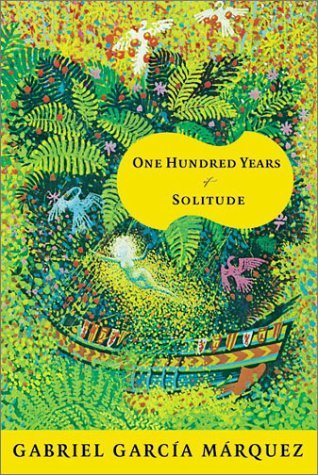
2. One Hundred Years of Solitude - Seven years of rain
| This counts as fantasy |
Why, you may ask, is such a book in a list of fantasy literature? Readers unused to GarcÃa's writing style may think this is simply due to the idea "magical realism", often tossed around when GarcÃa's name is mentioned. It's not a wrong phrasing, but truth be told: One Hundred Years of Solitude is fantasy. And wonderful fantasy at that. Things happen in a strange and mysterious way, all without a single logical explanation from the author.
A few weekends ago, the subject came up. My father mentioned that one aspect he loved so much about the book was that:
It could appear to be completely normal and everything would be entirely realistic and all of a sudden something happens that doesn't make any sense."Like seven years of rain," I mentioned. Yes, now he remembered. Seven straight, completely acceptable years of rain. Or a character living forever. Or the wonderful ending.
This is not a man who likes fantasy. Not fantasy as it's typically perceived, at least. Almost every reader I've encountered who has read One Hundred Years of Solitude would probably balk at the idea of putting it on a list of fantasy greats, but I call it as it is.
If I mentioned in my definition of fantasy that Lord of the Rings is fantastic without being magical, here is a book that is entirely magical and entirely fantastic, perhaps without being pure fantasy. Much as my father said: things just happen. And as they happen, it makes sense. Except for how it absolutely doesn't. It's this fantastic quality to the storytelling. Pure magic.
Friday, January 28, 2011
1. Time Quartet - Good vs. Evil
| The Time Quartet |
I have a long and close relationship with these books, one that no matter how many years go by, I'll always be able to rely on. This is a series that I was absolutely obsessed with in 4th grade (and a bit of 5th). One of my best friends and I would sit for hours and hours, pretending we were the characters and could bend time and space as they could. I recall during one history unit, we needed to create characters and write a background story for them. We decided to be Murry twins Dennys (him) and Sandy (me), getting so into our characters that on a class field-trip (several days away from home), my family sent me a letter signed with all the character names in place of themselves.
| The first lesson |
There's an odd book out here, and it's Many Waters. Though taking place chronologically before A Swiftly Tilting Planet, it focuses on two characters who until that point got very little screen time - Murry twins Sandy and Dennys. It's a book that focuses more on fate and love as a grand, dramatic statement rather than a simple battle of "good vs. evil". Hints appear (good angels versus bad), but it's a very different story and wonderfully fresh in that sense. Reading it third in the quartet worked well for me... it showed me something completely different.
Any reader who seeks quality science fiction or fantasy needs to look no further than L'Engle's wonderful series. Though adults may not be as heavily influenced by these books as I was as a child, the Time Quartet is a cornerstone in science fiction for younger and older readers alike.
Wednesday, January 26, 2011
The Svieeperrr
After reading Meir Shalev's wonderful A Pigeon and a Boy several months ago, I decided that I liked Meir Shalev. I began to read The Blue Mountains a few months ago, but set it aside due to certain circumstances that kept me from reading it through. Then, a few days ago, I decided to have a go at Shalev's most recent publication My Russian Grandmother and Her American Vacuum Cleaner (to be published in English at the end of 2011).
I suppose it's because I take reviews and opinions with a grain of salt, but I really didn't expect this book to be quite as awesome as it was. Shalev admits that this memoir (or "family memoir", as it seems it will be called in English) isn't a grand, huge book. He writes (somewhat edited in length; rough translation is my own):
This one small story is, in truth, built around many other small entertaining stories, sometimes educational, sometimes sad and sometimes incredibly funny. There are moments of pure awkwardness (made more uncomfortable when one realizes that the stories are true), moments of utter insanity and a lot of touching scenes that make this book wonderfully real. It tells snippets of Shalev as an author (pointing out scenes and characters that Shalev reworked for his fiction, which incidentally enough leads me straight back to The Blue Mountains), includes an abridged family saga and showcases the importance of stories. I'm really looking forward to seeing how the English-speaking world will accept this most Israeli of tales.The grand story of my great big family is one I might someday write in another book. I'll write about my parents, and their parents, about river crossings and the trials they overcame. I'll describe their physical hardships and the eternal heartaches. [...]
"It went like this..."
If I write this book - it won't be written today, nor tomorrow nor in the coming years. I'll write it when I'm an older man, calmer and more apologetic - and I'm not certain I'll fulfill this promise either. In the meantime, in this small book, I seek to tell only one story: the story of my grandmother Tonya and the vacuum cleaner my uncle sent her from the United States.
Sunday, January 23, 2011
Displacement, the real world and fantasy: a definition
When Teresa of Shelf Love mentioned "high fantasy" several weeks ago, I found myself reading through a rather enlightening Wikipedia article and list of books. I wondered at the definition of high fantasy and realized that I didn't quite agree with the Wiki definition... nor several titles included in the list.
According to Wikipedia, fantasy is comprised of two main sub-genres: high fantasy, and the so-called "sword and sorcery" fantasy (whatever that is...). These two, while fairly encompassing, seem to leave many loopholes and bad combinations. Here's how I see it:
Fantasy can be divided into two: modern and high. High fantasy contains books with a complete displacement, often including an extreme use of imagination in creating a world utterly different from our own. Magic may appear to be completely normal and integral to the created world, though the books need not necessarily be magical fantasy. I wouldn't exactly define Lord of the Rings as "magical", but fantastic (from fantasy) it certainly is. This is the more classic, romanticized sub-genre.
What, then, is modern fantasy? Here are any books that create a fantastic world alongside the real world. These are books that use our world and add to it magical or fantastic elements. Harry Potter, then, for all its adventurous and romantic roots, would fall squarely into the modern category. The brunt of creature based fantasy, or urban fantasy (Twilight, etc.) would also be called modern.
A final group (though not entirely deserving of its own sub-genre) would be those books that successfully combine the two. Here might fall in portal worlds (like His Dark Materials) or books that have both real and magic worlds (Inkheart, The Neverending Story and The Dark is Rising sequence are all very different examples of this).
So is fantasy only defined by these two? Obviously not. No genre is ever fully encompassed by two generalizations. But these two subjects cover a lot of ground, enough to satisfy me. You'll have to tell me if you agree or disagree.
According to Wikipedia, fantasy is comprised of two main sub-genres: high fantasy, and the so-called "sword and sorcery" fantasy (whatever that is...). These two, while fairly encompassing, seem to leave many loopholes and bad combinations. Here's how I see it:
![]() |
| Highest of fantasy |
What, then, is modern fantasy? Here are any books that create a fantastic world alongside the real world. These are books that use our world and add to it magical or fantastic elements. Harry Potter, then, for all its adventurous and romantic roots, would fall squarely into the modern category. The brunt of creature based fantasy, or urban fantasy (Twilight, etc.) would also be called modern.
| Modern magic |
So is fantasy only defined by these two? Obviously not. No genre is ever fully encompassed by two generalizations. But these two subjects cover a lot of ground, enough to satisfy me. You'll have to tell me if you agree or disagree.
Friday, January 21, 2011
Is one out of three the same as one third?
![]() |
| First in a trilogy - cliffhanger ending, but still its own book |
As one final note, I've always thought it interesting that many readers are afraid of long, thousand-page novels, but don't seem to have that same terror of trilogies, that when taken collectively, add up to much longer pieces of fiction. I can see how a reader with this idea would argue, "Well, if I don't like the trilogy after the first book, I can just quit, and I'm not committed to reading another two-thirds of a novel I'm not enjoying." But the kind of reader who would quit after one novel in a trilogy is also the kind of reader who would quit after one-third of a very long novel s/he isn't enjoying, right? So I'm not sure I buy that logic. Anyway, no real point here — just an observation on others' reading quirks.On the one hand, Greg is right that a trilogy is often longer than a single chunkster book. Collectively, trilogies (or any series, for that matter) can be looked at as one entity. Someday, they very well may be combined into one volume. My favorite examples of this come from our beloved classics. What is War and Peace if not something like twelve serialized books, each one ending with its own dramatic cliffhanger, each beginning with its own brand of Tolstoy philosophy? Psychologically speaking, yes. It's easier to take in individually wrapped books.
But one volume, one entity... this does not make it one book.
Whether in a series or not, books have (hopefully) a beginning, a middle and an end. Some books, it's true, don't really have endings (The Subtle Knife, I'm looking at you) and some books clearly leave a lot of plot holes in anticipation of sequels, but I would say that most books that belong to series still maintain some semblance of independence and self-sufficiency. Compare that to most fat books (not even counting fat books that are allegedly part of trilogies... whew!), which, like their shorter counterparts, have a beginning, middle and end. When someone gives up on a book midway, it's because that book - that section of beginning middle and end - is not satisfying.
| Each book still viewed individually |
My favorite example of this is Pullman's The Golden Compass. While The Subtle Knife and The Amber Spyglass clearly continue the story, it's a book that can still stand alone and complete without the other two propping it up. It's a trilogy of three books - albeit where one directly leads into the next book. Each book comes with its own themes, its own struggles and its own style. The story that binds them together is not enough to justify looking at it as one book.
So in answer to Greg's theoretical question, no. No, I don't believe that the reader who gives up on a trilogy partway is the same kind of reader who would give up a fat book partway (as for whether or not that's even a bad thing... another time). Trilogies may seem like very long books split up for convenience's sake, but most at their core are comprised of individual, independent books. It's an important point to remember.
Subscribe to:
Posts (Atom)