Thursday, January 23, 2014

How to spend my upcoming vacation

I need help.

I haven't had much of a proper vacation in a year and a half. Since I started studying in the fall of last year, the stress, schoolwork, tests, work and a general lack of time has had a serious negative impact on my reading. And now, finally, I actually have a vacation. I'm going to the US. Ten days. Ten days to read.

Over the past week, I've made a list of books that I want to read. I looked at year-end lists, books that I've wanted to read for a long time, books that bloggers recently reviewed, and of course my own slightly directed intention to read more women in translation. I started compiling a list of titles to place holds on. And then yesterday I realized that the list had gotten to about 70 books. 70 books in 10 days? Not going to happen. I started trying to cut the list down, but was not entirely successful and am still left with a list that is clearly both too long and too incomplete (there is only a very small amount of non-translated literature; little sci-fi, fantasy, young adult, or kids).

Here's where you come in. I want to know which books out of these books you all think are absolute musts. Which of these 40-odd titles needs to jump up my list? Which of these will make my vacation the most magical? Which will change my thinking? And what's missing? What are the books that haven't even made the "short"list, but obviously belong?

* I've noted which books are also available as eBooks, but to be honest, for longer books I definitely prefer the print version. So they made the cut anyways. For now.

THE LIST:
  1. In Translation: Translators on their work and what it means - Esther Allen and Susan Bernofsky (editors)
  2. The King of Trees - Ah Cheng
  3. Half of a Yellow Sun - Adichie, Chimamanda Ngozi*
  4. An Episode in the Life of a Landscape Painter - Aira, César 
  5. Swimming to Elba - Avallone, Silvia
  6. The Twin - Bakker, Gerbrand*
  7. Billancourt Tales - Berberova, Nina Nikolaevna
  8. Selections - Nicole Brossard
  9. Vertical Motion - Can Xue
  10. The Luminaries - Catton, Eleanor
  11. Silences, or a Woman's Life - Chaix, Marie
  12. Alphabet - Christensen, Inger
  13. 70% Acrylic 30% Wool - Di Grado, Viola
  14. Visitation - Erpenbeck, Jenny
  15. The Russian Version - Fanailova, Elena
  16. Kamchatka - Figueras, Marcelo
  17. The Blindness of the Heart - Franck, Julia
  18. First Love & Look for my Obituary - Garro, Elena
  19. Everyone Leaves - Guerra, Wendy
  20. Summerhouse, Later - Hermann, Judith
  21. Piano Stories - Hernández, Felisberto
  22. Wake - Hope, Anna (to be released while I'm in the US)
  23. The True Deceiver - Jansson, Tove*
  24. The Shadowed Sun - Jermisin, N. K.*
  25. The Budding Tree - Kitahara, Aiko
  26. The Dispossessed - Le Guin, Ursula K.*
  27. Ancillary Justice - Leckie, Ann*
  28. Koula - Koumantareas, Menes
  29. Shades of Milk and Honey - Kowal, Mary Robinette
  30. Satantango - Krasznahorkai, László 
  31. Children in Reindeer Woods - Ómarsdóttir, Kristin
  32. The Three Fates - Lê, Linda
  33. The Hour of the Star - Lispector, Clarice
  34. I'd Like - Michalopoulou, Amanta
  35. Stone Upon Stone - Myśliwski, Wiesław 
  36. The Armies - Rosero, Evelio
  37. How to Suppress Women's Writing - Russ, Joanna
  38. Tenth of December - Saunders, George*
  39. Everything Happens as it Always Does - Stambolova, Albena
  40. The Goldfinch - Tartt, Donna*
  41. The Bathing Women - Tie, Ning
  42. Realm of the Dead - Uchida, Hyakken
  43. Code Name Verity - Wein, Elizabeth
  44. White Snake and other stories - Yan, Geling
And whatever else you recommend. Have at it, internet. Help me out.

Monday, January 20, 2014

Is American literature overrated?

Last night, Greg of the New Dork Review of Books* tweeted an article in which author Jhumpa Lahiri denounces American literature as being "massively overrated". She points towards abysmally low translation rates into English as compared to those into other languages, using her own experiences with the Italian literary market as a contrast. Greg and I started discussing the use of the word overrated - what it essentially means here, and whether or not Lahiri was oversimplifying.

Lahiri was oversimplifying - period. You can't make a blanket statement about hundreds of thousands of books without oversimplifying. Furthermore, by using the word overrated, she implied that many of the highly regarded novels published in English (her own included, I suppose) are undeserving of any praise. But the essence of her point is spot on, and here's where I find myself ultimately agreeing: Anglo-American literature is rated more frequently and more prominently than almost any other literature in the world. And often, those ratings are not entirely deserved.

Just one example: Louisa Young's My Dear I Wanted to Tell You. A distinctly midlevel novel, not a huge bestseller, no lasting impact that I've noticed, not an award winner, no particular innovation (literary or otherwise), the author is not a household name, not really hyped... nor is it exceptionally good (it's alright). Yet this fairly mediocre book got translated into Hebrew. It got translated into French. It got translated into German, and probably a couple other languages as well. This unremarkable book has made its way across the globe. Contrast that with Amir Gutfreund's excellent short story collection The Coastal Mansions**, winner of the 2003 Sapir Award, which has never been translated. Or any of acclaimed, award-winning author Lea Aini's books. Or dozens of other Israeli authors who will never be translated, and thousands upon thousands of authors worldwide whose books will never see light in English. Because, well, hmm.

Here's a fact: Anglo-American literature is given more attention, more airtime, more importance and more respect than equivalent and better literature from across the globe. The NYT Book Review almost exclusively reviews Anglo-American books. The Ha'aretz Book Review, meanwhile, looks at Israeli novels alongside American, English, Italian, French, German, Latin American, Chinese, Swedish, Japanese, and all others every week. Every issue houses books from at least two languages, to say nothing of the countries these books visit. Just as Lahiri sees an Italian literary culture that embraces far more books from across the globe, so too does Israel***. And so do most countries outside of the United States of American and Great Britain.

This too is somewhat oversimplifying matters for a very obvious reason: the U.S. and the U.K. publish significantly more books than Israel could ever hope to. Maybe even more than France, Germany and Latin American as well, though I honestly don't know. This means that it makes a lot of sense for a certain amount of Anglo-centrism, but nowhere near the levels we see today. Not a token title or two out of 100 notable books per year. Not the rare review in the most respected literary journals. Something that respects and acknowledges the excellent literature to be found worldwide.

On the whole, Anglo-American literature is kind of overrated. I won't deny that some of my favorite books have been penned by British or American writers with an Anglocentric mindset, but I can also point to the other favorites which are distinctly not originally in English, or deal with cultures and ideas beyond the standard Anglo norm, and can easily show you how much less press and attention they've gotten. English is and will remain a language with a vibrant and wonderful literary tradition, one that gives us hundreds of truly excellent books every year, but for now it also remains the language that celebrates and touts its own mediocre options over top-notch, truly excellent titles from other languages from all around the world. It's this favoritism, this Anglo-American default that leads to Lahiri generalizing and calling all American fiction "massively overrated" (when that is obviously not true).

So yes: big picture, a lot of American literature is valued more highly than it should be. And while we can choose to view that as some sort of problem, I think we should focus on the flip side - let's get more international literature, more literature in translation. Let's have a broader picture of a bigger world. Let's have the very best literature, period. No matter where it's from.

* Still one of the greatest blog names ever, by the way.
** My rough-and-fairly-literal-and-inaccurate title translation; I hope the book gets a better title if it's ever actually translated.
*** Though to be fair, many of these titles in translation are from English, and indeed a weekly column in Israel's other (more popular) newspaper that aims to showcase "titles from abroad" almost always presents American novels...

Saturday, January 18, 2014

Stop writing books about novelists

There is a trope in fiction that I'm sure you've all come across - the story of the novelist. Whether the novelist is a side character struggling with a first novel, or the main character, mired in the struggles of overcoming writers block, I think we can all agree that this is not something completely unfamiliar.

Generally speaking, there are a lot of tropes I'm sick of. There are a lot of character types that bug me, a lot of basic cliches authors rely on to build a mood (particularly for anything that wants to be billed as "exotic"), a lot of phrases and ideas that crop up even though they're very rarely true... a whole literary world of tropes, and yet the one I'm most sick of is hearing about writers. You know why?

Because it's boring.

There's the old adage - write what you know. It used to be we'd get novels about doctors, novels about lawyers, novels about noblemen or noblewomen. And then came the all the artistic writers - books about generic artists, something that echoed the literary world but wasn't strictly identical. And now? Now every third novel I stumble across is about a writer. Usually living in New York. Usually struggling.

These books don't merely suffer because they're repetitive. They suffer from a fundamental lack, and that's a lack of scope. I have no problem with novels that focus very intently on one theme, idea, character or even location. I may personally find it to be a risky creative choice, but when it pays off, focused books can come off absolutely brilliantly (something like Beside the Sea). That's not the type of lack-of-scope issue novels about novelists have. Rather, those books seem to assume that they're the norm. It's an extraordinarily narrow, limited view of the world that annoys me every time.

Because how often do you see scientists in novels? How often do you see bankers, or researchers, or linguists, or programmers? How often do you have people who have an ordinary job that isn't the core of the novel? And let's be honest - how often do you see math teachers?

Write what you know. Writers today write about writing. It isn't meta, it isn't illuminating, it isn't clever... it's just dull. I for one have had enough.

Monday, January 6, 2014

Review | Stone in a Landslide

I didn't like Stone in a Landslide.

Could that be my entire review? Could I leave it at that, in the hopes of avoiding riling up readers I know enjoyed this book? Could I avoid awkwardness with the publishers, with the translators, with everyone involved in the project and just ignore this review? I could do all of these things... but I won't. That's not how it works.

Before now, I'd read three books published by Peirene Press. Though there was one I clearly liked less (the rather uneven Next World Novella), each offered a unique perspective and each had something about it that nonetheless kept me enclosed in the story. But the three also had a rather similar writing style - a bit disjointed, a bit loose... the kind of post-modern style that is popular in certain circles. It's not my favorite style and it sometimes hindered my appreciation of these novellas, but all in all, the first three were positive experiences.

Reading Stone in a Landslide was not. For such a short novel, I found myself struggling to remain interested in the story. And for good reason too: Stone in a Landslide has neither plot nor characters to latch onto, making it extraordinarily difficult to become emotionally invested in the story. Over at Goodreads, the publisher blurb describes main character Conxa as having "a voice totally free of anger and bitterness". This is true, but it's true because you could easily change that sentence to "a voice totally free of emotion". In the next paragraph, we're told that Stone in a Landslide has "everything": love, loss, history, death, war, etc. All of which is technically true. The book mentions each of those things. It just doesn't know how to feel them.

The story is this: Conxa is forced to move to her aunt and uncle as a young girl so that her family can avoid starvation. Though the move is said to be temporary, she ends up spending the rest of her life (essentially) in this new village, for all intents and purposes losing touch with her parents and siblings (who are only ever mentioned again in brief, offhand comments). This new life is described as being full of hard work and dedication, but we see none of it. Within a few years, Conxa falls in love with Jaume. There are approximately three paragraphs worth of courting and drama, then they marry. They start a family.

Around this point in the story, Maria Barbal slips in the first explicit reference to a year, grounding us in reality. This turns out to be more of a flashing warning sign for the war ahead. Except... not really? The war and its aftereffects are treated with the same dulled hand and the same utter lack of tone that the previous sections had. Tiny flashes of clever writing and thoughtful observations make their way into the narrative at this point, but it just isn't enough. From here until the end, the story is like a toy that's running out of batteries - slower and slower until it finally comes to a halt.

Does it seem like this is the bare-bones of the story? Yes. That's exactly what it is. Stone in the Landslide does one thing well, and that's its remarkable ability to skip over many years in the space of a sentence. But the pacing is still off, because nothing fills these gaps. The story is nothing more than an outline, and there is no hope of filling it in.

I didn't like Stone in a Landslide. I didn't like Conxa as such a detached narrator, who constantly tells rather than shows. I felt nothing from her - no real love for her husband, no real love for her children, no passion, no fear, nothing. And since Conxa's head is all we have, there are essentially no other characters. Jaume is nothing more than a prop, the children are nothing more than dolls Conxa occasionally feels possessive of, and Conxa's aunt and uncle serve more as a reminder of the "old days" than they actually have personalities themselves. Nobody has any personal spark that could make them remotely interesting to me as a reader.

But surely the writing! you must say at this point. The writing must be good, if so many other readers enjoyed it! If Peirene published it! But like I said, I have a bit of a different taste when it comes to Peirene's preferred writing style. The loose style found in previous novellas was once again present here, and once again failed to impress me. More than that, the writing was sometimes downright clunky, with passages that actually jolted me out of the reading experience. ("Even in the bumping and bouncing cart, I could feel myself trembling. It was happiness.")

It was impossible to read Stone in a Landslide without immediately comparing it to the significantly superior The Time of the Doves. These two Catalan books about women in the Spanish Civil War tell very similar stories, yet in markedly different ways and with clearly different results. Barbal minimizes her story so very much and spreads it out over the years such that nothing has a particular impact. Everything is told in a bland, dead-sounding voice; nothing is felt. Rodoreda looks at a more narrow slice of time and spreads it out over many more pages, but she delves deeper into the characters. She shows the world around them.

If you read the publisher summary Peirene provides, it sounds like they readily admit that there's nothing particularly new in Stone in a Landslide. In fact, their description of what makes up for the lack of voice is very similar to how I myself described The Time of the Doves in my review. At the end of the day, I can't view Stone in a Landslide as something unique because it isn't. I can't view it as well-written, because my reading experience was uncomfortable (at best). I can't pretend like I cared about the book, because there was just nobody to care about and nothing to learn from. It's a prime example of a pointless "literary" novella - instead of admitting that it's not particularly good, we're supposed to praise the minimalism (read: emptiness), praise the "glimpses" of life (read: all we get), and praise the detachment (read: utter lack of emotional connection).

So once again: I did not like Stone in a Landslide. In fact, I really didn't like it. It's the sort of book I'm sorry to have wasted an afternoon on, and quite frankly reminds me where I often diverge with the broader literary community in terms of defining certain books as "quality" versus not. Other prospective readers may go with the crowd on this one, but I felt the need to nonetheless share my opposing review: I did not like this book.

Tuesday, December 31, 2013

Surprising depth | The Golem and the Jinni

It's been a very long time since I read a book like The Golem and the Jinni. I'd heard quite a bit of praise for the novel going around, but I kept feeling like this wasn't really my sort of book. Which is utter nonsense and quite frankly colored by the fact that many of the reviews I'd seen labeled the book as a romance (which is a terrible way to describe it). The Golem and the Jinni is actually very much the sort of book I like - magic mixed in with the
real. Warmth. Depth. And it even has a bit of a nostalgic historical vibe that reminds me of an earlier time in my reading life.

I happened to read The Golem and the Jinni at a perfect time - the electricity had just come back on (after over eight hours without), snow was falling on a silent, solemn Jerusalem, and I wanted nothing more than a book into which I could dive without reemerging for many hours. I chose Helene Wecker's novel more for its length than its actual content, yet the mood and the vibe and the environment soon made their way into my own living room, and I found myself hooked.

Here's the thing about books like The Golem and the Jinni - they will always get a bit shafted by certain literary groups. For some, this richly written and very traditionally "literary" novel will be too heavy and atmospheric, seemingly lacking in plot for 3/4 of its length. For certain literary snobs, on the other hand, the book will be dismissed as simplistic and pedestrian because of a relatively straight-forward narrative, its length, and the fact that it's been pretty successful. Criticism of the latter sort particularly bothers me, because The Golem and the Jinni is actually a surprisingly alert and thought-provoking book. Wecker nudges a large number of Topics and Issues, without making them feel like a crutch or utterly ignored. There's quite a bit beneath the surface here, whether it's about belief and religion, loyalty and love, friendship or even human nature. I often found myself pausing to mull over a certain sentence, or thought, or idea Wecker had quietly slipped into the narrative.

That's not to say the book is flawless. Not at all. An entire subplot felt tacked on to make it a bit more conventional and "accessible". The characters involved in this story felt driven less by actual emotions as much as a need to insert this type of romance and drama, and it bothered me every time it arose. It's the sort of thing I feel ought to be taken care of in the editing stage, yet it somehow stuck. Not bad, exactly, but unnecessary in a novel that otherwise flowed very well.

The main reason to read The Golem and the Jinni is for those two characters, and their growing interactions with the world around them. There's the outsider-tries-to-understand-humanity thing here, except each character takes it to a different place. Both the Golem and the Jinni live in immigrant societies, surrounded by people who have come to the US in the hopes of starting a better life (or, in one case, ending it). "Chava" and "Ahmad" are foreigners among foreigners, each struggling with their own nature and their own needs. The Golem must fight her inherent servile nature at every moment; the Jinni is stripped of his powers and must constantly keep those powers he has left hidden. Both are guided by humans who themselves are unsure of how to help, humans who find themselves burdened with the knowledge they carry and the potential consequences.

The truth is, The Golem and the Jinni would have been a successful story even had the two characters never met (which they obviously inevitably do, though the course of their relationship and its placement within the larger novel both end up completely different from what I was expecting - in the best possible way). Had Wecker chosen only to look at the Syrian and Jewish communities of New York City at the end of the 19th century without ever having the two threads meet, the book still would have had a lot to say. The plot might have been severely hindered, but this alternate version of The Golem and the Jinni still would have been pretty good.

I really enjoyed The Golem and the Jinni. I enjoyed it for everything it is - intelligent, well-written in a very clear, simple way, thought-provoking, entertaining, heart-warming and engaging - as well as everything it isn't. This is a novel without much of the pretension I find in other books I'm recommended - it's not trying too hard to do anything (except maybe an attempt to be more mainstream - again, the unnecessary subplot...), and it doesn't hide its point in nonsense subtleties. The Golem and the Jinni is definitely a quieter, more subtle novel than many others of its ilk, but there's no trickery here, no omission which is supposed to convey cleverness, no hint of "well, if you don't understand it, it means you missed something". It's a book that can be appreciated and enjoyed on multiple levels. And it's a book I can warmly recommend to readers of many different genres. If you're on the fence - get off it. Read The Golem and the Jinni. It's not a perfect book, but it's a pretty great one nonetheless, and you just might find yourself as pleasantly surprised as I was.

Thursday, December 26, 2013

Women in translation | Responses

In the wake of my post from a couple weeks ago about the dismal percentage of women writers who have been translated into English, I cannot in good conscience leave the matter alone. It's not done. My post was meant not to throw the observations to the wind, but to search for answers and make sure that the playing field starts to change.

First of all, I'd like to thank everyone who was involved in the conversation: everyone from bloggers, to translators, to publishers play an important role in finding the source of the problem and rectifying it. Without your insights and thoughts, this really would have just floated away, never to be mentioned again. We've already taken the first steps. Now we continue.

Here on the blog and over on Twitter, a few theories arose as to why the stats look the way they do. Tony Malone of Tony's Reading List suggested that perhaps men are perceived as writing better "literature" than women, hinging on the fact that books in translation are often of a more "literary" nature. After a short debate over the use of the word "perceived" (in which I would argue that using such a claim only further implies actual, active sexism...), Tony also rightly pointed out the sad notion that while women will gladly read books by men, men are somewhat less willing to read a book written by a woman, and that perhaps publishers are merely "hedging their bets".

Meanwhile, Meike Ziervogel of Peirene Press provided a publisher's view on the matter. She argued that women are simply not writing the type of Literature that Peirene, for example, want to publish, adding that women write more "genre" and less "literary fiction", and that their technique is often "not up to scratch" as compared with men. While I greatly appreciate her perspective on the matter, I'm not sure I agree with it. At all. To start with, I struggle with the definition of "literary fiction" Meike seems to be using, especially the idea that books should not form a type of escape. While we clearly have different ideas on art, its power and what even qualifies, what troubles me more is Meike's perception (again that word!) that women lack the technical talents male writers have.

This is a problematic idea for several reasons. One, there is no logical basis for it. Writing is in no way something biologically influenced - it's not as though because of their better upper body strength, men will obviously be better able to describe dewdrops on a leaf. More than that, however, is the fact that it's an extraordinarily unfair and broad generalization of both men and women's writing styles. I will not pretend to have ever read books with the same type of scouting eye that Meike must, but I have read a lot of books in my short lifetime. Usually, the only differences between writing styles stem from the very type of book itself. Does Hilary Mantel's writing lack technique? Obviously not. Does Marie NDiaye's odd writing sound like a woman or like a writer experimenting with a different style? Definitely the latter. Does Alice Munro's actual writing sound like a woman wrote it? Nope, though the topics may be viewed as more domestic and as such "effeminate" (an assessment I thoroughly disagree with, by the way).

In both Meike and Tony's comments, a certain subtext appears - that women are not writing the type of Literary and Important and Quality books that these publishers are seeking. I take particular offence at this. Besides the fact that I don't believe it (basing myself mostly off of Hebrew, where women are just as likely to produce quality Literature as men, yet significantly less likely to get translated - as we saw, no Israeli women were translated in 2013), I think it shows a greater problem with literary elitism. I don't want to get into that argument today, but if this remains the last hurdle to cross before women are properly represented in literature in translation, I will happily tear it down.

Michelle Bailat-Jones (of pieces fame) linked to a brilliant article which I wish I could have seen before writing my own paltry post: Alison Anderson's Words Without Borders article which is exactly about this lack of women in translation. Yet this article raises a point I failed to mention in my own post - the strikingly low percentage of women to be recognized by the various translations awards (to be discussed more in the next follow-up post).

Michelle and T. Olmstead (of BookSexy Review) went on to discuss what might be the source of the imbalance. Michelle pointed out that most of the books she had received in 2012 for review from publishers (unsolicited or pitched) were written by men, while she had been forced to specifically request books written by women. 2013 might emerge with better statistics (indeed, Michelle felt confident that it would), but based on the broader numbers, I am somehow skeptical that it will be a perfect split at the end. Based on other comments I've seen and my own observations of the literature-in-translation blogosphere, publishers sending more books by male authors might just be a trend. More statistics are needed before we can really point fingers - I would greatly appreciate more insight from other bloggers and reviewers who receive books for review directly from publishers.

The next stage comes in several parts, asking help from across the board. But we'll be looking at that in the next follow-up post, hopefully in the coming weeks. Brace yourselves: we've got a long way to go.

Monday, December 23, 2013

Review | Too Much Happiness

I'm really beginning to doubt whether or not it was wise to start my literary relationship with Alice Munro through Too Much Happiness. As a collection it is surprisingly strong, but though I recognized an obvious brilliance to Munro's writing (something which is often lacking in Nobel laureates, oddly enough), I didn't feel quite the emotional resonance I was expecting. It'll come, I'm certain - unlike an author like Mo Yan (who will take me a long time to revisit...) or an author like Herta Müller (with her depth and quiet pounding who can only be visited on rare, carefully planned occasions) - I have every intention of reading another of Munro's collections within the coming months.

The stories in Too Much Happiness generally follow the same idea - characters' lives revolving around a before-and-after pivot. These pivots are misleadingly quiet plot points, usually so calmly dealt with they almost lose their whiplash strength. These are not quiet events - divorce and death and children and love - but they lack the grandeur and pomp many other writers would ascribe to them. In "Fiction", the pivot is most strongly felt by a chapter-like division, giving us the set-up and then an entirely different story in the second half. Or the powerful opening story "Dimensions", which has reveals the backstory in bits, then all at once.

With the exception of the titular "Too Much Happiness" (the final story in the collection and by far the weakest - I'll get to it in a moment), each of the stories seemed to strike me like a punch while I was reading them, then leave behind a mildly bitter aftertaste (except "Dimensions", which simply left me speechless and almost physically winded), and then appear remarkably clearly in retrospect. Looking back on the stories a couple weeks later, I'm reminded of the characters and their lives. I'm reminded of Munro's absolutely clean writing. The stories have stuck, even if it seemed for a short time like they might not. They still don't scream, but they've firmly pushed their way to the front. They will not be forgotten so easily.

Weierstrass was last semester 
My main struggle with the collection on the whole comes from the final story - "Too Much Happiness". This, it should seem, would be right up my alley, telling the story of Sophia Kovalevsky, a mathematician in the late 19th century (with extra Weierstrass references!). But it's not. The back cover describes this one as being about Sophia's "yearnings", but if so, her yearnings are decidedly dull. "Too Much Happiness" is too long, too clumsy in its characterizations (namely, its lack of it - the previous story "Wood" managed to make me significantly more emotionally invested in the struggles of its lead than the almost-sprawling-by-comparison "Too Much Happiness". It's a story that seemed hemmed in by its own ambitions of telling a bigger story, but also hindered by a lack of space in which to grow and breathe. The story is also unique in that Munro seems to be experimenting with a different writing style (a bit more old-fashioned, less coolly detached and more dramatically involved). It's a nice idea, but I don't think it worked particularly well within the story, and certainly not within the rest of the collection. Much less as the closing story.

All in all, I liked Too Much Happiness. I wasn't blown away by it (no absolute adoration here) but I appreciated it very much. After hearing so much about Munro's stellar writing, it was a joy to experience it myself, and the multi-layered strength of her stories will stick with me for a while longer. It may not turn out to be Munro's best collection, but Too Much Happiness certainly made me want to read more of her stories... perhaps it wasn't such a bad introduction after all.

Monday, December 9, 2013

Where in the world are women writers?

A realization: most of the books in translation I've read this year have been written by men. A quick run through my reading list confirmed this suspicion: 21 written by men, 7 written by women.

This is a shockingly disproportionate number (especially since my overall male to female writer ratio is a perfect 50:50). I considered that it might just be my own personal reading tastes or biases, so I decided to run through Three Percent's list of titles in translation for 2013. The list is a bit outdated, but the results are strikingly similar to what I found in my own reading. Based on my rough calculation*, women writers contribute less than 30% of the literature that is translated into English.

The top three languages from which books were translated in 2013 are French, Spanish and German. Out of 59 books translated from French, 17 were written by women. Out of 41 books translated from Spanish, 7 were written by women**. Out of 35 books translated from German, 12 were written by women. Even here we see statistics that heavily favor male writers. Meanwhile, my (very brief) survey of French and German bestseller lists seemed to show a fairly balanced playing field - certainly there wasn't as wide a gap as what I found in the translations.

Closer to home for me, the four books that were translated from Hebrew were all written by men, despite the fact that I can firmly attest that Israeli literature tends to be very balanced in terms of men-women writers. The fact of the matter is that nobody has yet translated one of 2011's most highly regarded Israeli novels Rose of Lebanon, nor any of Gail Hareven's other novels (despite the fact that her one translated title won the Best Translated Book Award!), nor dozens of other highly respected novels and bestsellers written by Israeli women. And this is clearly something that is happening across the board, across the world.

What does this mean? For starters, it doesn't seem as though the source of the problem is in various countries around the world. Rather, it seems that the problem lies in the process of translation. It isn't that women aren't writing books, or that they aren't getting published in their own countries***. The problem is on the English-speaking world's receiving end. With us.

These are only preliminary findings. Without more information about Spanish, French, German and any other language bestsellers and without more understanding about the selection process for translation, there is little more to be said. Only this: readers of literature in translation, take note. If we were looking at a ratio of 40% to 60%, I would be able to accept it as a minor bias. But we're not talking about a small preference for male writers. We're talking about a preference for men that is over 70%... and that is a problem.

So readers: share your own stats. Let's find out where the problem starts - whether I'm missing something in France and Germany and Latin America, or whether something is getting stuck in the publisher's offices in the Anglo publishing world. Let's be aware that this problem even exists. Maybe then we can start to fix it.

* My calculation was generally based on first names (easily recognizable male-female names like Paul or Charlotte didn't get double-checked, names I was uncertain about I attempted to track down)
** One of these happens to be one of my favorite books of the year
*** Though I'm certain that this is the case for certain countries in which women do not have much freedom, it does not appear to be true for the major sources of literature in translation, nor would it make much sense given which countries we're talking about...

Sunday, November 24, 2013

Review | The Girl Who Fell from the Sky

I'm not sure what it is about Heidi Durrow's The Girl Who Fell from the Sky. It's not that anything about it was inherently bad, or even specifically disappointing. It is ultimately the fact that the novel failed to move me and felt so under-resolved that leaves me with a wholly empty feeling and a sense of "what was the point?"

The Girl Who Fell from the Sky has been praised for its presentation of a character growing up mixed race, essentially growing up neither here nor there. Indeed, this would have been enough to set main character Rachel apart. Yet on top of this, Rachel has a troubled and traumatic past that is mostly revealed through different point-of-view chapters (essentially flashback chapters). These two heavy concepts alone should be enough to fill a couple hundred pages, but Durrow also tacked on multiple other threads that weakened the stronger parts of the novel.

The first major theme - that of growing up mixed race and never quite fitting in - is by far the novel's strongest. Durrow handles the racial issues deftly, using some familiar ideas and a couple new ones to emphasize Rachel's struggles. For example, Rachel's musings over her hair, her struggles with accepting it one way or another (and comparing it to her white mother's hair) felt entirely real and believable. Or how she couldn't just forget half of her origins - shown thr
oughout the book in her effort to retain her mother's Danish tongue. In these moments, Rachel truly came alive as a young woman struggling to find her identity in a society that generally views matters in a binary.

From here, though, Durrow's ideas and themes start to fall apart a bit. There was a muddled theme about redemption and drugs somewhere near the end of the book, but it utterly failed to lift off. Themes of alcoholism similarly seemed to come apart quickly. Meanwhile, the secondary plotline - that of the family tragedy that leads Rachel to live with her grandmother in the first place - didn't leave much of an impact on me. It felt much more like a straight-up plot device than an actual opportunity for character growth or development. Finally, Durrow's sharp turn towards focusing on sexuality in the latter half of the novel felt oddly out of place and did little to further either the story or character development. I have seen many readers praising the inclusion of this theme, however I found it to be in an awkward middle-ground - not given enough space to properly grow, but also intrusive to the core of the novel.

As a character herself, Rachel generally felt underdeveloped. True, the novel is a relatively short one, but in that time I didn't feel like I could understand her motives or many of her decisions. She seemed to exist in a bubble that occasionally ran tangent to the story, but was really disconnected from it. And that doesn't make sense for the main character (and generally the narrator) of a novel. The other characters didn't feel particularly better developed, though at least with them I felt as though their behavior was a bit clearer and less drawn from nowhere.

The strength of a novel like this could (and should) have been rescued by Durrow's writing. Alas, it was not exactly to my taste - neither crisp enough to compensate for occasionally awkward turns of phrase, nor beautiful enough to make up for my general disinterest in the characters. It's the sort of writing I know many readers enjoy, but it didn't thrilled and it didn't moved me, leaving very little impression.

Overall, The Girl Who Fell from the Sky is an interesting novel with quite a bit of potential that just didn't live up to my expectations. I appreciated the messages it tried to get across, however I think Durrow attempted to tackle too many ideas in too short a book, ultimately leaving each one lacking for it. Besides the notable racial themes, nothing was particularly worthwhile about the book - not the characters, nor the writing, nor the way the premise played out. I can see how readers who prefer a writing style like Durrow's might have had a much greater appreciation for the book than I had, but I personally wouldn't be able to recommend it to readers.

Wednesday, November 13, 2013

The pendulum swings

Here's the thing I've had to accept about my life right now: I don't have as much time to read. I just don't. Lives are messy, complicated beasts that take up our time in different ways. Mine right now is filled with stress, work, extremely difficult studies, and personal things. This is how it goes. Reading comes second to school, comes second to health, comes second to a lot of things. And so reading has been bumped down many slots on the stuff-that-is-important list. That doesn't mean I've stopped reading altogether. It just means that when I do read, I don't have quite the time or the same temperament for it that I might have once had. It also means that I have less time to write reviews, or my thoughts on publishing, or my thoughts on the book world altogether. Alas.

I often talk about how I don't like setting goals for my reading, or reading according to some sort of plan, but the truth is that I inevitably don't follow my own advice. I may not set a direct reading plan, but I have that rough sketch, those "guidelines" and quiet hidden quotas that shape my reading from behind the scenes. It does matter to me, despite the fact that I wish it wouldn't.

These quotas exist because at the end of the day I have a general life-goal from reading. And that goal is to read far and wide. I watch what books I read to make sure I don't get caught up in one genre too exclusively, or wrapped up in one very limited mindset, or just reading the default. I don't want to read books just because those are the ones that publishers felt were worth the strongest marketing. I don't want to read books that repeat themselves, that tell me the same story again and again. I want books that challenge my thinking, entertain me, excite me, and take me to new places, intellectually and maybe a bit more literally. This has made me branch out my reading much more than I ever could have imagined, ultimately leading me to many wonderful books.

But it also leads me to a lot of books that are, for lack of a better term, hard. And I don't really mean books with more complex vocabularies or darker stories or even necessarily a greater subtlety to their storytelling. Often, it's just literally a book that's harder to read. For example, a book in Hebrew. Or a particularly thick tome. Or the type of book that requires perfect concentration for four hours while you devour it in one go, while I can only give it fifteen minutes between classes. To be perfectly honest, many of the books I've read in the past year have been wholly unsatisfying, while many of the best have been the ones from the genres I tend least to visit. Some of the most "standard" books have proven to be the most innovative and exciting, while some of the most "impressive" books have turned out to be nothing more than overly ambitious messes.

The pendulum swings. When I was very young, I used to read a lot of fantasy. Later it was historical fiction, then the Classics, then a burst of young adult and "grown-up" fiction (mostly American). Then the growing power of translated literature, my desire to seek out the strange and the magical. And now? Now the pendulum looks like it's heading back towards all those old friends, to books that give me new angles from which to view the familiar. I still don't want to read the same books I've read many times before, but I also don't want to feel like reading is hard work. I don't want to feel like I'm forcing myself to read these huge post-modern "masterpieces" when I'm just not feeling it right now. When it turns out that a simple work of fiction in a genre I tend not to visit manages to suck me in for a whole day. But the pendulum swings, and I know that one day it will take me back to these books I'm currently setting aside. In the meantime though, I think I'm just going to have to take it "easier".

Thursday, October 31, 2013

Abandoning Akata Witch

I'm just about a quarter of the way through Akata Witch by Nnedi Okorafor and to be perfectly frank, there is no point in continuing. I read Okorafor's Who Fears Death years ago, and while I found the novel to be an interesting break from the vast majority of modern fantasy, I had a really hard time with the technical side of things. The writing was clunky, the plotting bothered me, the characters never quite clicked... all in all, I appreciated the book much more than I actually liked it.

And with Akata Witch... I just can't.

Okay, I can see glimmers of intrigue in Akata Witch's premise. Not only its Nigerian locale, but also how quickly it hammers out messages about belonging, appearance, culture, and race... way too strongly. I'm dropping the book just as the potential for fantasy is about to hit, but something about the entire concept feels very weak to me. And then there's the writing, which reminds me a bit of how I used to write in middle school - lots of exclamations, clumsy introductions to characters, very not-subtle infodumps and a general lack of flow. This is the same type of writing that frustrated me in Who Fears Death, except here - perhaps because of its younger intended audience - it feels even clunkier.

I could force myself to finish the book - it's not too long and is far from too complex. But I'm not enjoying it. I like books to have a bit more subtlety than Okorafor is providing me with, and I find the writing to be both a distraction and an annoyance. I don't feel like in a quarter of the book Okorafor has convinced me to care about any of the introduced characters, nor feel a particular attachment to the their world. I'm sure Akata Witch has its relevance, but that doesn't necessarily mean it's a good book. So... abandoned.

Monday, October 28, 2013

Defining "average"

If there's one thing I don't shy away from, it's my belief in the negative review. I strongly believe that negative reviews are pivotal for criticism, and that without them we would never be able to do the proper filtering of "good" versus "bad". This is nothing new. But something that ties into this is the less-obvious realms of everything in between amazing and terrible. We get a lot in the murky regions of the ordinary, the passe, the mediocre, the average and the moderately good. Or, at least, we should.

For me, years and years of a critique-minded approach to art has "tainted" me. I can no longer read books, watch movies, listen to music, watch shows, eat food, or take in any sort of art without approaching it from a very specific, critical perspective. This has taken some of the joy out of my art appreciation, no doubt, but it also means that when I find something that moves me... it really moves me. My average is a solid five out of ten, and though I once bemoaned the fact that not all of the books I was reading were amazing, I've grown to appreciate the fact that though I could select only books that will most likely be amazing, I'd be missing out on a lot of the in between gray. And I think we learn most about literature in that unclear region where we try to distinguish between books of worth, books we like, and books that other people will like.

The truth is, I'm not sure I really believe that everything can be good. What does it mean if your average is an eight? If something you call "good" isn't worth recommending? When I see a 4.5/5 rating from a reviewer who never gives anything below a 3.5, it's not the same as seeing a 4.5 from someone who frequently gives ratings under 2. Sure, this ties into a lot of the inconsistencies with star ratings (even across similar platforms!), but there's also a clear matter of trust here. It's hard to trust someone who consistently glosses over their own quiet dislike of something without at the very least addressing it.

This isn't a real post. It shouldn't be viewed as one. This is a mishmash of thoughts on a subject that has been bothering me for over five years. I'm curious to know what others think about this and where their "average" falls, if it even exists.

Monday, October 14, 2013

Review | The Best of All Possible Worlds

It's official. Karen Lord is not only an author to watch, but she's an author to hunt, track down and follow with a passion. Last year when I read and quite enjoyed Redemption in Indigo, I appreciated Lord's use of a different literary approach than most fantasy. Redemption in Indigo didn't feel like most books in its genre, and stood out marvelously as such. The Best of All Possible Worlds is perhaps a bit less groundbreaking in that sense and I would even almost classify it as more mainstream, but it is still a surprising, unique and impressive book.

The Best of All Possible Worlds could have easily been a simple sci-fi book. The plot points are not so utterly foreign, the framing and the character types are not brand-new, and generally speaking, the single components of the book aren't exactly innovative. What's impressive is the way they tie together to create something, while perhaps not new, but original and special nonetheless.

The first easy and seemingly obvious comparison one can make about The Best of All Possible Worlds is the Star Trek one. This in large part stems from the various similarities between the Sadiri (one of the races/cultures in the book whose planet destruction sets into motion the entire plot) and Star Trek's Vulcans. Really, it's impossible not to see the similarities - like Vulcans, the Sadiri are telepathic (more so than Vulcans, actually), very logical and level-headed, lacking in many outwards displays of emotions (though unlike Vulcans they actually have them), and restrained. From around halfway through the novel, I struggled not to imagine the Sadiri characters with the characteristic Vulcan ears, or bleeding green. Minor note.

More than that fairly superficial similarity is the thematic relation The Best of All Possible Worlds has with the Star Trek universe. The story has a similar "exploration" kind of theme, except instead of exploration for the sake of it (like in Star Trek), Lord's version has a clear goal in mind - the remaining Sadiri (mostly male) are seeking appropriate brides to rebuild their society while maintaining various cultural and biological properties (namely all sorts of telepathic abilities). The main cast visits various societies and cultures on their diverse new homeworld, all the while encountering racism, complications, and gradually developing a future for the remaining Sadiri. The types of messages of diversity that emerge from each visit is reminiscent of Star Trek, but it's much more deftly handled - actions have consequences and nothing really disappears into the haze of "last week's episode", but leaves a clear impact on the characters and their understanding of the world.

The diversity theme is especially strong. This is not merely a remark on the choice of skin color for each of the characters (which is generally, though not necessarily explicitly, not-white) or a character whose gender is never revealed (narrator Grace amusingly often remarks that it's none of our business, if we're so interested we can just ask...), rather the entire premise of different cultures meshing and attempting to balance each other out. One story deals particularly explicitly with the difference between the outward appearance of people versus their various abilities. Together with messages about slavery based on appearance, it's clear that Lord has no intention of shying away from what her original point is supposed to be. This is science fiction with its own original story and ideas, but it's also meant to remind us of our own world. Lord does an excellent job of keeping the message from overwhelming the narrative, but the point gets across perfectly.

Finally - and it would be impossible to review The Best of All Possible Worlds without mentioning this - is the gentle, subtle and rather lovely romance at its heart. The Best of All Possible Worlds is in large part a story of acceptance, and part of that acceptance is of a romantic nature. It's clear from the beginning that Grace and Dllenahkh have their chemistry, but the calm, very mature form of flirtation and the gradual quality of their love story is a thing of beauty. This romance takes along with it many of the other themes mentioned throughout the book and adds to them trust, respect and friendship. This is how a literary romance should be - believably gradual, subtle and yet ultimately extraordinarily satisfying. Beyond Grace and Dllenahkh's core romance is the love between Nasiha and Tarik, a married Sadiri couple who are part of the delegation. Though they're generally side characters (Tarik in particular does not develop very much), they serve as a gentle reminder of another, perhaps more traditional, love. It complements the developing story very nicely.

The Best of All Possible Worlds is a great book. It's not perfect - some of the stories were a bit random and unresolved - but despite its seemingly traditional premise, it's a very original take on a lot of familiar ideas. That alone, however, would not make the book worth reading. Luckily, Lord's writing is clear and conversational (if at times somewhat simple), and the characterizations are excellent. Even the minor characters felt like real people, whose motives I could understand and appreciate. All in all, it's a book well worth reading.

Thursday, October 10, 2013

Little Fingers | Huge disappointment

This is one of those cases where if I'd read Little Fingers first of Filip Florian's books (both translated by Alistair Ian Blyth), I would not have bothered to read anything else. Then I would have missed The Days of the King, which is actually quite a wonderful little book. So it's a good thing I started with The Days of the King, because Little Fingers? Terrible.

I don't often dislike books as much as Little Fingers. That's because there's usually at least something worth appreciating in a novel (also because usually I'd give up on a book this bad, only that Little Fingers was so short I figured I might as well finish it off). I suppose that's also true of Little Fingers, but I just. Couldn't. Find it. Little Fingers is a great example of a debut that has the individual pieces that will later fit to make a competent novel, but here in the original they absolutely fail to mesh. The vague writing isn't alluding to anything, the non-existent characterization is baffling at best, the plot is so hidden behind layers of intrigue and subplots and minor references that it ultimately disappears, and the pacing is... slow.

I suppose the greatest disappointment in Little Fingers stems from its inability to deliver on its promise. The novel is trying so hard to be a complex sort of literary, it forgets what it actually is. With all sorts of strange and surrealistic stories padding the main plot, there ultimately remains no plot. The back blurb promises all sorts of intrigue, but then the setup for this intrigue is only really revealed at the end and there's no actual outcome to it.

Florian is the sort of author who goes for this looping, very roundabout style of writing. In The Days of the King, this worked nicely - the minimal dialogue may have been jarring for many other readers, but the historical setting and the way the story grew paid off for any stumbles this somewhat awkward (yet beautiful) approach may have caused. Not so with Little Fingers. Dialogue here is more prevalent, but it's stickier and clumsier as well. It seems trite, old-fashioned and out of place. It doesn't move the story along and it doesn't flow properly.

Add to all this a series of characters I neither cared about nor understood and the recipe is for an extraordinarily frustrating, disappointing book. Little Fingers is a very short book which I read it one sitting, but it was a forced read - gritted teeth and the hope for a pay-off that never arrived. A few clever turns of phrase here and there made the reading more interesting for momentary flashes, but the moment I finished the book, I tossed it aside and felt relieved. I'll likely give Filip Florian another chance should his later books be translated, but this will only be based on the merits of The Days of the King. Little Fingers is, in my mind, a wasted book and a waste of time.

Monday, October 7, 2013

How not to teach kids to love reading

I'll be blunt: Melissa's post at Scuffed Slippers and Wormy Books about children's reading scores and their according recommended books made me furious. It's not just another story of someone doing something predictably stupid when it comes to books. It's not even like book banning, which is ridiculous on a thousand different levels. Melissa's story about teachers assigning books to students only according to a computerized test (this Lexile nonsense, whatever it may be) and refusing to accept books that have lower scores is enraging. And it's set me so utterly over the edge not only because it's stupid, but because I'm convinced that it will have a lasting harm on getting kids to read.

I'm not going to pretend I wasn't lucky when it comes to my love of reading. My parents frequently read with me as a child, and encouraged my reading all throughout my childhood. We were often in bookstores and libraries. My local libraries were very helpful and welcoming, with long lists of recommended books according to genre. My schools always had libraries packed with more books than I could ever read, some of which even went "beyond" the official grade levels. I was encouraged to read and explore from a very early age. Nobody ever tried to stop me, and so I didn't. I found the books I loved, those books led me to others, and from there... the rest is history.

When I was in fourth grade, we had an incentive project to read. If we read books in five different genres and wrote reports about them, we would get a small prize and a big colorful star put up on the wall. By year's end, only two had achieved stars (myself and a good friend of mine), but many others had read many books as well, having just eschewed the writing part or had neglected a certain genre. But the incentive worked, both in an effort to broaden our reading and simply to get us to open a book.

Two years later, again I found myself in a classroom that incentivized reading - here, if our parents signed off that we had read over a certain number of hours throughout the year, we would receive a bookstore gift card. Many of us won this prize, filling our lists with the books we wanted to read. Page count didn't matter. Speed didn't matter. Even the book itself, though written down, wasn't the point. What mattered was the fact that we spent time reading. So I, who read much faster than everyone else in the class, ended up having to read twice as many books to reach the same threshold. Did it matter? No. I enjoyed every minute of it. The incentive was major enough to be worth achieving, but minor enough that I read because I wanted to read, not because anyone was forcing me to.

When a teacher (or a parent, or a librarian, or whatever) tells a kid to read, there's a weight and meaning that comes attached with it. I remember that wonderful Arthur episode where the kids have to write book reports. Buster admits to his friends that he's never completed a book in his life. Everyone is shocked, and their response is to throw at him easier and easier books. But Buster's unable to finish any of them. In the end (the night before the report is due) we see him reading a tiny picture book ("The sky is blue. The ocean is blue."), but he abandons this as well. Instead, he starts to read some version of Robin Hood, which Arthur had lent him saying it's for when you're a real reader. When Buster hands in his incomplete report, he realizes what the problem was - he was trying to read books that didn't interest him. And honestly, that's one of the best messages I've ever seen on television. Don't try to read what you don't like. Not as a kid. Not when you're supposed to be cultivating a love of reading.

Teachers who look only at numbers are failing their students. Plain and simple. Teachers who assign books based on a computerized analysis of the reading level without taking into account whatever other books this kid may have read and enjoyed are failing their students. Educators (and to a more minor degree parents) have a responsibility to their kids. Forcing children to read won't get you readers. Finding something they'll love and want to continue with themselves just might.

Sunday, October 6, 2013

Review | Thomas F's Last Notes to the Public

* This review is of the translation from Norwegian into Hebrew. As far as I can tell, the lead story "Thomas F's Last Notes to the Public" was once translated in a collection of Askildsen's writing but is now out of print.

Thomas F's Last Notes to the Public by Kjell Askildsen is not really a novella - it's a relatively long short story, that in my (quite lovely) slim edition comes padded with two other shorter stories that are similar in tone if not theme. The stories follow these rather disconnected, unappealing older men as they either go about their business or are entangled in certain dramas that gradually grow in magnitude and influence.

The titular Thomas F in the main story has the calmest story of the bunch. This "novella" (but really: it's a short story) is comprised of tiny vignettes that detail minor day-to-day interactions of an old man turned major: a surprise meeting with a daughter, the kindly neighbor coming to help, the landlord's visit, etc. The back of my edition describes each of these "scenes" as "a true literary gem", and that "each sentence contains an entire world". This is not so extreme an exaggeration. In "Thomas F's Last Notes to the Public", the stories have a certain clean minimalist clarity to them that few vignettes ever truly achieve. The stories flow seamlessly into one another; I found myself telling myself after each one "After this one I'll go to bed" and then continuing onward anyways.

In all of the stories, the writing is sparse and simple. With surprising restraint, Askildsen manages to sketch out both his characters and their world. The second story in my edition, "Karl Lange" is a bit darker and heavier, but similarly light in terms of writing. The sentences don't ever drag, and they very gently get their message across. The main character in this story (Karl Lange himself) is a translator, and I want to quote from Author's and Translator's recent interview with literary translator Jamie Richards a particular sentence that exactly encompasses the core of the story: "It is not simply the solitary nature of the work that makes translation deadly but the obsessiveness of it—the anxiety of error and the lingering sense of never having finished." This sort of mood and perspective fully defines the story's drama - an accusation, a mounting isolation and increasing obsessive madness. "Karl Lange" may be the weakest of the stories in my collection, but it is hardly bad.

The fact that Askildsen chose to tell stories about fairly unsympathetic men (two nearing the ends of their lives, one in that middle-aged rut) and the fact that each seems to view the world through a decidedly tinted lens makes for interesting if somewhat uncomfortable reading. Askildsen's strong writing is enough to compensate for the rough characterizations (which seem much more like a stylistic choice than any failing on the author's part), and coupled with that excellent minimalism, the stories end up vivid, darkly memorable and enjoyable to read. Though I seem to have exhausted Askildsen's available writings at this time, he is certainly an author I'd like to meet again, and "Thomas F's Last Notes to the Public" is without a doubt a story worth tracking down.

Tuesday, October 1, 2013

The greatest empire, period | Kalpa Imperial

Once or twice a year, I'll read a book that is so amazing, so wonderful, so utterly entrancing that I will devour it eagerly and also hold myself back for fear of losing it too soon. Months ago, I came very close to that feeling with Angélica Gorodischer's unique Trafalgar. I was very impressed by Trafalgar, but I had to admit that I did not fall for it quite in the same way that I had in the past for other favorites. It was good enough, however, to ensure that I would read Gorodischer's earlier Kalpa Imperial, a book that Trafalgar even casually referenced.

And then, lo and behold, Kalpa Imperial is that book: beautifully written, wonderfully translated, magical, unique, imaginative, entrancing, enticing, absorbing, amazing and just... brilliant.

Really. I'm understating here.

Kalpa Imperial (subtitled The Greatest Empire That Never Was) is exactly the sort of book I've often imagined writing myself. It creates a fictional empire and tells stories about it. That's it. There's an order, sure, but I was never really certain that the story was being told entirely chronologically. There are references to previously mentioned stories, but these are calm connections that - despite being located in what is officially the same empire - could be taking place in entirely different worlds.

One of the incredible aspects of Kalpa Imperial is its ability to take full advantage of its short story style, while still making the book feel overall like a coherent, balanced whole. There are no duds in Kalpa Imperial, no stories that seem out place. It's clearly not a novel, but unlike most short story collections, Kalpa Imperial has no moment in which the standard slips even a smidgen - the stories flow seamlessly into each other, painting an ever growing portrait of this entirely fictional empire. And these stories are absolutely amazing.

Kalpa Imperial falls into the category I've decided to call "imaginative fiction". This is the genre that Borges, and Calvino, and Michal Ajvaz and a whole host of other authors belong to. I think by this point it's safe to say that I really, really like these types of books - the crossover between the believable and the imaginary, the gentle overlapping of fantasy with reality. Each of the above authors takes it to a different level and uses different techniques to tell their story, but there's no doubt that Gorodischer's imaginary kingdom (and also the lovely techniques used in Trafalgar) place her directly in this category.

Kalpa Imperial is fantasy unlike any other - there's no hero's quest, references to magic are far and few between (and even then may just be myths that have been twisted along the way), the society hardly seems based on medieval Europe (I kept imagining various Middle Eastern kingdoms, to be honest), there are vague references to modern technology such as cars and buses, the time frame is huge (thousands of years!), there are no warring gods... and yet it's all clearly fantasy. It doesn't merely build a world; it builds an entire history, legacy, culture and, indeed, empire. I wish I could describe the perfection of these stories (among which one ranks as the greatest 30-odd pages of literature I have ever read) but I can't. It has to be read, it has to be experienced.

As for the writing: clear, beautiful - a perfect storytelling technique. But there's another tone here, one that I often felt creeping into Gorodischer's style: that of Ursula K. Le Guin, the grand mistress of fantasy and sci-fi herself, who translated Kalpa Imperial. Small witticisms and offhand remarks rang so clearly as those of Le Guin that - had the translation been any less perfect and the writing even slightly less smooth - they could have jolted me out of the story. This didn't happen. Le Guin, it turns out, is also a master translator, imbibing Kalpa Imperial with just a dash of her own tone while still letting Gorodischer's style reign supreme. It's incredibly done.

I don't know what else I can say to possibly convince a reader who hasn't been convinced yet. Only this, I suppose: Kalpa Imperial is worth it. It's worth taking a day off from work to sit and read. It's worth stepping out of your comfort zone if this isn't the type of book you'd normally read. It's worth it for fantasy fans, sci-fi fans, fans of Le Guin, fans of unique stories, fans of imaginative fiction, readers who like being challenged, readers who like feeling at home, readers who like stories... It's worth reading, it's worth recommending to your library, it's worth buying. It's worth every minute you may spend on it. My list of perfect books is very, very short, but Kalpa Imperial is on it. And it's near the top.

One final note: Small Beer Press, thank you for publishing two wonderful books by Angélica Gorodischer. Now... please publish the rest.

Wednesday, September 25, 2013

Review | And the Mountains Echoed

I had only a few distracted hours separating between Between Friends and And the Mountains Echoed. It was an abrupt and rather unpleasant transition from Amos Oz's blunt, at times cold writing style to Khaled Hosseini's beautiful, emotion-steeped approach. But to Hosseini's credit, the discomfort quickly faded, and as had happened with his two earlier novels, I soon found myself oblivious to all but the book.

And the Mountains Echoed is fairly good book. I hesitate to call it much more than that, because though I enjoyed it and though I sped through it and though I think Hosseini's writing is excellent and though the story has lingered in my mind the past couple of weeks since I finished it... it's a bit problematic. Structurally speaking it's a complicated book, and in terms of writing it has its stumbles, and there were some issues with the pacing and even a smidgen with the characters. Shall we dissect?

When it comes to its structure, And the Mountains Echoed opts for that oh-so-popular "literary fiction" choice of having a bigger story told through seemingly unrelated (but obviously related) shorter pieces. And the Mountains Echoed is less roundabout in its use of this style (it's obvious from the very start that the stories fit together in terms of characters and story, if not chronology), but it does use various characters to access similar stories from all sorts of angles. This is not my favorite storytelling style, to say the least, but at least it works okay in the book, in large part because of the time jumps Hosseini opts for. The story is linear-not-linear, unfolding in the same way along different threads.

And the Mountains Echoed's strength is in its use of emotions. This is Hosseini's go-to trick, even more than his clear writing. How can our hearts not twinge at watching our characters get torn away from each other, and the twists and turns their lives take until they can, perhaps, hopefully, be united? How can we not feel while reading of loyalty and love, of friendship and family? And the Mountain's Echoed may not have the most clearly defined characters and maybe its story twists a bit too much, but beautiful writing and tugged-at-heartstrings make the book a worthwhile read.

There are some more problems. The non-linear style makes the book uneven, as we try to figure out how each story fits into the larger whole. Some of them are obvious continuations of each other. Others have only thin threads that connect them, but their overall value - their message, their emotional punch, their clear implications on the world at large - makes them worth it. But there are a few that felt weakly attached and too in-your-face with their messaging. Instead of the story flowing seamlessly from one angle to the next, we're forced to make a couple "eye opening" pit stops that really only emphasize the disconnect between the messages Hosseini (perhaps rightly) wants to convey and the natural course of the stories. This also influences the pacing, making the book feel a bit slower and clunkier than it really ought to be, even as the overall impression is one of a clean, flowing novel.

And yet. Come novel's end, I had to completely disengage myself. In the two weeks since I've finished it, I've come back to think over some of its finer moments again, and wonder at its weaker ones. The stories have not slipped my mind, the characters (though not always fully realized) have retained themselves remarkably well, and though I don't feel as though And the Mountains Echoed hit me quite as strongly as Hosseini's earlier A Thousand Splendid Suns did, it's a surprisingly accomplished and rewarding read. Though there will no doubt be readers who dislike the structure even more than I did, and find the characterization wanting, And the Mountains Echoed is a good book, one I can comfortably recommend to many readers.

Thursday, September 19, 2013

Review | Between Friends

Between Friends... between friends
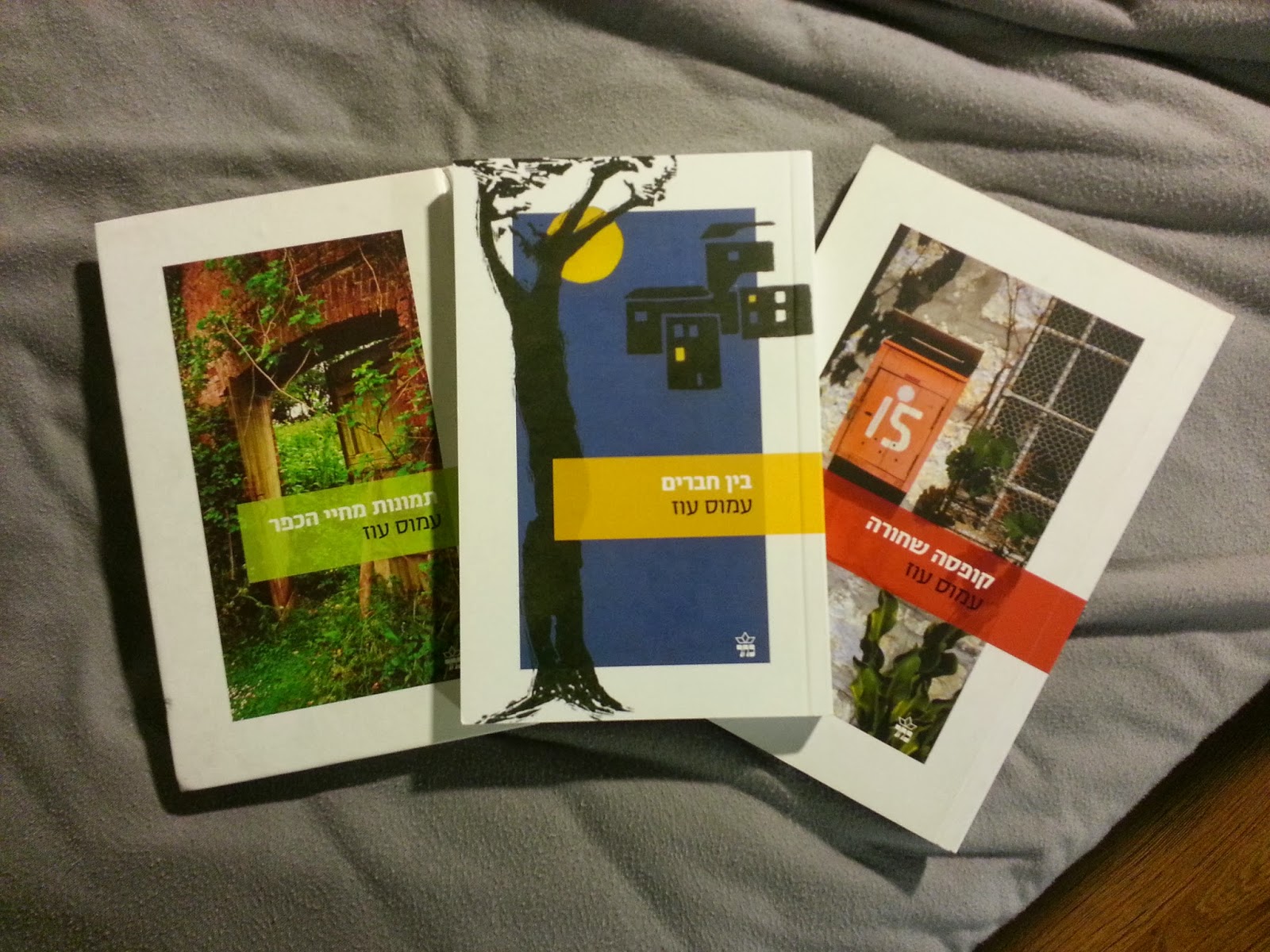
Readers may recall a few months ago I read Amos Oz's The Black Box, saying that I was debating between reading that book and... this one - Between Friends (בין חברים). Reading The Black Box was a thoroughly interesting, but also somewhat uncomfortable feeling. I wanted to recommend the book, but I didn't like it. I was fascinated by it, but I hadn't enjoyed it at all. And I knew that it wasn't like Scenes from Village Life, which I had really enjoyed.

Between Friends is in some ways much more like Scenes from Village Life than The Black Box. This is mostly because of its format - like Oz's earlier book, Between Friends is a collection of short stories about a certain place, where characters appear and reappear throughout, and where the location is more of a main character than anyone else. Scenes from Village Life used a level of distance to tell a story about modern Israeli life; Between Friends goes back in time to the kibbutz of the fifties.

But here Between Friends finds a major similarity with The Black Box. Unlike Scenes from Village Life which had some perfectly crafted stories and characters I immediately felt connected with, Between Friends is filled with utterly unsympathetic characters in frustrating situations. The stories made me feel thoroughly uncomfortable; I honestly didn't want to spend much more time with this kibbutz and its inhabitants. But I did, because despite its rougher edges, Oz's writing is compelling and compulsively engaging. As always, his writing is distinctly "not-beautiful", but... it's worth reading.

The historical setting of this one sets it apart from either of Oz's previous novels that I've read. Between Friends takes advantage of the shadow of the Israeli War of Independence, in regards to the political situation in Israel as well as its socioeconomic situation. Oz uses his foresight as a modern author to play with the concept of the kibbutzim's socialism, through the prophecies of a dedicated founder of the kibbutz, or the hard-line beliefs of one of its prominent members, or the casual acknowledgement of its changing future from its young-generation secretary. Oz uses his distance to gently emphasize the future that is to come, but oddly enough he casts no judgement one way or the other. Oz's voice is usually a dry, almost dead tone behind his characters; this time he seemed even more unresponsive than usual.

I can't help but compare Between Friends to both The Black Box and Scenes from Village Life. In structure, it is similar to the latter; in my tepid but intrigued response to it, it is much more like The Black Box, except I think I got more from The Black Box than I did from Between Friends, which felt a bit like a weak imitation of Scenes from Village Life for me. It can work as an introduction to Oz, certainly, and it's not a bad book by any means. But it's not particularly likable either, as accomplished as it may be. In other words... it's a book by Amos Oz. Difficult to classify, but recommended reading.

-------

Finally, a minor quibble. When I first saw the translated title on the inside cover of the Hebrew edition*, my immediate instinct was to correct what I felt was a bad translation. I hoped it was a temporary title. Now that I realize that Between Friends is indeed the final title, I'll only mention as a side-note that I personally would have translated the title as Among Friends - like many Israeli titles, there's an air of ambiguity to the original Hebrew. But this is entirely irrelevant.

* Hebrew books almost always (always) have an English version of the title inside. This isn't always the actual title once (if) the book is translated into English, but it often is.

Sunday, September 15, 2013

Twitter, author interactions and other thoughts

One of the reasons I joined Twitter a couple months ago was to breach what I felt was an uncomfortable divide between myself and the greater literary world. Does this sound pretentious? Stupid? It's probably a bit of both. For so long, I had seen bloggers shifting towards Twitter for their quicker thoughts and opinions, for wit and for a much simpler blogger-publisher connection. And blogger-author bonds, for those who read a lot of books by living, English-speaking authors. To put it simply: I wanted in.

Whether or not my attempt to enter the Twitterverse has been successful is up to debate; what isn't is my new awareness for aspects of the literary world that I never even imagined. Bloggers give each other advice, talk directly to publishers, authors, bookstores... it's rather incredible*. There's an entire community of book lovers who live only on Twitter, just like those who live on Youtube, or Tumblr, or even here in what I think of as "book blogging central".

This is a long and hesitant opening to what is a rather difficult post to write. Because a few hours ago, I witnessed a fairly painful, intense argument between many different book bloggers I follow. I don't particularly feel like linking to it, but the argument (in Hebrew I would say "ספק דיון, ספק ויכוח", essentially meaning not really a discussion, implying an argument...) covered topics ranging from authors involvement on blogs to the definition of bullying and... more.

I mostly want to talk about the first point. Like I said earlier, part of the reason I started using Twitter in the first place was to be a bit closer to authors and publishers. When I write a review of a book, I don't assume the author or the editor or the publisher are actually reading my review**. I write reviews for two purposes: firstly, to share my thoughts on a book with other readers, and secondly for myself - I enjoy the process of approaching a book from different angles, whether analytically, critically, emotionally or anything else.

But here's the catch: I don't object to authors reading my reviews. And I definitely don't mind if they want to talk to me about my thoughts. I know that authors have been trained to avoid responding to negative reviews (and let's be honest, most of my reviews are not exactly glowing), but I have no problem with an author politely engaging me in a debate. I probably won't change my opinion on the book, though it will certainly change my approach. Vaddey Ratner probably wouldn't like my reviews of In the Shadow of the Banyan. But if she wanted to tell me why she chose to avoid subtlety and why she opted for certain tropes I felt were cliches, I would listen. I would probably also gain something from it.

I understand that some readers want a bit of distance between themselves and authors. It's not easy to have that "face-to-face" interaction. I understand getting frustrated by authors who leave defensive comments on reviews. Not everyone wants to deal with it, and I'm not sure they have to. I honestly don't know. But I definitely think that authors have the right to respond (politely), and I feel like it might be a bit of a double standard to invite certain authors for interviews and allow them that personal interaction, but then avoid interaction with authors who maybe aren't as thrilled with your appraisal. But... it depends. And not wanting it and expressing that feeling, while maybe not something I personally agree with, isn't bullying. So there's also that.

I don't really know how to summarize these thoughts. I know pockets of arguments like this often crop up online and will probably continue to exist until long after I've quit this corner of the internet***. I can only hope for calmer discourse in the future, and maybe this is the advantage of old-school blogging - we have to pause and take the time to really think about what we're writing... and even then, we may not have all the answers.

* The other day I tweeted a recommendation for the next Goodreads app update. I received a response. Whether or not they actually take my advice to heart, someone noticed.
** This is in large part because I have a generally under-the-radar blog, which can be both a blessing and a... something boring and unnoticed.
*** Not something I'm planning on doing any time soon. I know, I know, so disappointing...