Showing posts with label fiction. Show all posts

Thursday, August 13, 2026

Maria Turtschaninoff's feminist fantasies

I wrote about Maria Turtschaninoff's Maresi many years ago (almost a decade!), not long after I first read it. Like many books, my impression of Maresi has changed somewhat over the years. After reading its sequel Naondel, I remember thinking how Maresi had been a little childish compared to Naondel's dark story. The basis for this was mostly because Maresi reminded me of Tamora Pierce's works, which I had read as a preteen, and I had felt that I would have loved Maresi as a teen. And somehow this morphed into a perception that Maresi was only a "good" book, not much more. That somehow cemented in my mind when I read and adored Maresi Red Mantle (or just Red Mantle), the third and final book in the series. The leap to no-disclaimers-needed love retroactively turned Maresi into a lesser work in my mind.

I carried this wrong perception with me for years, until a couple of weeks ago, when I decided to reread it.

But let's take a step back for a moment. I decided to reread Maresi not out of simple curiosity, but because I'm currently reading Maria Turtschaninoff's more recent book - Tangled Roots in its English translation (though I'm reading the translation to Hebrew). This novel is quite different from the Red Abbey Chronicles, with its feminist YA framing. Tangled Roots is instead a more mainstream sort of work of fiction. It's not quite a novel, comprised as it is of snippets from the lives of one(ish) sprawling family over several hundreds of years, specifically rooted to a particular patch of land. On the one hand, there are leaps and jumps between characters and eras, and each story is typically distinct. On the other hand, there are clearly threads that tie between the stories such that it's more similar to a family epic than just a discrete collection of short stories. It's less overtly feminist than the Red Abbey Chronicles (to begin with, it centers some boys and men, though most of the protagonists are women), and only less fantastical if you decide to ignore the actual text. It somehow feels like something about its more mature style makes it easier to pretend that the book isn't just as much a feminist fantasy as Maresi.

Tangled Roots - novel, epic, story collection, whatever you want to call it - is a good book so far. I read half of it fairly quickly, and then felt like I needed a short break, not because it's a bad book, but because it was shifting gears a bit as it leapt through the 19th century. I wanted to give it space. But I didn't want too much space. I kept thinking about Turtschaninoff's writing, about that love that I felt for Red Mantle, and the way I'd hunted for any news of a new book from her before learning of Tangled Roots. I wished I had my copy of Red Mantle with me (it's on the other side of the world), but I instead found that my library carried Maresi as an ebook. So I reread it. And reader, I'm sure you'll be shocked, I loved it.

I remembered little more than a sort of stereotypical "dark feminist fantasy", but Maresi has a lot more depth than that. The story is certainly dark in many parts, but a lot is also just about the communities that women build to support each other. This is a theme that appears in Tangled Roots as well, though to a lesser degree. Maresi also lingers on faith more than I remembered, where there is little outright magic in the world rather than the power of the goddesses. This too appears in Tangled Roots, with the magical qualities of the land tying into questions of faith in the "old ways" versus Christianity.

The one thing that surprised me is that I haven't managed to feel a connecting thread between Turtschaninoff's writing itself in Maresi and Tangled Roots. Part of it may be that I'm reading the books in different languages, but I think it's more than that (especially considering how many authors I have felt as having a continuous voice, regardless of the language in which I read their book). Tangled Roots feels a lot more confident in its writing, with a sort of depth permeating its different stories and the sinews that connect between them. Could Tangled Roots work for younger adults? Certainly. I have yet to encounter anything in it that doesn't work for teens. But its tone and its atypical structure just feel fundamentally different from Maresi, for all the other similarities.

There is no consensus about what happens when authors make the jump from YA to adult fiction. Sometimes, the more "mature" book is lauded even when there's little actual difference between the author's YA work and the newer, "adult" book (other than maybe the age of the protagonist, and sometimes not even that). Sometimes, the author is dismissed for trying to elevate themselves inappropriately. Maria Turtschaninoff should surely fall into the previous category, with her tangled tale of men, women, and children (young adults included!) who live and breathe on a particular patch of Finnish land. The feminist fantasy may be more muted, more "appropriate" for a wider audience, easier to generalize, but it's not really so far removed from the Red Abbey Chronicles. And ultimately, I continue to hope that all of her books find more readership and look forward to whatever she writes next.

Saturday, August 13, 2022

WITMonth Day 13 | Last Words from Montmartre by Qiu Miaojin

I appear to have never written a full review of it on the blog, but when I read Notes of a Crocodile several years back, I enjoyed it quite a bit. Qiu Miaojin's novel (translated from Chinese by Bonnie Huie) was tightly written, insightful, and ultimately extremely rewarding as a general reading experience. It's a book I've frequently recommended, and one that I will likely continue to recommend. It also guaranteed that I would purchase Qiu's other book available in English - Last Words from Montmartre, translated from Chinese by Ari Larissa Heinrich.

Last Words is a harder book to classify. For starters, it hardly reads like fiction, with a deeply up-front first-person narration that is hard to separate from Qiu the author, though it also very much reads like a novel. The idea that any book with biographical elements must be a memoir is, of course, ridiculous, but there's something intensely intimate in this text that I could hardly separate what I knew of Qiu from the narrative unfolding on the page. (It's hard to call it a story, exactly, but there is certainly a narrative.) Maybe it's possible to read Last Words without the meta-knowledge that Qiu committed suicide not long after the novel concludes. Maybe it's possible to truly shuffle these letters and separate the art from the artist, but I often couldn't. Even as I read the letters that form Last Words as fiction, they somehow felt colored by Qiu's own life and, sadly, her death. When read linearly (as I did), it feels even more like a narrative that is pushing toward this final conclusion that can only be reached by the external reader. And since the book is comprised of letters which the reader is basically intruding upon (or being invited into?), there emerges this sort of unique conversation between author and reader that both defines the novel and breaks it down into little pieces.

I liked Last Words, though I cannot say I liked it nearly as much as Notes of a Crocodile. In many ways, it's a much more complex work, certainly in terms of what it demands of its reader. As translator Ari Larissa Heinrich writes in the fascinating and insightful afterword, it's an almost relentlessly dark book, challenging its readers and raising extremely difficult, ugly topics. If Last Words is meant to be a conversation with the reader, it is one that is shaped by the narrator's anguish, depression, and even violence. Slim a work as it may be, it is heavy. That's not necessarily a bad thing, but there's a bleakness to the entire reading experience that I don't think existed in quite the same way as in Notes of a Crocodile.

It's also a fascinating text in how it addresses relationships and sexuality. For a work written in the 1990s, it feels astonishingly modern in its approach to bodies, sexual desire, and romantic love. Parts felt like they could have been written just a few weeks ago, and shared on a Tumblr blog. Qiu also delves into cultural topics, frequently looping back to discussions of particular films and artistic narratives that the narrator admires. It's one of the few spaces in which the book gains a little distance from the internal darkness that dominates it. It wasn't necessarily my favorite part (I can't say that I really understood what Qiu was going for, not being familiar with many of the films cited), but it provides an interesting dimension to an already complex, multifaceted work.

Ultimately, this isn't as easy a book to recommend as Notes, because it's much less straightforward. At the same time, this is probably what makes Last Words such a unique, lasting piece of art: I can't think of many other novels, memoirs, or even poetry collections that managed to convey such intimacy and depth in so short a time. On just about every technical level, it's hard to find fault in Last Words. Its brutal honesty can be uncomfortable at times, and there were certainly aspects that I didn't connect with as much, but that has little to do with how the book is built on the whole. No, it's not easy, and no, I can't say that I found it to be as globally rewarding a reading experience as Notes of a Crocodile, but I did like and admire the work. I suspect others will too.

Friday, August 6, 2021

WITMonth Day 6 | No One Writes Back by Jang Eun-jin

No One Writes Back is one of the ultimate WITMonth books. Why? I purchased it during the first ever WITMonth - August 2014, way way back in the earliest days of the women in translation project. I recall purchasing it alongside another book from Dalkey's Library of Korean Literature (Lonesome You, a collection that left very little impression upon me), and it's languished on my shelves for years and years since I purchased it. Somehow, it became one of those books that simply blends into the background of the bookshelf. It was always there, and it gradually became one of those always there books that doesn't seem very attractive and readable. There was always going to be something newer and more appealing. Not to mention that it was never a particularly popular book to begin with, and as such was easy to ignore.

I don't know what brought it off my shelves a few weeks ago, but goodness. Goodness. I'm so glad I finally read it.

No One Writes Back (translated from Korean by Jung Yewon) surprised me from the start. Something about its tone is just so confident, so strong, and so clearly defined that I was a bit taken aback. This was the book I'd been avoiding for so long...? Okay then. The novel immediately sets its stage with the narrator informing us that he's left home, he's a traveler, and he's traveling with Wajo (his dog). Bit by bit, we learn more about who this man is, who his friends are, and what makes him tick. As he goes from city to city, motel to motel, he assigns numbers to the people he meets and then writes them letters. Letter-writing is something pivotal to this novel, reflective of an almost naïve adherence to a past that is quickly disappearing (and has disappeared even more since the novel's original publication in 2009). 

The narrator soon meets a woman on his journey, but she is not there as a love interest or narrative-altering presence. Rather, she is writer and curious mirror to the narrator. The two both travel, they both try to make peace with their home, and they both interact with their environment in a unique way that shapes (and is shaped by) their worldview. The writer seeks to keep traveling as long as she's still working on her latest work; the narrator seeks to keep traveling as long as he hasn't yet received any letters of response from his many correspondents. The two travel together for a while and their relationship is fascinating to watch, because it's always still very clearly about the narrator. He is the center of this story, someone who is lonely and yet not alone, alone at times and yet not lonely.

By the midway point of the novel, I was certain I was reading a good book, but something about it felt hollow. The writing is excellent, the character designs precise and clear, and the pacing extremely direct, but I couldn't for the life of me tell where the story was heading (or if, indeed, it was heading anywhere). I wasn't sure what was keeping me reading, but it didn't seem to be the sort of situation to quit. I resigned myself to the idea that No One Writes Back would have some sort of placid, dissatisfying ending, like so many other well-built novels.

But no, this is so much better than that. With a precision that made me feel like rereading the whole novel as soon as I'd finished it, the pieces fell together into one of the more beautiful, emotionally affecting endings to a book I've read in a long time. That sounds so cliched, but it's true - it wasn't about whether aspects of the ending were sad (and yes, aspects were), it was about the way everything fit together and completed each other. No One Writes Back not only did a brilliant job of justifying almost every one of its pages prior, it also did so in a truly uplifting, positive, and life-affirming way. I finished the book feeling like I'd just had something wonderful open up before me, and while I don't want to spoil what made the ending so beautiful for me, suffice to say that it inspired something pretty good in me.

By the end, I didn't just enjoy No One Writes Back, I loved it. I loved what it sparked in me. I loved how it made me think. I loved how it unfolded and grew. I loved how its technical pieces didn't mask or try to replace its emotional ones. I loved how it made me want to read (and write) so much more. I loved how much it made me feel.

I am also ultimately grateful for how long the book spent on my shelves. I usually bemoan books that I read at the wrong times and ask myself whether I might have liked the book better at a different stage of life (or even on a literal different day). No One Writes Back probably wouldn't have meant the same to me seven years ago, when I first purchased it. I might have liked it, no doubt, but I think that initial hollow feeling would have dominated. Now? The book fit in perfectly.

As to you, dear reader? I suggest you give it a try. I think there's a decent chance you will find it as beautiful as I did.

Saturday, August 29, 2020

WITMonth Day 29 | Dark Heart of the Night by Léonora Miano | Review

There's a lot of meta to unpack before I can write about Léonora Miano's Dark Heart of the Night, translated from French by Tamsin Black. Miano, after all, is credited with disliking the University of Nebraska Press edition of Dark Heart of the Night even on her own Wikipedia page, having publicly critiqued the book's foreword (which I assume has been removed from subsequent print runs, since my edition has none) and much of the book's paratext (cover and title). A little digging reveals that Miano had serious concerns about how the University of Nebraska Press ultimately framed the book, from the foreword that was "full of lies" to changing the book's original title to resemble Heart of Darkness (a comparison that is also mirrored in the back cover description). I thus came into Dark Heart of the Night knowing that Miano had critiques, but not quite remembering what they were, instead reading into it more after reading the book. And I have to say - her critiques are valid from all sorts of perspectives and also point to a pivotal reading of the novella itself.


I'll start with my conclusion: Dark Heart of the Night is a bit of a brutal, unpleasant read, but one that is uncompromising and fascinating. It's a book that batters its reader again and again from all sorts of perspectives and doesn't seem particularly concerned with expectations of how the story is supposed to advance or fall into place. Its pacing is steady, its plot scattered without a single fixed peak, and its emotional impact a sort of pulsing, constant effect. Miano packs an extensive critique of different forms of violence and community life in the short novel, with a sense that there is much more that she could say on either topic (as well as many others). Dark Heart of the Night does a lot, almost all of it efficiently and effectively, and the end result makes for a book that is hard to set aside but also... not entirely enjoyable.

One of my impressions while reading Dark Heart of the Night was the Miano sought to create a sort of generic form of violence in the face of war and chaos. Miano's descriptions of village life as a contrast to city life all felt a little purposely blurred, with fictional names designed to place her story across a wide range of regions. Nationalism does not feature in regards to this specific country, exactly, rather the story's core violence stems from a place of a flawed and despotic perception of African identity. Perhaps I should have, but I did not assign too much importance to this on a deeper level; can Miano not critique violence in the same way that any other novelist might write of in the world? 

The brutality of violence that Miano introduces feels like a contrast to the individual identity subplot that centers now-village-outsider Ayané who has returned to her home village following her mother's death, yet the two narratives intertwine in defining identity, community, and belonging. Dark Heart of the Night is not just its most violent moments, but also their aftermath, their effects, and the way these fit into larger political balances. It seems important to remember that the novel continues past what can be viewed as its darkest moments, with that unrelenting continued bluntness. 

It's hard to write about Dark Heart of the Night without getting into details, and I think that any details take away from the book's power. It is a powerful novel, in many of its different threads. It's true that they occasionally muddle and the writing style sometimes feel out of place for the different subplots, but the book on the whole is depressingly effective. 

It's also - to loop back to my introduction - a lot more nuanced and complex than its paratext would suggest. To begin with, the back cover description centers Ayané in a way that frankly seems to emphasize one of the novel's themes over others. While Ayané is very much the novel's main character, she is often counterbalanced within the story and her experience contrasted. These contrasts feel important in how Miano builds a larger narrative regarding that blurry African identity. Furthermore, the casting of the novel through the lens of Joseph Conrad's Heart of Darkness (a work that has roundly been criticized for its racist, generalizing portrayal of Africa, though I have not read it myself...) also seems to strip away some of the weight of Miano's vague placement of her story. I can't imagine how the original foreword also attempted to alter Miano's experiences and identity herself in order to fit a narrative regarding African literature. Why can Dark Heart of the Night not simply be allowed to stand on its own?

I'm not sure that my own review doesn't fall into similar, problematic patterns in terms of what I'm mistakenly focusing on. I feel as though I walked into the novel mostly unaware of the controversies and thankfully unaware of the actual plot. (For once, I can at least be grateful for the book's vague and vaguely inaccurate back cover for not creating false expectations.) I read the book with little external context and without feeling like I knew enough to place Dark Heart of the Night's plot in any one specific place. My ignorance, it seems, ultimately matches Miano's own intentions. But is my sense that Miano is deeply involved with questions of identity something that follows from the retrospective reading of her critiques of the original foreword? Am I misreading her response to it? Was there something else in reading this novella that I was supposed to take away? Knowing what I now know in terms of Miano's own sense of her work, I find myself wishing for a deeper, detailed analysis that views Miano's work as part of a larger whole. Individual debut work as it may be, Miano clearly has had more to say, having published several books over the past decade. Would we as readers not benefit from reading those works as well? (Yes, we would.)

I did not struggle with reading Dark Heart of the Night, though the book saddened, angered, and disheartened me in many ways, as I believe it intended. The writing is brisk and clean, and again, the pacing is remarkably steady for a book that contains several different gut-punch peaks. It is far from a pleasant book, but it is definitely a good one, perhaps even a great one. It is certainly a work worth reading. I also think there is some value in the questions it forces us to grapple with regarding how works by African writers in translation (and perhaps African women writers more specifically?) are packaged for English-speaking audiences. Miano's critiques may be presented as a surprising bit of anger from an author over how her writing is sold in translation ("drama"), but ultimately it's worth noting two things: 1. The original foreword no longer appears in print, and 2. Miano's critiques end up providing a much better context for what Dark Heart of the Night is trying to do than the book's remaining paratext itself. I suppose some good comes of bad as well...

Friday, August 21, 2020

WITMonth Day 21 | Island of Shattered Dreams by Chantal T. Spitz | Review

I first heard of Chantal T. Spitz at the wonderful, inaugural Translating Women conference last year. Spitz's English-language translator Jean Anderson presented a paper about cross-cultural literature, representing Pacific literature in a way that I had never before heard. I'm not in the literary field, after all, and the Translating Women conference was my first experience attending a literary academic-style conference; I've attended other literary events and plenty of scientific conferences, but nothing like this. For me, Anderson's presentation was one of the most fascinating and memorable of the conference as a whole. In the course of the talk, she discussed Spitz (as well as other, untranslated writers), and I jotted down in my notes "French is 'not her language', but the language she writes in due to school and education". Moreover, I was fascinated by the idea of exploring Tahitian and Pacific literature, since these are regions of the world I know very little about. I ultimately ordered Island of Shattered Dreams a few months later and read it just at the onset of August.

It would be unfair to say that I devoured Island of Shattered Dreams in one rapturous swell, though I did. It would also be unfair to say that I've been thinking about the short novel extensively since finishing reading it, though I have. These both feel unfair because they don't do enough to emphasize just how strongly Island of Shattered Dreams made me feel, nor how strongly I feel that more readers should be seeking this translation out. From a technical standpoint, Island of Shattered Dreams manages to do so much in so few pages (157), and with an extraordinary balance. Poetry, lyricism, history, politics, and romance all intertwine to form a tiny epic that never feels incomplete. Simply saying "oh, this book is wonderful!" or "I couldn't put it down!" seems like underselling.

The novel - which carries with it a unique meta-context that becomes more apparent and important by the story's end, which I won't get into because I quite enjoyed how it unfolded - follows an Indigenous Tahitian family, initially focused on Tematua and his great love Emere (whose mother is Indigenous and father a white Englishman), later shifting focus to their children: Terii, Eritapeta, and Tetiare. The fluid passage of time is beautifully framed by Tematua: "As Tematua foresaw in his heart, time is rushing out of control", precisely at the cusp of the novel's focus change. Island of Shattered Dreams covers a significant portion of the 20th century without it feeling like an overly drawn out narrative, and the tight family saga means that the novel's overall flow is never impeded. 

Yet this very sentence I just quoted also defines a second, critical theme in Island of Shattered Dreams, since the quote does not end where I stopped it. The full quote is actually "As Tematua foresaw in his heart, time is rushing out of control, troubling people's minds and surreptitiously filling their hearts with shame for the Mā’ohi world and admiration for the pale reflections of the foreigners' world." Ultimately, Island of Shattered Dreams must also be read as a novel about Tahiti/French Polynesia at large: its cultural shifts, its status as an island outpost for a massive colonial power, and various racial/cultural complexities that come attached with both. 

Emere's story is particularly central in this, as she is the not only the product of a mixed-race relationship, she is also caught between cultures and the love both of her parents have for her in that context. Her mother Toofa "hadn't prepared her daughter for the difficulties of life on the outlying islands. She had wanted an easy, modern lifestyle for her, hoping that the man who married her would provide her with a housekeeper and every comfort." Toofa remains rooted to joining the white, Western world (which goes on to influence her grandchildren too), yet accepts Emere's choice leave this society behind and marry Tematua. It's a balance that ripples throughout the remainder of the novel, a reminder of the family's complex history and one that shapes the drama in the book's final chapters.

It's impossible for me to ignore how much I learned from Island of Shattered Dreams. Learning from literature is obviously wonderful and part of the point, but I can't help but feel disheartened by how much I end up relying on fiction to teach me things that I probably should have known earlier. I knew absolutely nothing about French Polynesia or Tahiti prior to reading Island of Shattered Dreams; it's just about exactly on the opposite side of the world from my own home and with no shared language, so this isn't particularly surprising. Still, I left Island of Shattered Dreams wanting to learn more about France's colonial history in the region and its power today. Much like the anthology Indigenous Literatures of Micronesia left me hungry to learn and read other books, so too does Island of Shattered Dreams make me wonder about the island today (Island of Shattered Dreams was published in 1991, which makes it as old as I am, aka not exactly young anymore...). What does Tahitian literature look like today? Will any more of it get translated into English? Spitz's other works are themselves still unavailable in English translation - are these also to remain out of grasp for English-language readers?

And I'm left with more questions, hearkening back to Spitz's remark about writing in French. There are several Mā’ohi words and phrases throughout the novel and Spitz even opens her novel in Mā’ohi. Spitz has already made her words "more accessible" to Western readers by writing them in the colonial French, a language that is bountifully translated from across the world. Yet Island of Shattered Dreams does not appear to have been translated between most languages. It is certainly not available in my native Hebrew, nor, to the best of my Googling, does it appear to have been translated into German, Spanish, Portuguese, or Japanese. Why not? The supposed language barrier (had Spitz written her work entirely in Mā’ohi)  has been "helpfully" removed by the author herself. What more is needed?

I've written all these words without getting to the heart of my response to Island of Shattered Dreams which is, quite simply, that I loved it. I loved the writing. I loved the fluidity. I loved the poetry. I loved the warmth with which Spitz describes her world and life, new-to-me yet so far from being new (and it never feels like an introduction, it feels like... life). Most importantly, I loved the love that is central to so very much of the novel. To use what Anderson explains in her translator note as a Mā’ohi cultural touchstone which I was obviously unfamiliar with until reading the book, I felt Island of Shattered Dreams deep within my belly, that place from which emotions truly do rise (even if this is not how it's usually described in either of my languages). I could not set this book aside for a moment, sitting outside to read under a perfect summer sky, drinking in the book from when the morning air was still cool until the hot noonday sun reached my reading nook. Alongside all of the rest that makes it a valuable work, Island of Shattered Dreams is a beautiful story brimming with all sorts of different forms of love and a love of storytelling (once oral, now put to print) at its very core. How could I not fall in love myself?

Wednesday, August 19, 2020

#WITMonth Day 19 | The Restless by Gerty Dambury | Review

I was not expecting The Restless to be what it was. Gerty Dambury's novel (translated from French by Judith G. Miller) somehow struck me as the sort of book I'd need to slog through, something that would be experimental in a frustrating-but-understandably-important way. I have no idea where that idea even came from or why I was initially so put off from the book. Maybe (as always...) the fault is in my own perceptions of the meta-framing - the Feminist Press cover shows a brown-shaded old-fashioned classroom, rows of empty seats. The back cover blurb leads with a little girl's concern over her teacher's disappearance. Somehow - bafflingly - I created some sort of story in mind of what The Restless would be and concluded that I would struggle to read the book. Oh, how wrong I was.

I positively devoured The Restless

At 237 pages, The Restless is neither a short nor particularly long book, but it's somehow massive and brisk at the same time. The best word I can think to describe it is "crackling". And okay, maybe part of my association with that word is because I accidentally got the book wet a year back when I bought it and it dried in such a way that the spine crackles whenever you flip the pages, but goodness if it doesn't apply to the inside as well. The Restless is indeed experimental in a lot of senses, using an honestly pretty strange quadrille framing technique, with alternating narration and constant perspective shifts. That most of the narrators are dead is definitely another weird factor, but my goodness it works. There's so much about this novel that could go wrong, and yet it all works so well.

At the center of The Restless is Émilienne, the young girl "struggling with the sudden disappearance of her teacher and father", per the cover description. Émilienne defines the novel through her insistence on sitting outside of her house, waiting for her father to return home. Her older siblings look on with worry and fear, narrating the dance that outlines the novel as a whole. Émilienne tells her story in bits, but is also in the process of an abstract conversation with dead neighbors and semi-strangers, characters whose lives intertwine or at times barely brush each other. The dead constantly jostle each for their stage, arguing in little asides and scenes. Together, this mish-mash of different characters tells the story of several pivotal days in Guadeloupe's history, starting from a worker's strike and leading into widespread rioting and violence in May 1967. Thus alongside the story of Émilienne's family history and personal narrative arc (and oh, I do so love a good childhood arc!), Dambury paints a striking portrait of Guadeloupe as a complex whole.

These different threads frequently tug at each other, but the balance is shockingly good. Dambury has the rare ability to pack her story with dozens of characters and plot pieces and keep things tight. The Restless never feels like it's unsure of where it's going or what the point of the novel is. There's always that crackle, something tense and fully confident, both in the writing and the plotting itself. The writing never lets you forget that this book is telling a wide story that is at the same time fully focused on Émilienne. It's relentless. It's excellent.

The Restless has, unfortunately, not gotten very much attention in English, nor has its author. As of publishing this review, Gerty Dambury does not have a Wikipedia page in English and The Restless appears to be her only work translated into English. Dambury, it turns out, is predominantly a playwright, and it occurs me now that this may explain The Restless's pacing, tension, and excellent storytelling balance. I would absolutely love to read/experience more of Dambury's writing, but in the meantime I'd be satisfied to see her gain a wider audience in English through The Restless. A wonderful, special book that I'm so glad I ended up reading.

Monday, August 17, 2020

WITMonth Day 17 | A Kitchen in the Corner of the House by Ambai | Review

 It's an odd thing to retroactively compare a book to another that you read later, and yet this is what happened to me with Ambai's A Kitchen in the Corner of the House (tr. from Tamil by Lakshmi Holmström). Not long after reading this collection of short stories, I read the multi-author collection Spark of Light: Short Stories by Women Writers of Odisha. In essence, there is very little that connects these two books other than the fact that they are both short story collections by Indian women writers, except of course we need to remember that Tamil and Odia are two completely different languages representing completely different parts of India (which, you know, is huge), they don't even belong to the same language family. Perhaps I would have had the same feeling had I read a short story collection from China or Senegal or Haiti as well. Either way, reading Spark of Light seemed to cement some of my struggles with A Kitchen in the Corner of the House. And I did ultimately struggle with this one quite a bit, even as I recognized a lot of good in it as well.

I'll start with the positives: I loved some of the stories in this collection. I loved the cool writing style. I loved many of the journey stories. I loved how Ambai centered her stories around women's experiences in many different ways. There are some fiercely feminist stories in this collection, as well as stories that reflect changing cultures and societies. As one of the back-cover blurbs note, Ambai does a brilliant job of conveying women's anger in the face of injustice. There's a lot to appreciate here.

The problems begin when judging the book as a whole. First, like many collections, A Kitchen in the Corner of the House doesn't find a very good balance between stories sounding individual enough to stand out and stories flowing together. Short story collections are so often frustrating for this reason, with stories either sounding too similar or too apart. At first, I thought that Kitchen... did a pretty decent job of this balance, but the stories and characters began to blur as I got deeper into the book. This was one of the early points of contrast I found with Spark of Light; that collection is comprised of short stories by different authors and their individual voices carried the book admirably. Kitchen... started to lose me around halfway through, with stories that felt narratively repetitive (if not actually on a plot level). 

The next problem was another retroactive contrast with Spark of Light: the story topics themselves. There are several parallels in terms of stories conveying women's domestic/personal struggles in both collections, but Ambai's oddly seemed less consequential. Ambai's stories are often experimental or slightly shifted in terms of their narrative frame, which leads some to end abruptly or never quite reach their point. I can understand the literary value behind this, but it ends up creating a collection that's much less satisfying than it could be. Many of the stories hover around certain themes without fully landing on them, and this too led me to feel like Kitchen... was somewhat incomplete. The clean lines and conclusions of Spark of Light - which also includes some more experimental stories, yes? - felt like a sharp contrast.

But the biggest problem I had with Kitchen... was ultimately in its lack of context. I have long argued and will continue to argue that readers do not need to be spoonfed when it comes to books from cultures or backgrounds that are different from their own. Moreover, who's to decide whether something is new or unfamiliar to a certain reader, right? I may be unfamiliar with Indian literary traditions, history, religion, or myths, but that doesn't mean that every reader is. Except... except that in translation, the point is often that a book is being brought across different cultures where the reader can't be expected to understand everything. 

And so A Kitchen in the Corner of the House has basically no context beyond the literal text. There is no introduction, there is no afterword, there are no translator notes, there are no footnotes, and even the author biography is not exactly extensive. For a book that includes so many regional, linguistic, and cultural references, this felt like a huge oversight. I tried to supplement what I could through Wikipedia, but this felt like a classic example where a well-written introduction regarding Ambai's writing style, feminism, and academic approach would have hugely benefited the book as a whole. Even just a brief afterword may have tied the collection together a bit better, giving some degree of context to the stories. Worst of all, rather than wanting to read/learn more, I felt like Kitchen... existed in some sort of isolated dimension that didn't invite greater interest. Something critical was missing. 

I came away from the book feeling a little baffled and unhappy. As I already noted, some of the stories were great - memorable, strong writing, powerful in their perspective - but others seemed to float in and out of my consciousness. I ended up skimming quite a few that just weren't doing it for me. And no matter how much I wanted to understand the collection, I felt like I wasn't fully able to, and that kept me from fully appreciating it too. Is it possible that other, more clever readers will understand A Kitchen in the Corner of the House without any sort of extensive introduction or spoonfeeding? Sure, it's possible. But it still feels like a missed opportunity and something that should be an option for the book, even as an external supplement. It still feels like the book - as a whole - just wasn't complete in a lot of ways, not in its context, not in its flow between stories, and not in its own overarching message. I ultimately liked A Kitchen in the Corner of the House, I can rank it as a decently good read and recommend it to some readers. But it's not an easy recommendation. And even with the positives, I find myself somewhat disappointed.

Friday, August 7, 2020

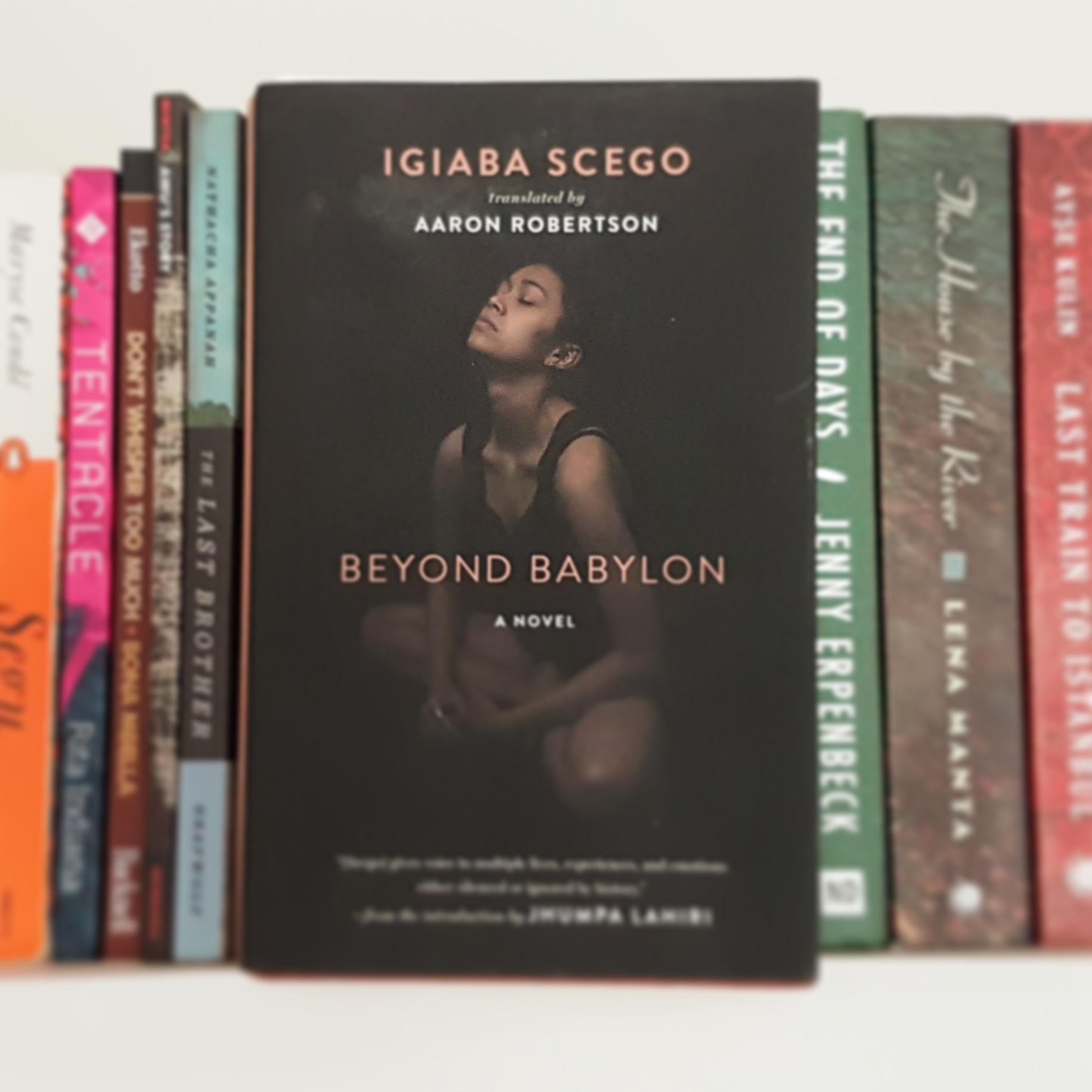
WITMonth Day 7 | Beyond Babylon by Igiaba Scega

I'll admit, I was somewhat surprised and disappointed by Beyond Babylon. Igiaba Scego's book (tr. from Italian by Aaron Robertson) caught me off guard from its first pages, which are filled with the sort of crude language that struck me as at odds with the quiet cover photo. And that was fine, for a start; I quickly recognized that the book had its own rhythm going and I was happier for it. The problems began once I realized how the book was progressing, or rather how it wasn't. Publisher-created expectations strike yet again.

I'm learning that I simply need to stop reading book summaries. Beyond Babylon markets itself as a reunion between half-sisters, but this is... emphatically not what the book is about. Narrated by wildly different voices - the aforementioned half-sisters (whose connection we discover fairly late in the book, and it is... honestly pretty subtle), their respective mothers, and their shared father - it's also a book that doesn't feel the need to stick to one narrative style too strictly. This is Beyond Babylon's greatest strength, with the book rarely feeling like any one dull progression. The storytelling is muddled and messy in the best possible way, with each narrator sharing a story across time and space and emotions and internal confusion. The daughters both have very present narrations, sharing about their recent lives in a sharp way that emphasizes both strengths. The mothers loop in their storytelling, with stories about their respective childhoods and thematic hints about what this teaches us about modern life. And then the father hovers in the background, the most distant of the protagonists, and not really much of one himself, preferring to tell .

The downside to this sort of storytelling approach (with a fixed order for each of the characters) is that it doesn't always work as a whole book. In the case of Beyond Babylon, I explicitly think it hurts the novel as a whole. Rather than feeling expansive and epic, each subplot feels perpetually truncated. The rhythm constantly felt just off, especially once three of the characters begin to narrate around similar events. There's an unsettling quality that feels intentional and well-placed, but the overall effect is still one of a story that isn't quite grounded enough in what it's trying to say.

This is another of my major criticisms of Beyond Babylon. The book touches on a lot of different themes, not least because its characters are all so thoroughly different from each other that they each have their own unique contribution to the story. And so we have stories about Somalia, about Italy, about toxic relationships, about sexual abuse and its after-effects, about Argentina's Dirty War, about the diaspora, about the concept of self, about bodies, about family, about identity... The themes end up largely overwhelming any semblance of story that lurks within each individual narrative, and certainly whatever overall message Scego wanted to convey. The individual pieces are there, but they don't really fit together.

It means that the novel as a whole just doesn't really flow well. Each character has such a strong voice that the transitions are jarring rather than identifying, which is such a shame given how well Scego gives them life. And the messages and themes that Scego explores end up feeling thin rather than part of a greater whole. Without getting into specifics, the novel's ending only emphasized the book's flaws, with a truncation that didn't actually wrap the story. At times, it felt like Beyond Babylon was little more than a vessel for conveying certain ideas. which is definitely a legitimate writing choice, but not one that works very well when the story is both so expansive and... padded.

There's a lot I liked in Beyond Babylon. Scego's writing often sizzles and it really is remarkable how well she managed to differentiate between her different characters (in many different ways). Scego also has a wonderful eye for cast-off comments that linger for pages afterward, whether in small observations or world-building remarks. There's so much excellent work going into play here that it ends up more disappointing that the book as a whole doesn't fully work. I'm not disappointed to have read it, but I'm also not sure I can recommend it to most readers. Beyond Babylon inspires admiration and recognition at best, not adoration. As a reader who lives and breathes emotional responses, that's just not enough for me.

Friday, August 23, 2019

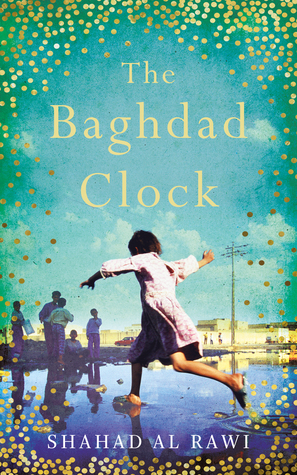
WITMonth Day 23 | The Baghdad Clock by Shahad Al Rawi | Review

The Baghdad Clock's cover and marketing is both exactly what it seems like and not quite what it's sold as. With a blurb that seems to set the story predominantly during the Gulf War, the book surprises somewhat in how quickly it moves past that war and focuses on the remainder of life in the aftermath (...within scant pages, to be honest). Yet it also hints at the type of story this is - my hardcover edition comes with shiny gold print and dots circling the edges of the cover. These make The Baghdad Clock feel a little... ethereal.

It's hard for me to describe The Baghdad Clock, written by Shahad Al Rawi and translated from Arabic by Luke Leafgren. Generally speaking, I liked the novel. It's not the sort of book that necessarily excels at every technical beat, but it does a reasonable job at enough different things that the end result is a good book. The writing style is very straightforward, though sometimes a little old-fashioned in a combination that didn't always work for my taste. Pretty much everything about the book is solid, but that's also a little bit of what made me a little cooler toward it in the end; it didn't spark particularly strong emotions in me in one way or the other.

At its core, The Baghdad Clock is a coming-of-age story. This is the part that felt undersold in the marketing - it felt at times like The Baghdad Clock was being framed as more political/about war than it actually is. Which is not to say that the book isn't political (it covers some serious ground), rather that my initial reading of the blurb leaned more towards a "war story" than "girlhood" story. It ends up being a little bit of both. While there is little of the Gulf War in the book itself, its shock-waves clearly felt throughout the narrator's childhood. Moreover, the back half of the book settles into more recent Iraqi wars and turbulence. It's still not an explicit war story, but it lives in themes of war, sanctions, and uneasy peace.

Even so, the coming-of-age narrative remains dominant. Like many books of this sort, the book skips along through childhood relatively quickly, slowing down for the narrator's teenage years and early adulthood. It's important to note that while the narrator is unnamed, she is very much our guide within this story. Not only does she filter her best friend Nadia's stories through her own experiences, the narrator also tells of her neighborhood at large. As the story progresses, she humanizes her neighborhood more and more, almost as though it itself is a living character in her story. 

By the novel's end, we definitely feel that we've encountered the world through the eyes of a specific girl (our unnamed narrator), but also that we've met her friends and neighbors. She remains somewhat elusive, though. The narrator shares bits of her budding romance with a neighborhood boy, but we learn little about her family life or even much about her personal aspirations. This too may have influenced how I felt about the book overall; I felt like the narrator was someone I just spent hours with, without really knowing who she was. A huge part of reading for me lies within the personal connection. Here, The Baghdad Clock almost explicitly sought to keep some distance between reader and main character. It's something I imagine won't bother most readers as it did me, but it still affected how I read the book.

But like I said: Pretty much everything about the book is... solid. The pacing is good. The way Al Rawi builds and populates her neighborhood is good. The way the story sometimes feels entirely real and sometimes just a little bit otherworldly is good. (This was actually one of my favorite touches and I would have been happy to have some more almost-fantasy in the story.) The story is interesting, the characters are solid, and the writing is fine. It's the sort of book I'd passively recommend, if it comes up. It might not make my "favorites" list any time soon, but I think readers are largely in for a good read.

Monday, August 19, 2019

WITMonth Day 19 | Awu's Story by Justine Mintsa | Review

For a book that's not even 100 pages long, Justine Mintsa's Awu's Story has a surprisingly long introduction. Clocking in at 24 pages (not including references), the University of Nebraska Press translation into English solidly leans into the idea that a short story can have a major impact. Unfortunately, like the introductions to many modern (and not-so-modern...) classics, translator Cheryl Toman's extensive (and fascinating) introduction also tackled some of the plot points in the book. Luckily, I've already learned to merely skim introductions for author-specific information and only read it fully after finishing the book itself. I advise other readers who prefer to go into the story with a clear mind to do the same.

And oh boy, do I advise readers get their hands on this book. Slim, yes, but Awu's Story packs major punch in such a brief space. The writing style is simple throughout, very direct and clear-eyed. Pieces of the story that feel unaddressed are almost all addressed more fully later. The book tackles huge subject matters, from ordinary village life, to family relationships, to love, to child pregnancy, to grief, to tradition... yet none of these feels out of place or dominant. With the exception of a single, somewhat rushed "payoff" scene near the end, the book largely feels like it earns its emotional beats.

To be honest? I kind of loved Awu's Story.

I mean, I guess I shouldn't sound so surprised or dismissive. There's nothing in Awu's Story's marketing or framing to suggest I shouldn't love it. On the other hand, there also isn't much to suggest it would hit me much beyond "oh this is a good book". Except Awu's Story really does end up feeling different, both in terms of my outsider view of Gabonese culture (of which, as you can imagine, I have limited exposure to) and just from a literary perspective. I have a mixed relationship with very simply written books, sometimes loving them and sometimes Awu's Story fell on the right side of that balance. The simplicity translated into straight-forward storytelling. The book progresses in a linear fashion; events happen one after the other and are cleanly described. The language is, by and large, direct. The one thing that bothered me a little bit was the dissonance between an older-style simplicity and occasionally very modern language (use of words like "hey" or "guy" in contexts that sometimes felt a little whiplash-y), but this too may have something to do with my expectations. It's also not really the point.

Awu's Story has a clear, progressing story, but it's hard to characterize this as a plot-based book. It is, as the English title implies, simply Awu's story, following life from early marriage through to middle age. It is, to a large extent, a feminist story with several characters breaking with traditional gender expectations within the story (Awu included). Its overarching themes and messages are definitely present and not particularly quiet, but they also still feel somewhat in the background. It's a book that feels natural in a lot of different ways. And I really did just love it. It's a short read that feels totally rewarding and enlightening and narratively satisfying. No, this is not a particular cheerful book in parts and I definitely cried a little bit by the end, but it's lovely and powerful and I hope that a lot more readers get the chance to read this. Awu's Story is far from one of the more popular, mainstream books you're likely to get a chance to read, but... you should. Highly recommended.

Saturday, August 17, 2019

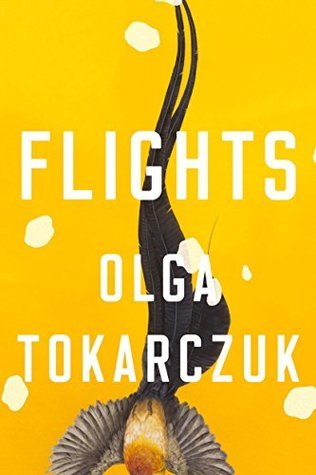
WITMonth Day 17 | Flights by Olga Tokarczuk | Review

I waited a long time to read Flights. Despite having had multiple translations of her books into English prior to Flights, this was the book that brought Olga Tokarczuk to my sphere of awareness. Everyone seemed to be reading Flights last year; it was a WITMonth hit, people were praising Tokarczuk and translator Jennifer Croft from all directions, and ultimately the book went on to win the 2018 Man Booker International Prize (and was shortlisted for both the Warwick Prize for Women in Translation and the National Book Award for Translated Literature). Flights has been... everywhere.

I waited a long time to read Flights. Not because I thought I wouldn't like it (though I won't pretend there wasn't some of my usual concern that I'd end up disappointed by a book that everyone else seems to have loved!). Not because I didn't want to read it (I very much did). And not because I couldn't get my hands on it (I lovingly passed my fingers over its cover when I was in London this past November). No, I waited a long time because the moment I saw this bright yellow hardcover for the US edition, I knew I wanted this version. I wanted a spine that would crackle under my fingers. I wanted a bright, bold cover. Forgive me, but the UK Fitzcarraldo blue just really does not do it for me.

And so I waited. I waited to begin my travels. I waited as I traveled through Fitzcarraldo-friendly lands. I waited as I arrived in the US and was exiled to the bookstore-deprived suburbs of Central New Jersey. (I mean... "was happily spending time with my family". *cough*) I waited as I placed online orders for several other books. I waited until I walked into a bookstore that had Flights on full display, and then I hugged the gorgeous hardcover to my chest. Flights boarded my flight home, carefully tucked into my backpack between my laptop and extra scarf. (And six other books. Let's not get into it...)

I began reading Flights on my last flight home. Three months of flying all across the world (16 flights in total...), traveling to new countries and continents, seeing new sights, meeting new people, exploring new experiences. At first, the book felt like it would be a slow burn - the shifts in style, narration, and literal stories kept throwing me off. How much of Flights was a novel? How much was short stories? How much was autobiography? The book seemed to progress with its own unique rhythm, sometimes working for me, sometimes less. I read slowly, steadily - first on my flight, then through my jetlag, and then bits and pieces every night before bed.

And then I began to read voraciously. Somewhere around the halfway mark, I felt something shift inside me; I suddenly felt like the book was pulsing with life, vibrating in my hands. I began to feel how the stories fit together. It suddenly clicked.

One story lingers, that of the (implied) New Zealand scientist who heads back to Poland to visit a dying friend. I kept feeling that the story was written for me, having just come back from my own travels throughout New Zealand and contemplating all sorts of bigger life questions (though obviously not as big as those in the story, for those who have read it). The story was one that suddenly had an additional dimension by virtue of the fact that I had waited - could the story have meant nearly as much to me before having traveled throughout New Zealand? (No.) Pieces of it seemed to fit perfectly into the tapestry of my jumbled emotional puzzle.

I ultimately loved Flights. I loved how the experimental, "weird" side ultimately ends up paying off. I loved how the book feels like it's growing as you're reading it. I loved the clarity of the writing (and translation!). I loved its unique voice, at once intimate and technical. I loved how it was quite unlike any of the other books I had read recently. I loved how it managed to be exactly what I needed at exactly the right time.

I waited just long enough to read Flights.

Sunday, August 11, 2019

WITMonth Day 11 | The Seventh Cross by Anna Seghers | Review

Confession: I did not like Anna Segher's Transit very much. I didn't loathe it, I just... didn't connect to it. I felt like I didn't understand it the way that I was supposed to. So when NYRB very kindly sent me The Seventh Cross, I was somewhat hesitant. Would I again be disappointed? How would I respond to this long, gloomy-seeming novel?

It turns out that while I didn't quite love it, I did actually like it quite a bit.

The Seventh Cross (translated, as Transit was, by Margot Bettauer Dembo) feels like a very different book from Transit. Where that one progressed in a deliberately slow, almost lazy style, The Seventh Cross takes place over a compressed timescale and has a remarkable tension throughout. The novel isn't exactly brisk - it has its fair share of side characters who get surprisingly whole arcs and there are plenty of slowly meandering portions - but it never stops feeling like it's pushing. It pushes towards its ultimate goal.

This is a tense, exciting novel.

Seven prisoners have escaped a Nazi camp. They are political prisoners, Germans, and this is still prior to the great horrors of the Holocaust. Written while the war was still at its earlier stages, just as the Final Solution was being set into motion, The Seventh Cross is less about the war itself and more about the culture that bred it. As we follow escapee George desperately trying to stay alive, we're exposed to people and places and contexts that help and hinder his attempts. We witness his escape not only from his perspective (his initial rush, his realization that others have been captured and killed, his constant search for safety), but from that of the guards and camp commandant who desperately need to capture him, his (mostly)ex-wife and her family as they are placed under strict surveillance, his old friend who begins to put two and two together, casual passersby, people caught in the crossfire, and strangers who only want to help.

While the core of the story remains George and George's escape, the narration is hardly consistent. This, in fact, was my greatest frustration with the novel - I often felt as though I couldn't keep track of which side characters were whom and what they were contributing to the narrative. While most of the stories felt like they did make some degree of sense by the end of the book, I wasn't sure that I liked all of the sidetracking. It was a little draining. The style, however, remains consistent across the characters, which only made things more complicated.

But pretty much other than that, I really liked The Seventh Cross. Once I got into it (and it did take a full chapter, basically), I was in it. The tension throughout (will George survive? will George make it?) works so well and the relatively slow pacing alongside a sharply anticipatory story makes for wonderful reading. It's the sort of pacing that I wish more books could have, with no question that the story is moving forward yet plenty of time to linger on smaller moments too. The writing is solid, well-suited for the story, and I appreciated the way Seghers gave each of her characters distinct personalities and traits, even when their voices blurred together and they didn't necessarily get a lot of focus themselves.

The politics are also important, and not to be ignored. The Seventh Cross is focused not on the plight of Jewish camps, but on political prisoners who have been too vocal in their objection to the Nazi regime. This is still in the 1930s, before the worst. And yet it is still horror that we need to remember and be aware of. The story reveals the degree to which these camps swallowed up people's lives, regardless how political they themselves might be. Like almost all stories that detail life under fascist rule, it's an important reminder of how quickly things may change. There's a lot to take in here from a meta perspective as well, remembering that Seghers wrote and published this before the death camps became the massive murder machines they would become. There were moments that hint at what is to come, but that's far from the point of the book. Which, frankly, only makes it more interesting to a certain degree.

I can't promise that you'll like The Seventh Cross. There is something unsettling about it and the beginning feels a little out of time, not quite fitting the pacing of the rest of the book. But it's a powerful piece of fiction that works on almost every other level. Even if you, like me, didn't like Transit all that much, give The Seventh Cross a try. It's a pretty great book.

Monday, August 5, 2019

WITMonth Day 5 | Celestial Bodies by Jokha Alharthi | Review

Jokha Alharthi's Man Booker International winner Celestial Bodies (tr. Marilyn Booth) is an odd and special book, made odder by my own expectations of it. Not that these expectations came out of nowhere - this is another example of a book with a thoroughly misleading book cover blurb and marketing effort from almost all readers. From the marketing, the book casts itself as the story of three sisters whose love lives reflect societal changes in Oman over the 20th century. It's quite simple/standard, isn't it?

As interesting a summary as that may be, it sorely undersells the modernist, vaguely experimental, extremely nonlinear techniques that Celestial Bodies utilizes to tell its story. Little about this book is particularly standard, nor does it play to reader expectations all that much, despite how the marketing may spin it. (And what I've found fascinating is also how many other readers seem to have embraced this interpretation of the text, even though the book is... really not that.)

I've struggled to write my own summary of Celestial Bodies that doesn't feel similarly inaccurate. Is this truly a cultural history, or is it simply a story that encompasses within it 2-3 generations? Does describing societal changes really make it a book about society? Is it a family epic simply because it is largely focused on one family (and its offshoots)? None of the traditional phrases used to describe books feel entirely right. The best I could come up with was "a story told in a nonlinear style, tracking deep emotional divides of its characters". Ah yes, that's helpful! (Not.)

Part of the problem is that Celestial Bodies just doesn't follow the traditional, expected norms of "first woman writer from [insert country] to be translated into English"... which of course is not its fault at all. We've (wrongly) grown to assume that "firsts" serve as encompassing cultural introductions, plus the very concept of "first"s is fraught with issues. While Celestial Bodies can certainly teach quite a bit and sell itself on that front, that's just not what it's doing on a literary level. The story isn't straight-forward and designed to be easy reading; it switches narrators, perspective, and focus easily and quickly. Moreover, its nonlinear storytelling plays with memory and perspective in ways that constantly challenge the reader. The book feels thoroughly modernist in parts, with its contrast between the very structured narration of some characters versus the loose style of others. It's a novel that feels like it carries within it so much more than appears on the surface, even as it remains accessible to most readers. Thus it emerges an odd novel for its simultaneously standard story (...no, but really... is it, though?) and its very non-standard storytelling style.

From a plot/story perspective, Celestial Bodies doesn't have all that much. It's not the sort of book that will leave you feeling wholly satisfied upon its ending. The story feels more like layers peeling back than anything direct. It's also very imbalanced in terms of characters and narration; not all characters are equal in the novel. And to take it a step further, it turns out the story is less women-focused than its framing suggests. The stories are heavily reliant on each other and feed into each other in unique ways in terms of character interactions, but the most consistent narrator turns out to be Abdallah (the second narrator in the book, who even gets his own font in the Sandstone Press edition), with a loose, out-of-time story that seems to connect most of the other stories. So there's another point against the marketing.

On top of that, the three sisters touted as the main characters? We don't actually get to know all three to the same degree. We end up learning far more about the oldest, Mayya, than either Asma or Khawla; Khawla in particular is relegated to the margins of the story and never develops into her own whole character. Asma's story begins fairly strongly, but essentially gets cut off the moment she starts to have children, effectively finishing within the space of a few lines and never getting full closure. It was a startling decision - clever, perhaps from a storytelling perspective, but ultimately disconcerting.

These all added to the odd feeling that the book left me with. Nonlinear... sure. I liked that. But the fact that some characters get totally rushed conclusions (or have sidelined arcs to begin with) left me fairly cold. It's hard to feel for a character that just exists in the background. Unfortunately, Celestial Bodies occasionally feels like it wants to be more far-reaching than it is, as such forgetting the characters that it already has. It sprawls in a way that seems more suited to a book three times its size, on the one hand making me want more and technically appreciating the novel, and on the other hand... deeply frustrating me.

But there's a lot more to Celestial Bodies. Again, to counter some of the marketing, while it very much exists in the context of Oman's history and cultural shifts, it's not really about that. It's not written to exoticize or perform changes in Oman's society, they simply are. (Which is a nice change from many Western perspectives on "exotic"/unfamiliar countries and goodness do I dislike those sorts of stories...) This means that on the one hand, the book doesn't explain a lot of background/context (and shouldn't have to!), but on the other hand... it also feels like there are nuances I will never quite understand. Which is definitely neither a point against the book nor in favor of it, simply an observation.

Which leaves me with this review. I realize that until now, I have mostly focused on the things that bothered me. This review sounds like I didn't like the book, and that's really not the case - I enjoyed Celestial Bodies overall, found it interesting, and can easily recommend it to a lot of readers. That said. false advertising is obviously not the fault of the novel itself, but it's hard to shake off the effect that it had on my reading. I actually liked a lot about the book, whether the unique style, the way it challenged my expectations, its intelligence, and its clear-sighted approach to writing about cultural changes. I also liked many of the characters and the way that the story felt like it flowed between them. And yet I came away from the book feeling somewhat... cheated is maybe too strong a word, but I'm not sure what else works. Again, it's not the novel's fault, but I came into the story with certain expectations (from the publishers and marketing, specifically) that were not met. And within the novel itself, I felt like there just wasn't enough - at just under 250 pages, this isn't a particularly long book. It left me wanting more, both in terms of those underdeveloped characters and in terms of fully understanding how the stories that did exist fit together.

Wanting more isn't necessarily a bad thing. Here, it mostly washed for me: I was already somewhat dissatisfied by the framing, which meant that I was ready to be disappointed by something else. Ultimately, I wish I could read Celestial Bodies again with fresh eyes. I wish I could erase the perception that the misleading back cover blurb instilled in me and just enjoy the book for it is - a clever, intelligent story that does a lot of brilliant work within its pages. It doesn't have to be more than that. For most readers, the experience was just those positives and I totally understand that. I find myself maybe a little cooler on the book itself than some other readers, but also able to give a warm recommendation: This is very much a book worth reading. But it might help to know what you're (not) getting.

Sunday, April 15, 2018

A True Novel by Minae Mizumura | Review

It feels redundant to review a book that has been praised to the skies by so many readers and critics far more eloquent than myself. I'm coming to the party so late that I can hardly imagine which readers are left unaware of this "Wuthering Heights remake" (I'll explain the quotations in a moment), and of its lingering impact. Doesn't everyone already know that A True Novel (tr. Juliet Winters Carpenter) is a masterpiece of modern Japanese literature? Doesn't everyone already know that it is worth looking past the novel's length and reading it? Doesn't everyone already know, far better than I do, that this is a true novel, a truly good novel?

On the surface, I knew each of these claims when I began to read A True Novel. Like so many other titles on my shelf (particularly the longer ones...), A True Novel had spent a long time languishing before I bothered to actually read it. Sure, some of that had to do with the length, but the real reason I was put off every time was that allusion to Wuthering Heights. Because goodness, I hated Wuthering Heights. It's one of those novels that somehow even got worse in my memory as time went by (rather than simply fading away). A True Novel's blurbs all insist on reminding me that this is a Japanese reworking of that classic tale, and didn't you know that this is a reworking of Wuthering Heights, and oh! You should read this because it's an adaptation of Wuthering Heights.

So I started reading, hesistantly, and found myself baffled. The first part of the novel does not remotely resemble Wuthering Heights; in fact, it's more like autofiction, with Minae Mizumura detailing a cross-cultural youth in the US and a later literary career. It was an odd, slightly off-kilter opening to a book that promised something entirely different. I kept waiting to see what Mizumura must be hinting at, the references I must be missing... but it soon became clear that this was simply a very long, elaborate introduction. Indeed, A True Novel turns out to have multiple layers to its story - a story being told, then retold, then retold, then conveyed to the reader. Yet the submersion feels gradual, possibly because this introduction ends up taking so long. And is then followed by another introduction. And then another that leads to the actual story. And not long after, I realized I had finally gotten to the point at which that Wuthering Heights parallel came from.

Here's why A True Novel works so well: By the time I finally realized how this narrative echoed Wuthering Heights, I didn't care. Sure, the cast characters had shifted several times before the resolution focused on the "main" narrative. (Several hundred pages, in fact.) And yes, once the story itself began, it was easy to recognize how Mizumura had planted the "Wuthering Heights" seeds earlier. It just didn't matter anymore, because I was hooked. Each introduction had felt like one, but once the pieces fell into place, I recognized how this novel was progressing and I didn't want it to stop. I fell in, breathlessly, and was swept up.

A True Novel certainly has several callbacks to Wuthering Heights, but to market it as the "Japanese Wuthering Heights" is to undersell the novel by an almost catastrophic degree (and not simply because I don't love the original). A True Novel contains within its pages a unique take on the story-within-a-story model, one that manages to make each layer even more worthwhile by being just meta enough to make the withdrawal its own almost-story, challenging how stories are told and the concept of narration itself (in parts). Remarkable still is the fact that A True Novel does all of this without ever straying into the dull gray zone of having technical innovation at the cost of narrative and writing. The writing threw me off a bit, at first, with a sort of straight-forward roundedness that I couldn't quite place as being either modern or old-fashioned; it's somehow both simultaneously. Whatever it is, I enjoyed it a lot.

Bottom line: A True Novel does a lot of wonderful things within its (many) pages. It's not only an expansive modern history of Japan, but also a personal drama/tragedy and even a meta narrative about storytelling. It's written in a convincing style and ultimately kept me absolutely hooked. It's intelligent and clever (yes, those are different things!), emotionally engaging (even in the most Wuthering Heights-like plot moments that had me on occasion wanting to slap the characters, but with much less vitriol against the novel itself than Brontë's text), and well-written.

If like me, you've been put off by the length or the Wuthering Heights comparisons, do me a favor: Pick up the book and just start reading. Just start. I think, like in my case, you'll find yourself finishing the book before long...

Saturday, November 18, 2017

The Impossible Knife of Memory by Laurie Halse Anderson | Review

The Impossible Knife of Memory has been on my shelves for so long, that I honestly wasn't sure I'd ever get around to reading it. Except, of course, I enacted a book buying ban on myself to exactly motivate myself to read these older, forgotten books. So it was time to visit an author that I loved as a teen, with a novel that - when it had been published - was touted as being an important, powerful novel of PTSD.

Perhaps it's that the book hasn't aged very well. Perhaps writing conventions have shifted just so in the three years since I purchased The Impossible Knife of Memory. It could be that the book just isn't very good, I don't know. It's certainly not terrible, but I found myself taking issue with quite a few portions of the novel.

To begin with, this is a book that misses so many of the opportunities it itself raises to tackle major issues. Take the central theme of PTSD. Hayley's father very clearly has PTSD, and this is well explored. However, Anderson also very clearly shows that Hayley has some form of PTSD as well, yet never expands on it. Hayley is very much defined by the fact that her memory is full of gaps and we frequently see her crumbling somewhat as a flashback hits. Yet even with these scenes (and those that show Hayley being triggered by a series of different situations), Anderson never actually builds on this idea or how it affects Hayley. We only have her response to her father's pain, not her own. (And don't get me started on the way the book glosses over abuse and false memories. Just... no.)

Similarly, the book makes several references to other struggles young adults might face and their responses to them, but fails to treat it with the expected depth. Hayley is repeatedly critical of her fellow high schoolers' behavior and hypocrisy, that their lives are dull and "zombie"-like. On more than one occasion, she links this behavior with prescription drug abuse. Later in the book, we see Hayley's close friend self-medicating in exactly the way that Hayley describes (ultimately, even Hayley is tempted by the pills) in response to problems at home, but Hayley doesn't reflect on it or wonder at her own ignorance of the struggles other teens are going through.

These are two examples, but they stem from the same underlying problem: The Impossible Knife of Memory is populated by thinly drawn characters. Even Hayley, our narrator and main girl, feels underwritten. What are her motivations? What does she like? Why does she like what she likes? This is a chiaracter with baggage galore, but no real personality. It means that while we're shown a lot about her life, it cannot be explored. It means that there is no additional wisdom or complexity to her thoughts. It's all... oddly flat.

This impacts the two main narratives as well. It's hard to be invested in Hayley's budding romance with fellow student Finn when neither character is well-developed enough to care about. Why do they like each other? We know that they're physically attracted to each other, but... that's literally it. There's nothing else except minor quips here and there. It felt like a portion from a totally different novel, that didn't quite fit in. Similarly, it's difficult to really feel the struggle that Hayley's father is going through when we neither know him, nor really understand Hayley's relationship with him.

Now, if the novel was brief, I could probably understand this level of non-depth. I've read a lot of young adult novels that walked this line relatively well (I'm thinking of Chris Crutcher's relatively concise novels), but The Impossible Knife of Memory is just under 400 pages long. And I honestly cannot understand how. The book takes place between the beginning of the school year and Christmas. That's it. The pacing is wildly inconsistent, both rushed and oddly slow. This is most strongly evident in an incredibly rushed ending, that literally time-skips eight months of recovery and healing in an honestly shockingly sloppy way. So what, I must ask, was the point? Why linger on Hayley's story if we're never going to have any sense of its impact?

It's ultimately disappointing, because it's not as though there's a plethora of young adult novels (or non-fiction) about PTSD or war or recovery. Anderson has also in the past proven her worth in writing about teens going through rough times (Speak, of course, but I also find Catalyst an underrated gem), but The Impossible Knife of Memory is just... not great. And heck, even the teen-isms are all off. It's got a lot of good pieces and is definitely "important" in parts, but it feels like a mess as an overall work. A shame.

Friday, August 11, 2017

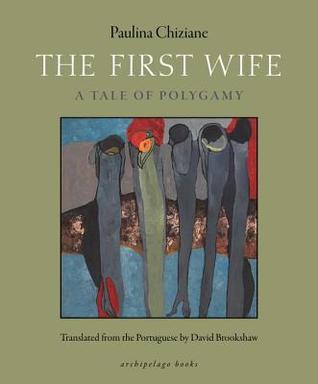
WITMonth Day 11 | The First Wife by Paulina Chiziane

The First Wife: A Tale of Polygamy by Paulina Chiziane (tr. David Brookshaw) was the last book I bought during WITMonth 2016, and I read it in early 2017. I neglected to review it, despite, unsurprisingly, finding it to be a fascinating and important novel. Let's ask ourselves, seriously, how I could not be interested by "the first Mozambican woman ever to publish a novel"? Or a novel that explores polygamy from the eyes of the wives?

I should begin, then, by noting that from a literary perspective The First Wife isn't necessarily the most brilliantly written text you'll ever read. There were times in which the writing felt a little flat, with certain passages dragging on just a bit longer than I might have otherwise preferred. It's far from a poorly written novel, but it's also... not quite the best.

The content makes up for it, though. This is far and away one of the more culturally fascinating books I've had the pleasure to read as a result of the women in translation project, in large part because it often feels as though The First Wife really isn't trying to talk to me, but within Chiziane's own cultural consciousness. I have found that I like these sorts of books more than those that try to "talk" to a foreign audience - Chiziane doesn't try to address "Western concerns" or questions about whether polygamy is good/bad. The First Wife instead works entirely within the assumption that polygamy is... just a thing. Not a great thing, undoubtedly, but main-character Rami plots the entire concept.

The story begins with Rami - the titular "first wife" - finding out that her husband Tony has been keeping not one, but four different mistresses for years. Each woman is progressively younger and typically more beautiful than the previous, stemming from a variety of ethnic backgrounds. Each woman is also deeply in love with Tony. But of course... they can't have him all the time. Under these circumstances, Rami sets out to force Tony to marry each of the mistresses and adopt a polygamous family under older traditions.

In this way, the novel fails to adhere to typical "Western" feminism. Rather than demonizing the subjugation of women (since of course the mistresses had had no legal claims before marriage...), there's an interesting exploration of what it means and how women find their strength within confining environments. Rami's initial fury over being duped turns into a fury over her husband's treatment of his various mistresses and children. Polygamy becomes a weapon not of the patriarchy against the women, but of the women against a man who seems to view them as meaningless and interchangeable in his life.

Slowly, over the course of the novel, each of the women - initially so emotionally and practically dependent on Tony - begin to change. Rami's "rivals" become more than just the younger mistresses of her husband, and she grows close with most. In her role as "the first wife", Rami exerts a great amount of control and influence over their lives, helping them achieve their ambitions and finding them stability (and indeed, sometimes love). In this way, The First Wife is able to display women's power in the places we assume women have none.

This, I think, is what makes The First Wife a uniquely feminist text. Chiziane is exploring what it means to be a woman, what it means to be women in a society that places them below men (Rami coolly refers to women's inferiority until the very end of the novel), and the ways in which women do find their voice, their strength, and sometimes their independence.

Wednesday, August 9, 2017

WITMonth Day 9 | One Hundred Shadows by Hwang Jungeun

Something that has happened more and more frequently to me in recent years is an odd tendency to start a book, be moderately disappointed by the first chapter, set it aside for a few days (or weeks), return to it, and fall in deep. This doesn't happen with every book, of course, but it's happened often enough that I've taken it as a sort of indicator: Sometimes you start a book at the wrong time. Give it a moment, give it a week, give it a few months... you might end up enjoying it a lot more when the time is right.

Hwang Jungeun's One Hundred Shadows (tr. Jung Yewon) felt very much like that sort of book. I read the first chapter during a particularly stressful week and found myself put off somewhat by the quotation-mark-less writing and the odd, almost airy style. I set it aside for a week. When I picked it up again, the prose felt like it had undergone some sort of transformation (though it was obviously I who underwent the change...). The simple style felt fresh and sharp, unburdened by unnecessary weight or false "literariness".

And I liked it.

It's an odd, sort of melancholic sort of book, framed by some rather nice symmetry and a quiet sort of social message. Curiously, based on the jacket description, I was expecting One Hundred Shadows to focus more explicitly on class differences and social inequality in modern Seoul, but... it's not that sort of book at all. Not that there aren't politics - narrator Eungyo and her friend-maybe-more Mujae discuss at some point the definition of the word "slum", and Eungyo often thinks about the state of their status as repairmen of sorts, working in a cheap market that has been marked for demolition. Both characters acknowledge the difficulties they've had, with Mujae referencing his inherited debts and the cost of college ("I didn't think what I was learning [in college] was worth getting into debt for") and Eungyo contemplating her reasons for dropping out of school as a teenager. In that sense, One Hundred Shadows is a solidly "working class" sort of a novel, something that shouldn't be as rare as it is.

In the midst of this political exploration of class comes a fantasy-like twist on it: rising shadows. The short novel begins with Eungyo following her newly-risen shadow out into the woods; Mujae is there to guide her back to reality. Over the course of the novel, several different characters describe stories of their rising shadows or undergo similar events. When his shadow rises, Eungyo notes that "it seemed as though Mujae was no longer present." These events seem to become more and more frequent as the novel progresses, linked perhaps to the anxieties of the neighborhood as the threat (and action) of demolition looms closer. Certainly references to shadow-risings that happen earlier are linked to death and despair...

And yet there's a surprising sweetness to the story. Eungyo and Mujae's friendship develops slowly, with the two supporting each other and balancing each other nicely. Each is there for the other when their shadow rises, and their growing bond seems to reflect that sort of deeper connection. It's a refreshingly honest sort of relationship, never overly explicit or harshly obvious.

This can be said of the novel overall - it's understated. The jacket, as I've already mentioned, calls this a "hard-edged novel", which seems like the last term I'd use for this sloping story (though many other reviewers have adopted it). It's certainly powerful, but the writing is almost explicitly quiet, with the fantasy elements also wrapping the story rather gently. It's more like a softly rolling dreamscape, but one that refuses to forget the world that shapes it. One Hundred Shadows doesn't have to be loud in order to make its political/social point clear to readers. On the contrary - I found that I much preferred this character-focused approach. It makes for a powerful, unique little novel, and one that I can easily recommend.

Thursday, March 27, 2014

The Pomegranate Lady and Her Sons | Review

I'm honestly surprised that I'd never heard of Goli Taraghi's The Pomegranate Lady and Her Sons (tr. Sara Khalili) before reading it. It's not that I think I know of every new book that's published, but as a longtime book blogger, there's always a bit of awareness of new titles. Particularly titles from more mainstream publishers. The irony of it is that I'm often more aware of literature in translation from smaller publishers than I am from the heavy-hitters, where they seem almost passive in their attitudes despite more newspaper coverage. The fact is that I can't recall having seen any reviews of The Pomegranate Lady and Her Sons. Fairly undeserved.

It's been a bit over a month since I read this short story collection, so I won't pretend that all the facts and figures are perfectly aligned in my head. But truthfully, that's less relevant for a book of this sort. Like many short story collections, the plot is not really the point. More important is the clear-headed assessment of a culture, and a culture of emigration.

The fact that most of the stories in The Pomegranate Lady and Her Sons either revolve around emigration (or return), or some form of outside cultural influence, says quite a bit about the collection as a whole and about the state of Iranian culture. This is not particularly surprising given Taraghi's current status as an expat herself, but there's power to the fact that she continues to write in Farsi. There's meaning to the fact that these stories have such strong themes of coming and going, forming a core that does not dismiss offhand cultural differences between Europe/America and Iran, but also does not entirely embrace them.

One of the nice things about this collection is in its rather excellent balance of pace and story. These are short stories that know how to breathe - nothing is rushed, but no story feels unnecessarily bloated either. One story tells of a dinner party broken up by a raid. There's anxiety running throughout the story, the narrator's tense apprehensions and unease with further complications that result from her arrest. Taraghi's writing conveys this tension without resorting to blunt measures. Everything flows gracefully and smoothly, straight through to the story's end. This makes for a nice change from most novels, and certainly from flash fiction which often ends up missing important story elements.

Though certain themes crop up again, The Pomegranate Lady and Her Sons nonetheless relatively succeeds in staying fresh. This is not a collection bogged down by the same story again and again with slight variations; even the most similar stories feel distinct in their characters and settings. Some also sharply deviate from the standard mold, making for an overall bolder, more diverse collection. There's a lot here about human nature, quite a bit about passion and force of will, and sprinkles of love, often in the most roundabout way.

I liked The Pomegranate Lady and Her Sons when I really didn't think I would. The stories grow on a reader, and though the writing was a little awkward at times (a fault whose source I'm not sure of - writer or translator...), generally speaking I found myself delving quite deeply into each story. Nothing bombastic happens in any of these stories, nor are they unique for their sparseness. Instead, Taraghi looks at characters (primarily women) in different situations, calmly building the broader world around these characters and ending on just the right note. All in all, a good, balanced collection, deserving of more attention.