Showing posts with label french. Show all posts

Tuesday, August 9, 2022

WITMonth Day 9 | Far From My Father by Véronique Tadjo

Upon finishing Far From My Father by Véronique Tadjo (translated from French by Amy Baram Reid), I found myself itching to find more of her works. The additional material on Tadjo included in my edition made references to her earlier novels, as translated into English. It didn't take me long to realize that those novels were no longer in print. Indeed, despite a rather rich catalog of works in both French and in English translation, Tadjo is a fairly "under-the-radar" sort of writer. Far From My Father and her recent not-quite-novel of the Ebola epidemic In the Company of Men (translated by the author and John Cullen) are the only two of her books that I have been able to easily track down. This, again, despite many of her works actually having been translated into English (and published). Including children's books! Go figure.

It's hard not to want to keep reading Tadjo's writing after settling into Far From My Father. The novel - marketed as semi-autobiographical, though I have found myself less and less inclined toward that definition in recent years - is crisply written, with a clarity that I wish more stories has. It tells of a woman returning to her old family home, upon the death of her father. There, she untangles pieces of her history and her father's secrets, with a solid exploration of identity and selfhood.

If you're reading that brief (and wholly inadequate) description and thinking "that sounds really banal", you're right that it's a basic framework that has been written of many times throughout history. But Far From My Father is elevated by a warm directness, excellent writing, and a solid understanding of its own limits. A lot of family stories get bogged down in their attempts to explain everything and everyone; Far From My Father is thankfully a fairly brief novel and one that knows to tighten its focus when needed, even if I didn't love some of the subplots and tangents.

At its best, Far From My Father tells of the complications that arise after a man's death. There are practical considerations, but also an emotional toll from the very predictable decisions that need to be made. Not to mention, the aforementioned secrets. It doesn't necessarily feel like outright spoilers to get into the details, but ultimately it also doesn't feel necessary. Is it not enough for a novel to examine grief, loneliness, and self-identity? Is it not enough for a novel to weave together different threads without actually forming a whole picture out of them, instead leaving much open to reader to continue contemplating?

Regarding the latter, I can see how Far From My Father might not work for everyone. Tadjo doesn't linger much on her characters, who can often feel a tad hollow as they orbit the protagonist. But it also very clearly isn't their story, and some characters in particular are almost designed to be just a little... vague, I suppose. Imprinted.

This is not a long enough book to justify writing a full, detailed review. I'm not sure I'd have something particularly meaningful to write, either. I can only emphasize that initial sentiment: Reading Far From My Father immediately made me want to pick up Tadjo's other works. This is a novel that can feel a little underbaked at times (see the above-mentioned hollow characters, as well as that all-too-common blurry plot matter), but its writing is so immediately engaging that it's hard to set the book aside. And isn't that one of the great strengths of literature?

Saturday, August 29, 2020

WITMonth Day 29 | Dark Heart of the Night by Léonora Miano | Review

There's a lot of meta to unpack before I can write about Léonora Miano's Dark Heart of the Night, translated from French by Tamsin Black. Miano, after all, is credited with disliking the University of Nebraska Press edition of Dark Heart of the Night even on her own Wikipedia page, having publicly critiqued the book's foreword (which I assume has been removed from subsequent print runs, since my edition has none) and much of the book's paratext (cover and title). A little digging reveals that Miano had serious concerns about how the University of Nebraska Press ultimately framed the book, from the foreword that was "full of lies" to changing the book's original title to resemble Heart of Darkness (a comparison that is also mirrored in the back cover description). I thus came into Dark Heart of the Night knowing that Miano had critiques, but not quite remembering what they were, instead reading into it more after reading the book. And I have to say - her critiques are valid from all sorts of perspectives and also point to a pivotal reading of the novella itself.


I'll start with my conclusion: Dark Heart of the Night is a bit of a brutal, unpleasant read, but one that is uncompromising and fascinating. It's a book that batters its reader again and again from all sorts of perspectives and doesn't seem particularly concerned with expectations of how the story is supposed to advance or fall into place. Its pacing is steady, its plot scattered without a single fixed peak, and its emotional impact a sort of pulsing, constant effect. Miano packs an extensive critique of different forms of violence and community life in the short novel, with a sense that there is much more that she could say on either topic (as well as many others). Dark Heart of the Night does a lot, almost all of it efficiently and effectively, and the end result makes for a book that is hard to set aside but also... not entirely enjoyable.

One of my impressions while reading Dark Heart of the Night was the Miano sought to create a sort of generic form of violence in the face of war and chaos. Miano's descriptions of village life as a contrast to city life all felt a little purposely blurred, with fictional names designed to place her story across a wide range of regions. Nationalism does not feature in regards to this specific country, exactly, rather the story's core violence stems from a place of a flawed and despotic perception of African identity. Perhaps I should have, but I did not assign too much importance to this on a deeper level; can Miano not critique violence in the same way that any other novelist might write of in the world? 

The brutality of violence that Miano introduces feels like a contrast to the individual identity subplot that centers now-village-outsider Ayané who has returned to her home village following her mother's death, yet the two narratives intertwine in defining identity, community, and belonging. Dark Heart of the Night is not just its most violent moments, but also their aftermath, their effects, and the way these fit into larger political balances. It seems important to remember that the novel continues past what can be viewed as its darkest moments, with that unrelenting continued bluntness. 

It's hard to write about Dark Heart of the Night without getting into details, and I think that any details take away from the book's power. It is a powerful novel, in many of its different threads. It's true that they occasionally muddle and the writing style sometimes feel out of place for the different subplots, but the book on the whole is depressingly effective. 

It's also - to loop back to my introduction - a lot more nuanced and complex than its paratext would suggest. To begin with, the back cover description centers Ayané in a way that frankly seems to emphasize one of the novel's themes over others. While Ayané is very much the novel's main character, she is often counterbalanced within the story and her experience contrasted. These contrasts feel important in how Miano builds a larger narrative regarding that blurry African identity. Furthermore, the casting of the novel through the lens of Joseph Conrad's Heart of Darkness (a work that has roundly been criticized for its racist, generalizing portrayal of Africa, though I have not read it myself...) also seems to strip away some of the weight of Miano's vague placement of her story. I can't imagine how the original foreword also attempted to alter Miano's experiences and identity herself in order to fit a narrative regarding African literature. Why can Dark Heart of the Night not simply be allowed to stand on its own?

I'm not sure that my own review doesn't fall into similar, problematic patterns in terms of what I'm mistakenly focusing on. I feel as though I walked into the novel mostly unaware of the controversies and thankfully unaware of the actual plot. (For once, I can at least be grateful for the book's vague and vaguely inaccurate back cover for not creating false expectations.) I read the book with little external context and without feeling like I knew enough to place Dark Heart of the Night's plot in any one specific place. My ignorance, it seems, ultimately matches Miano's own intentions. But is my sense that Miano is deeply involved with questions of identity something that follows from the retrospective reading of her critiques of the original foreword? Am I misreading her response to it? Was there something else in reading this novella that I was supposed to take away? Knowing what I now know in terms of Miano's own sense of her work, I find myself wishing for a deeper, detailed analysis that views Miano's work as part of a larger whole. Individual debut work as it may be, Miano clearly has had more to say, having published several books over the past decade. Would we as readers not benefit from reading those works as well? (Yes, we would.)

I did not struggle with reading Dark Heart of the Night, though the book saddened, angered, and disheartened me in many ways, as I believe it intended. The writing is brisk and clean, and again, the pacing is remarkably steady for a book that contains several different gut-punch peaks. It is far from a pleasant book, but it is definitely a good one, perhaps even a great one. It is certainly a work worth reading. I also think there is some value in the questions it forces us to grapple with regarding how works by African writers in translation (and perhaps African women writers more specifically?) are packaged for English-speaking audiences. Miano's critiques may be presented as a surprising bit of anger from an author over how her writing is sold in translation ("drama"), but ultimately it's worth noting two things: 1. The original foreword no longer appears in print, and 2. Miano's critiques end up providing a much better context for what Dark Heart of the Night is trying to do than the book's remaining paratext itself. I suppose some good comes of bad as well...

Friday, August 21, 2020

WITMonth Day 21 | Island of Shattered Dreams by Chantal T. Spitz | Review

I first heard of Chantal T. Spitz at the wonderful, inaugural Translating Women conference last year. Spitz's English-language translator Jean Anderson presented a paper about cross-cultural literature, representing Pacific literature in a way that I had never before heard. I'm not in the literary field, after all, and the Translating Women conference was my first experience attending a literary academic-style conference; I've attended other literary events and plenty of scientific conferences, but nothing like this. For me, Anderson's presentation was one of the most fascinating and memorable of the conference as a whole. In the course of the talk, she discussed Spitz (as well as other, untranslated writers), and I jotted down in my notes "French is 'not her language', but the language she writes in due to school and education". Moreover, I was fascinated by the idea of exploring Tahitian and Pacific literature, since these are regions of the world I know very little about. I ultimately ordered Island of Shattered Dreams a few months later and read it just at the onset of August.

It would be unfair to say that I devoured Island of Shattered Dreams in one rapturous swell, though I did. It would also be unfair to say that I've been thinking about the short novel extensively since finishing reading it, though I have. These both feel unfair because they don't do enough to emphasize just how strongly Island of Shattered Dreams made me feel, nor how strongly I feel that more readers should be seeking this translation out. From a technical standpoint, Island of Shattered Dreams manages to do so much in so few pages (157), and with an extraordinary balance. Poetry, lyricism, history, politics, and romance all intertwine to form a tiny epic that never feels incomplete. Simply saying "oh, this book is wonderful!" or "I couldn't put it down!" seems like underselling.

The novel - which carries with it a unique meta-context that becomes more apparent and important by the story's end, which I won't get into because I quite enjoyed how it unfolded - follows an Indigenous Tahitian family, initially focused on Tematua and his great love Emere (whose mother is Indigenous and father a white Englishman), later shifting focus to their children: Terii, Eritapeta, and Tetiare. The fluid passage of time is beautifully framed by Tematua: "As Tematua foresaw in his heart, time is rushing out of control", precisely at the cusp of the novel's focus change. Island of Shattered Dreams covers a significant portion of the 20th century without it feeling like an overly drawn out narrative, and the tight family saga means that the novel's overall flow is never impeded. 

Yet this very sentence I just quoted also defines a second, critical theme in Island of Shattered Dreams, since the quote does not end where I stopped it. The full quote is actually "As Tematua foresaw in his heart, time is rushing out of control, troubling people's minds and surreptitiously filling their hearts with shame for the Mā’ohi world and admiration for the pale reflections of the foreigners' world." Ultimately, Island of Shattered Dreams must also be read as a novel about Tahiti/French Polynesia at large: its cultural shifts, its status as an island outpost for a massive colonial power, and various racial/cultural complexities that come attached with both. 

Emere's story is particularly central in this, as she is the not only the product of a mixed-race relationship, she is also caught between cultures and the love both of her parents have for her in that context. Her mother Toofa "hadn't prepared her daughter for the difficulties of life on the outlying islands. She had wanted an easy, modern lifestyle for her, hoping that the man who married her would provide her with a housekeeper and every comfort." Toofa remains rooted to joining the white, Western world (which goes on to influence her grandchildren too), yet accepts Emere's choice leave this society behind and marry Tematua. It's a balance that ripples throughout the remainder of the novel, a reminder of the family's complex history and one that shapes the drama in the book's final chapters.

It's impossible for me to ignore how much I learned from Island of Shattered Dreams. Learning from literature is obviously wonderful and part of the point, but I can't help but feel disheartened by how much I end up relying on fiction to teach me things that I probably should have known earlier. I knew absolutely nothing about French Polynesia or Tahiti prior to reading Island of Shattered Dreams; it's just about exactly on the opposite side of the world from my own home and with no shared language, so this isn't particularly surprising. Still, I left Island of Shattered Dreams wanting to learn more about France's colonial history in the region and its power today. Much like the anthology Indigenous Literatures of Micronesia left me hungry to learn and read other books, so too does Island of Shattered Dreams make me wonder about the island today (Island of Shattered Dreams was published in 1991, which makes it as old as I am, aka not exactly young anymore...). What does Tahitian literature look like today? Will any more of it get translated into English? Spitz's other works are themselves still unavailable in English translation - are these also to remain out of grasp for English-language readers?

And I'm left with more questions, hearkening back to Spitz's remark about writing in French. There are several Mā’ohi words and phrases throughout the novel and Spitz even opens her novel in Mā’ohi. Spitz has already made her words "more accessible" to Western readers by writing them in the colonial French, a language that is bountifully translated from across the world. Yet Island of Shattered Dreams does not appear to have been translated between most languages. It is certainly not available in my native Hebrew, nor, to the best of my Googling, does it appear to have been translated into German, Spanish, Portuguese, or Japanese. Why not? The supposed language barrier (had Spitz written her work entirely in Mā’ohi)  has been "helpfully" removed by the author herself. What more is needed?

I've written all these words without getting to the heart of my response to Island of Shattered Dreams which is, quite simply, that I loved it. I loved the writing. I loved the fluidity. I loved the poetry. I loved the warmth with which Spitz describes her world and life, new-to-me yet so far from being new (and it never feels like an introduction, it feels like... life). Most importantly, I loved the love that is central to so very much of the novel. To use what Anderson explains in her translator note as a Mā’ohi cultural touchstone which I was obviously unfamiliar with until reading the book, I felt Island of Shattered Dreams deep within my belly, that place from which emotions truly do rise (even if this is not how it's usually described in either of my languages). I could not set this book aside for a moment, sitting outside to read under a perfect summer sky, drinking in the book from when the morning air was still cool until the hot noonday sun reached my reading nook. Alongside all of the rest that makes it a valuable work, Island of Shattered Dreams is a beautiful story brimming with all sorts of different forms of love and a love of storytelling (once oral, now put to print) at its very core. How could I not fall in love myself?

Wednesday, August 19, 2020

#WITMonth Day 19 | The Restless by Gerty Dambury | Review

I was not expecting The Restless to be what it was. Gerty Dambury's novel (translated from French by Judith G. Miller) somehow struck me as the sort of book I'd need to slog through, something that would be experimental in a frustrating-but-understandably-important way. I have no idea where that idea even came from or why I was initially so put off from the book. Maybe (as always...) the fault is in my own perceptions of the meta-framing - the Feminist Press cover shows a brown-shaded old-fashioned classroom, rows of empty seats. The back cover blurb leads with a little girl's concern over her teacher's disappearance. Somehow - bafflingly - I created some sort of story in mind of what The Restless would be and concluded that I would struggle to read the book. Oh, how wrong I was.

I positively devoured The Restless. 

At 237 pages, The Restless is neither a short nor particularly long book, but it's somehow massive and brisk at the same time. The best word I can think to describe it is "crackling". And okay, maybe part of my association with that word is because I accidentally got the book wet a year back when I bought it and it dried in such a way that the spine crackles whenever you flip the pages, but goodness if it doesn't apply to the inside as well. The Restless is indeed experimental in a lot of senses, using an honestly pretty strange quadrille framing technique, with alternating narration and constant perspective shifts. That most of the narrators are dead is definitely another weird factor, but my goodness it works. There's so much about this novel that could go wrong, and yet it all works so well.

At the center of The Restless is Émilienne, the young girl "struggling with the sudden disappearance of her teacher and father", per the cover description. Émilienne defines the novel through her insistence on sitting outside of her house, waiting for her father to return home. Her older siblings look on with worry and fear, narrating the dance that outlines the novel as a whole. Émilienne tells her story in bits, but is also in the process of an abstract conversation with dead neighbors and semi-strangers, characters whose lives intertwine or at times barely brush each other. The dead constantly jostle each for their stage, arguing in little asides and scenes. Together, this mish-mash of different characters tells the story of several pivotal days in Guadeloupe's history, starting from a worker's strike and leading into widespread rioting and violence in May 1967. Thus alongside the story of Émilienne's family history and personal narrative arc (and oh, I do so love a good childhood arc!), Dambury paints a striking portrait of Guadeloupe as a complex whole.

These different threads frequently tug at each other, but the balance is shockingly good. Dambury has the rare ability to pack her story with dozens of characters and plot pieces and keep things tight. The Restless never feels like it's unsure of where it's going or what the point of the novel is. There's always that crackle, something tense and fully confident, both in the writing and the plotting itself. The writing never lets you forget that this book is telling a wide story that is at the same time fully focused on Émilienne. It's relentless. It's excellent.

The Restless has, unfortunately, not gotten very much attention in English, nor has its author. As of publishing this review, Gerty Dambury does not have a Wikipedia page in English and The Restless appears to be her only work translated into English. Dambury, it turns out, is predominantly a playwright, and it occurs me now that this may explain The Restless's pacing, tension, and excellent storytelling balance. I would absolutely love to read/experience more of Dambury's writing, but in the meantime I'd be satisfied to see her gain a wider audience in English through The Restless. A wonderful, special book that I'm so glad I ended up reading.

Saturday, August 15, 2020

WITMonth Day 15 | Kuessipan by Naomi Fontaine | Review

I rarely remember how a book gets on my radar, but when I find a small gem that doesn't seem to have gotten much attention, I find myself wishing I could remember who deserves that credit. How did I first hear of Naomi Fontaine, a French-Canadian First Nations writer? What made me look up Kuessipan (tr. from French by David Homel)? What eventually led me to actually buy it? Even though it was all within the past year or so, I no longer remember.

Yet I'm grateful to whoever it was, dear anonymous reader. Kuessipan is a tiny book that I could easily have not connected with, and I wonder if I was almost expecting to not enjoy it. I have often found myself struggling to enjoy vignette-style novellas, feeling as though they're neither the style of poetry that I typically like nor fiction-y enough. Kuessipan was teed up for my disappointment, and yet. And yet! I liked it a lot.

Part of what worked, I think, was that I ended up reading Kuessipan as an almost wholly poetic book. Not poetry, but poetic. Something in its rhythm didn't feel like it was trying to build a structured narrative, nor was it especially loose. Each vignette felt well and intentionally crafted, with care and detail. The pieces flowed into each other naturally. The book - generally speaking - flowed, and this perhaps is also what made it feel so much more poetic than a standard novella. 

There's a part of me that also wonders if Kuessipan simply doesn't feel more consequential than the average vignette-style novella. Stark, clean writing isn't a rarity for novellas (isn't it kind of the point?), nor is plotlessness with powerful resonance, but I feel most novellas don't really manage to tell an epic in such sparsity. Fontaine's writing covers so much and so many in a way that makes it feel like a much longer book than it really is (and it really is tiny, barely 99 pages). Part of Kuessipan is a coming-of-age story, part is a cultural history, part is a contemporary snapshot, and yet these different pieces fit together smoothly. Fontaine includes many different pieces of Innu life (based on her own experiences, I have to assume), whether in describing community life or traditional history. Some are painful - substance abuse is a recurring theme - and others almost wistful, casting their eye toward things like salmon fishing or hunting or nomadic wandering. Fontaine writes of young motherhood, childhood, and leaving home with the same sensitivity as in describing death, old age, or memory. 

Kuessipan does not feel like a linear work. As I write this review, I find myself flipping back through different vignettes and segments. The poetic nature of the writing means that these don't feel out of place in any order, even though I quite liked how things fit together and grew when read in sequence. But something about the out-of-time nature of the work makes it feel like it has a slightly longer impact. Novellas and poetry can often get lost in one's memory, if only because the power is in the emotional response. Kuessipan certainly doesn't feel like it has the strongest plot-based hook, but the clarity of its writing and storytelling is remarkably memorable. Even without clinging to specific phrases or segments, I have found myself thinking about the book quite a bit in the months since I read it. Kuessipan is yet another in a long line of books that deserves far more attention than its received. I - for my part - eagerly await the opportunity to read more of Fontaine's writing in English translation in the near future.

Thursday, August 13, 2020

WITMonth Day 13 | The Future Has an Appointment with the Dawn by Tanella Boni | Minireview

I first learned of Tanella Boni through A Rain of Words, which I finally reviewed earlier this month. Boni's poems jumped out at me enough that she was one of the authors I featured in last year's 50 Day Countdown, one of relatively few poets that I featured in the list. I don't quite remember when it was that someone (can't remember who, either, ack!) pointed out to me that a full length book of hers actually was published in English, but it immediately jumped to the top of my "must buy" list. And once I received my copy of The Future Has an Appointment with the Dawn, it was pretty clearly bumped to the top of my reading list.

I read The Future Has an Appointment with the Dawn in a single sitting. It's not a poetry collection, but a poetry book, that rare, single piece that fits together so very neatly and tightly that I'm not sure why there aren't more such works. (I imagine because they're so hard to pull off well?) Reading Boni's writing (translated by Todd Fredson) reminded me of reading Inger Christensen (tr. Susanna Nied), not because the styles are necessarily similar (though both have a certain thematic clarity that I think complement each other nicely), but because like Alphabet, The Future Has an Appointment with the Dawn left me fairly breathless. It's the sort of breathlessness that comes from wanting to swallow the words whole, pausing, reflecting, but needing to keep reading, always needing to keep reading. Some lines biting so strongly you recoil, some lines so beautiful you can't find your next breath, all of it flowing in the best way.

I've said it before and I'll say it again: I cannot review poetry. What can I say here? I loved The Future Has an Appointment with the Dawn. It's one of the better single poetry books I've read in ages, ranking up there with my favorites. Not just the language, not just the structure, not just the use of breaks and pauses and recurring motifs, not just the flow, and not just the emotions. All of these things together. If I liked Boni beforehand from a sample of her poetry and knew I wanted to read more of her writing, I can now say that I want to read all of her works. I want to be able to bask in her poetry, whether individual, isolated poems or whole works like this. Whatever she's written, I want it.

Wednesday, August 5, 2020

WITMonth Day 5 | A Rain of Words edited by Irène Assiba d'Almeida

I was surprised to realize I never reviewed this collection. I was certain - certain! - that I must have reviewed it last year. Did I simply discuss it? Did I mention it in so many other contexts that I forgot to discuss it here? Either way, A Rain of Words: A Bilingual Anthology of Women's Poetry in Francophone Africa (edited by Irène Assiba d'Almeida and translated by Janis A. Mayes) is a remarkable collection that deserves that much more attention and recognition.

I have often described my inability to review poetry books, and this feeling is exponentially higher when it comes to poetry anthologies. How can I really review a book that encompasses so much, that showcases so many voices, that alternates styles and perspectives and approaches? Some writers are given little more than a handful of lines to get their words across while others leap across multiple poems and pages. Some write succinctly, some write sprawlingly, some use intimate imagery, some use direct references, some bathe in lyricism, some laugh in modernisms, some are angry, some are happy, some are beautiful, some are not to my taste... The usual problems I have in addressing how poetry makes me feel are fully exacerbated by the nature of anthologies. So is this really a review? Who knows.

Suffice to say that I enjoyed A Rain of Words on just about every possible level. Did I love all of the poems? Of course not. I disliked some, was ambivalent about several, enjoyed many, and adored just a few. Each writer brings her own style and flair to this collection, making it less an individual song and more a cacophonous choir that doesn't always know what it's trying to do. Yes, there are moments when it sounds a little awful, but it's mostly glorious just to have the opportunity to experience it.

And in a WITMonth when I'm trying to focus on African women in translation in particular, it seems necessary to remind people that books like this exist. Some of the poems here address topics that can be viewed as uniquely "African", whether in addressing politics within their own or neighboring countries, or in raising specific cultural or religious touchstones. Some are from uniquely feminine perspectives, like poems that deal with motherhood or sexism. But many of the poems simply are, without adhering to any cultural assumptions or expectations, sometimes telling a specific story about a specific place and a specific experience and sometimes not. Poems about family, love, nature, peace, war, politics, life. Each one of these poems has value for the same reason that any poem does, and simply from the perspective of experiencing new poetry, I'm grateful to the CARAF Books series for putting out this collection. The collection sent me hunting for more works by these writers, and though I'm disappointed to see that too few of their full-length books have been translated into English, I am grateful for the exposure to those that have, whether poetry, fiction, and nonfiction. This book was indispensable for me while compiling this year's 50 Day Countdown (see tomorrow's post as well) and has been a great jumping off point in terms of finding other works.

For you, O poetry lover, I simply say this: In the same way that we seek out collections by writers from all sorts of different backgrounds, so do I recommend A Rain of Words. I think you'll enjoy it as I did.

Monday, August 3, 2020

WITMonth Day 3 | Don't Whisper Too Much / Portrait of a Young Artiste from Bona Mbella by Frieda Ekotto

It wouldn't surprise me if you missed the publication of Frieda Ekotto's Don't Whisper Too Much / Portrait of a Young Artiste from Bona Mbella (translated from French by Corine Tachtiris). Published in 2019 by Bucknell University Press and distributed by Rutgers University Press, this isn't exactly a major publishing event. There's a part of me that also feels that it shouldn't be a major publishing event, because queer African literature in translation should simply be a natural part of our literary landscape. And yet... we're nowhere near that reality.

On each level, Ekotto reflects the ways in which bias pervades our literary consciousness. In her introduction, Lindsey Green-Simms tracks the difficulty Ekotto had in initially publishing Don't Whisper Too Much in French, writing: "Ekotto persisted for ten years until the novel was eventually picked up in 2001 by Editions A3, a small publishing house in France, and then reprinted in 2005 by L'Harmattan, who also published Portrait in 2010. Thus, even the publication history bears the traces of confinement and the difficulty of breaking through power structures." That it would take almost two more decades to publish Don't Whisper Too Much in an English translation doesn't even surprise much. The WIT publishing gap is especially wide when it comes to African women writers in translation (particularly black African women writers, it should be noted), and it's not as though the English-language market is particularly eager to embrace queer stories from outside a handful of highly specific (and often fetishized) narratives. 

And yet Ekotto's work is, surprisingly (and pleasantly) enough, not the only queer book by an African women writer to be translated into English in recent years. While there is absolutely no similarity between these books in either writing style, storytelling approach, subgenre, or even broader socio-political context, my immediate association is with Trifonia Melibea Obono's La Bastarda (translated from Spanish by Lawrence Schimel). It's an unfair association for both works, largely borne only because both books deal with African love between women, but I think it's also reflective of why we need more stories like this - each represents a wholly different experience and perspective on queer African women. That's exactly the point of why we should all be trying to read more widely, in that eternal effort to avoid Chimamanda Ngozi Adichie's single story and experience the world through different voices.

It further helps, I think, that this book comes in a bundle. Don't Whisper Too Much and Portrait are two very different works, both in terms of style, narrative voice, and "messaging". There's a lot to learn from both works individually. From a purely literary perspective, however, I wasn't able to read the two fully back-to-back (I paused for a few hours between the two halves), and I think that the stylistic differences of each work would have been better served by a cleaner separation. Oh well.

Don't Whisper Too Much is the first of the two works, and the more... I suppose the word "lyrical" or even just "stylistic" is the closest way to describe it. It's a story that feels somewhat removed from time, hovering at the outskirts of village life and shifting narration and era in a way that feels consistently fluid. I also felt this fluidity in the central, encompassing "love story" that forms one of the pillars of the novella, something in the way Ada seems to move between childhood and adolescence in the context of her growing love for Siliki. This style isn't always my favorite, and I have to admit that it didn't always work for me here either. Parts of the story felt like they connected all too loosely, and I found myself somewhat at a loss when the story ended. This is partly intentional with several stories explicitly untold by the novella's end, but it didn't make me feel any less... unsettled. Perhaps that was the point.

Other aspects, however, struck me hard. The storytelling theme translates much more specifically into the promised whispering from the title. Ekotto frequently returns to this theme of women's voices and women's intimate stories, whether in Siliki's stories of her mother, the lessons Ada learns from Siliki, or Ada's own storytelling around Siliki's daughter Affi. Early in the story, Ada "[...] decides to give her own version of the story of the old legless witch. No matter what, she must tell her own story, which includes the stories of all women without voices, condemned to muteness." This follows her passionate interest in Siliki, even before "gain[ing] admittance to her refuge". Ada draws parallels between her own status as a cast-aside daughter and Siliki, the legless hermit. Later, Siliki's voice literally rings out: "The force of Siliki's voice awakens [Ada's] entire realm, not because she speaks loudly but because her voice overflows with a strength that envelops every creature's soul in immense joy." Yet in the very next passage, Siliki is whispering. Later still, deep into their relationship, Ada reflects on the lessons she has learned from Siliki: "Siliki once told her how important it is to sculp violent words onto her skin. The hollow of the text always loses its strength, but a woman's text - a text that inscribes her pain - is powerful. A woman's written story is not at all saturated; on the contrary, this writing is animated by the sign of survival, the symbolics of life where language is traced." In a novella where women's texts outlive them and carry their stories onward in direct and plot-relevant ways, it's hard not to feel that this theme of words, stories, and women's voices (particularly in the context of queer love) is the most important pillar on which the novella stands.

There are other themes as well, alongside subplots and side stories that are effective to varying degrees. In one thread near the novella's end, Ekotto introduces an American couple that, while moving the story forward in a relatively minor way, seem mostly to present a social commentary on many "Western" attitudes toward African villagers. "'We want to observe the marriage ritual of the Fulani culture. These poor women are victims, oppressed, bullied by their traditions. It has to be exposed!'" This proclamation triggers a fierce response from a new of Ada's, Nafi, who criticizes the "anthropological" approach of Westerners coming to Africa and ultimately describes (albeit not in these exact words) the ways in which different cultures may define things differently, and particularly what that means for women. This section of the novella also comes with a slightly tighter, more traditional writing type; it's a fairly jarring shift, and despite appreciating many of the cool observations Nafi and additional friend Sula whip out in the face of American obtuseness, I'm not entirely sure that the story flowed well around it. The tonal shift along with my general preference for tighter stories meant that I came away from Don't Whisper Too Much feeling somewhat disappointed.

Portrait of a Young Artiste from Bona Mbella, in contrast, feels like a much more "standard", straight-forward narrative. A short story collection that alternates narration and storytelling style and is deeply rooted in modern city life, it ends up feeling wholly distinct from Don't Whisper Too Much. I also, accordingly, ended up enjoying it a whole lot more. There's something a lot more casual about Portrait, whether in its quiet, sly self-references linking the stories together, or its portrayal of life in Bona Mbella, or the way love between women simply seems like a natural part of the world. The more structured nature of the short stories also meant that I felt like I was better able to follow what was happening within each vignette. I thoroughly enjoyed the short collection, and though I liked both Ada and Portait's primary narrator Chantou in relatively equal measures, I felt like the mysteries and vagueries of Chantou's life were more justified within the context of her (short) passage through time. Portrait felt like a series of crisp, detailed snapshots, filled with characters who felt real even without much explanation or exploration. 

Together, these two works form an odd whole, but it's very much a whole worth seeking out. Not all of Ekotto's different writing styles worked for me in the same way, but all were still remarkably effective in getting their story across. Even at the moments that I felt most disconnected from the text, I still had the pressing need to keep reading, to keep listening, to keep seeking out those stories that Ekotto was bringing forward. Later, in Portrait, there was also a sort of comfortable rhythm keeping the stories moving from scene to scene. The stories all work in different ways, but that too can be seen as part of the appeal; the way different voices leap out of the page across the various stories and sub-stories is another bonus. Not everything will work for every reader, but you're likely to find that one theme or perspective that will work for you, and it'll be totally worth it.

Wednesday, August 21, 2019

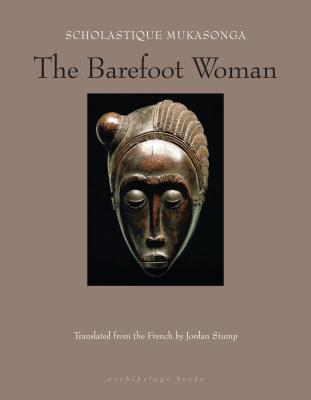
WITMonth Day 21 | The Barefoot Woman by Scholastique Mukasonga | Minireview

Some of you might remember that I'm quite a fan of Scholastique Mukasonga's writing. In fact, I still cite Cockroaches as one of my absolute favorite books of the past few years. It's a powerful gut-punch of a memoir, beautiful and heartbreaking and essential all at once. While I certainly liked Our Lady of the Nile (Mukasonga's earlier-translated novel), it has not had the same sort of lasting effect that has turned Cockroaches into one of my favorite books. It was obvious to me that I'd have to read Mukasonga's newly released The Barefoot Woman, though I kept reminding myself that it would likely not hit me to the same degree.

And, indeed, it didn't, in exactly the way I expected. The Barefoot Woman is far from a bad book or mediocre memoir; on the contrary, it's quite good. Slim, concise, and achingly real, The Barefoot Woman recounts Mukasonga's memories of her mother Stefania and her childhood home. Through her mother, Mukasonga describes details of Rwandan - Tutsi - life. There's a cultural reckoning here, alongside deeply personal and traumatic memories. It's hard not to recognize The Barefoot Woman as that combination of powerful and beautiful.

It's important to come into the memoir knowing that The Barefoot Woman is not seeking to replicate Cockroaches. While touching on similar themes and addressing Mukasonga's own past, The Barefoot Woman feels like it's much less about the Tutsi genocide than it is about the Tutsi. Often, it is more specifically about Mukasonga's mother - focused, directed, and intimate. It's neither a sequel nor a prequel to Cockroaches; at best, this could be called a companion piece, but truthfully it felt like it deserves its own space. It's a very different sort of book, at once more mainstream in its humanity and yet unique in its internal conflicts. I can't say that this had the same effect on me as Cockroaches, but it remains a very good memoir, well worth reading.

Monday, August 19, 2019

WITMonth Day 19 | Awu's Story by Justine Mintsa | Review

For a book that's not even 100 pages long, Justine Mintsa's Awu's Story has a surprisingly long introduction. Clocking in at 24 pages (not including references), the University of Nebraska Press translation into English solidly leans into the idea that a short story can have a major impact. Unfortunately, like the introductions to many modern (and not-so-modern...) classics, translator Cheryl Toman's extensive (and fascinating) introduction also tackled some of the plot points in the book. Luckily, I've already learned to merely skim introductions for author-specific information and only read it fully after finishing the book itself. I advise other readers who prefer to go into the story with a clear mind to do the same.

And oh boy, do I advise readers get their hands on this book. Slim, yes, but Awu's Story packs major punch in such a brief space. The writing style is simple throughout, very direct and clear-eyed. Pieces of the story that feel unaddressed are almost all addressed more fully later. The book tackles huge subject matters, from ordinary village life, to family relationships, to love, to child pregnancy, to grief, to tradition... yet none of these feels out of place or dominant. With the exception of a single, somewhat rushed "payoff" scene near the end, the book largely feels like it earns its emotional beats.

To be honest? I kind of loved Awu's Story.

I mean, I guess I shouldn't sound so surprised or dismissive. There's nothing in Awu's Story's marketing or framing to suggest I shouldn't love it. On the other hand, there also isn't much to suggest it would hit me much beyond "oh this is a good book". Except Awu's Story really does end up feeling different, both in terms of my outsider view of Gabonese culture (of which, as you can imagine, I have limited exposure to) and just from a literary perspective. I have a mixed relationship with very simply written books, sometimes loving them and sometimes Awu's Story fell on the right side of that balance. The simplicity translated into straight-forward storytelling. The book progresses in a linear fashion; events happen one after the other and are cleanly described. The language is, by and large, direct. The one thing that bothered me a little bit was the dissonance between an older-style simplicity and occasionally very modern language (use of words like "hey" or "guy" in contexts that sometimes felt a little whiplash-y), but this too may have something to do with my expectations. It's also not really the point.

Awu's Story has a clear, progressing story, but it's hard to characterize this as a plot-based book. It is, as the English title implies, simply Awu's story, following life from early marriage through to middle age. It is, to a large extent, a feminist story with several characters breaking with traditional gender expectations within the story (Awu included). Its overarching themes and messages are definitely present and not particularly quiet, but they also still feel somewhat in the background. It's a book that feels natural in a lot of different ways. And I really did just love it. It's a short read that feels totally rewarding and enlightening and narratively satisfying. No, this is not a particular cheerful book in parts and I definitely cried a little bit by the end, but it's lovely and powerful and I hope that a lot more readers get the chance to read this. Awu's Story is far from one of the more popular, mainstream books you're likely to get a chance to read, but... you should. Highly recommended.

Saturday, August 3, 2019

WITMonth Day 3 | Disoriental by Négar Djavadi | Review

I won't pretend that I didn't warm to Disoriental more slowly than I was expecting. Négar Djavadi's novel (translated from French by Tina Kovar) was hyped up for me to such an intense degree that I was extremely hesitant to begin reading it. How does one go about reading a novel that everyone has loved, knowing that you always end up with opposing opinions? This time, I can safely say that I did not emerge with a contrary opinion. While it took me about 100 pages to really get into the rhythm of Disoriental, once I did it was hard for me to get out. The book builds slowly, but it builds, pulsing through until a thoroughly satisfying ending.
Reading Disoriental at a rainbowed Grand Canyon

Disoriental tells multiple stories at once, but I'm not sure it's quite the story that the publisher blurb advertises. In fact, I again find myself wondering who wrote the blurb and to what end. The suggestion that this book is a sort of wide-reaching epic, told from Kimiâ's perspective ends up feeling off. Not that Disoriental isn't a wide-reaching story, but Kimiâ - unnamed for a significant portion of the story - hardly features in its first half. As we alternate between Kimiâ's stories of her family history and her own vague, at-present presence in a fertility clinic (why? how old is Kimiâ? where is her partner?), we get a fairly deep exploration of Iran's history and culture.

The imbalance in the narrative is probably what threw me off at first. Last year, I read an Israeli novel מטבעות הזהב של סנובר חנום (roughly translated as Sanober Khanum's Gold Coins), which is a multi-generational story of a Jewish-Iranian family, spanning their origins in northern Iran to their migration to Tehran, and then their relocation to the US, the UK, and Israel. I liked the book a lot and the synopsis of Disoriental definitely reminded me of that novel. Disoriental's opening - mostly historical, distant, written in a deeply reflective style - made me feel like the book was just a little too similar. The writing was good, but it didn't quite mesh. The mysterious initial narration (who is Kimiâ?) made me feel like the book was missing something, not that it was building to something.

But Djavadi proves to be a far more capable writer than that. Indeed, Disoriental achieves that rare feat of growing so precisely that it neither feels like the shift came out of the blue, nor that it never actually lifted off. What's fascinating is that Disoriental is not a thriller by any means, it is simply... thrilling. While Djavadi leaves certain things unspoken until much later in the book (and I use that word deliberately, since it soon emerges that these are not exactly mysteries...), the revelations don't end up feeling like too much of a statement or a process. Kimiâ tells her story differently in different parts, which at first feels like a writing flaw, but soon emerges as one of the more effective means of storytelling at Djavadi's disposal.

Disoriental does a lot. Alongside its family epic (of a sort), it is still a mildly political novel, even as it also... isn't. Of course any novel that writes about Iranian exiles is inherently political, and yet that is never the focus of Djavadi's story. As the narrative jumps backwards and forwards through time, through loops and Kimiâ's meandering thoughts, a small piece of Iran's history does emerge. Sort of. At times. In pieces. (This is something that Kimiâ herself muses about, the nature of political stories and what makes a certain story inherently political. It's a topic that I tried to write about during WITMonth a few years back and I found myself practically punching the book in excitement as I read it in-text.

If the first part of Disoriental is very heavy on Kimiâ's family history, part two insists on making sure we know who exactly we're dealing with. Here, we learn about Kimiâ's own personal history, her childhood, her relationship with her parents and sisters, and her outlook on life. We learn about why she is in the fertility clinic (I prefer to leave this part vague, because I was actually unaware of the reason and quite enjoyed the gentle build until this question was answered). We also learn about the Event that Kimiâ's references throughout part one, the massive, life-changing event that reshaped her life and that of her family. And while it's sort of easy to guess what the Event might be and feeling like it'll just end up being another event that vaguely disappoints (as many of those earth-shaking central mysteries in novels often do), Djavadi surprises by not leaving the mystery ongoing for too long, nor by treating it as something it isn't. Its effect, after all, is focused on Kimiâ herself, creating a far more intimate effect than I expected.

This is how the book builds, and build it does. Even with two clearly defined parts (Kimiâ gently mocks the B-side, which details her story), it never feels like the story shifts in a dramatic way. Kimiâ's narration in particular keeps the story well-grounded and I grew to love her voice. By the time we actually get to know her properly, I felt deeply invested in her life and emotional state. As the second half gently shifts gears, I almost didn't notice how much I cared. It's at the novel's end that it suddenly hit me that I was all in. Which is a fairly effective way to tell a story, if we're going to be honest about it.

That's how all of Disoriental feels - effective. It's not a particularly long book, but it achieves so much, whether in terms of its storytelling technique or its character building or its use of omission and tension. The books works on so many levels by its end, I genuinely felt like I wanted to share it with a dozen more readers. And so I finish this review on that note: This is a wonderful book, well worth your time. Even if you start off a little rocky, like I did. Trust me: It's absolutely worth the journey.

Sunday, February 17, 2019

I am an uneducated feminist | Thoughts on Simone de Beauvoir's The Second Sex

I don't think I quite expected to be confronted by my ignorance to such a stark degree while reading The Second Sex, Simone de Beauvoir's classic of feminist literature. I am currently reading the version translated by Constance Borde and Sheila Malovany-Chevallier, slowly immersing myself in this book I had heard so much about in references, but had never actually read myself. I kept telling myself there would be no reason for me to actually read this "original", second-wave text; after all, I have read so much literature from future generations of the feminist movement. Right?

I'm not a new feminist, nor do I consider myself to be a young feminist. I have followed feminist discourse since my early teen years and I have even actively engaged in it through the women in translation project. Feminism is a key part of my identity and I have long made sure that I read plenty of essays and discussions about feminism. I have often found myself enlightened by online feminists, but almost as often exasperated or frustrated. At times, I've even been angry with mainstream, popular feminist writers and their writing. But I certainly never considered myself uneducated, nor did I think that they were uneducated.

It's hard to come away from reading The Second Sex and not wonder if perhaps many more of us are ignorant than I previously believed: ignorant of the history of feminism, of the literature, and of our own inflated sense of self-importance.

Early in The Second Sex, de Beauvoir writes about the ways in which being a woman is not the only determining factor in political views or approach: "women as a sex lack solidarity: they are linked to their classes first; bourgeois and proletarian interests do not intersect". The use of the word "intersect" immediately caught my attention. While the translation is modern, it seemed unlikely that the choice of this word was necessarily modern. In essence, it struck me that I was reading a clear reference to intersectional feminism, years before it was canonized as a term by Kimberlé Williams Crenshaw. de Beauvoir actually has several discussions that are surprisingly parallel to modern intersectional theory, specifically in reference to the complex status that racial/ethnic minorities have in society (i.e. black people in the US, Jewish people in Europe).

I was surprised by these references, though I'm not sure why. Crenshaw is certainly the figure in truly establishing intersectionalism as a concept within the feminist movement, and her status as such should not be diminished. Rather, I use this example to point toward my own recurring ignorance of how prevalent certain ideas have been in feminist discourse long before they appeared on the internet in filtered, shallow versions. Furthermore, my own interest in this specific example emphasized that while I've seen Crenshaw - like de Beauvoir - referenced time and time again in online pieces or essay collections, I had never actually read any of her works or writing on the topic. It suddenly occurred to me that I had been reading watered down versions or reworkings of feminist theory, rather than the original.

There are a lot of things in The Second Sex that are outdated (and not just funny things, like references to Queen Elizabeth... singular, since in 1949 there had only been one). It's understandable that certain norms and psychological understandings would have changed over 70 years. The clearest example of de Beauvoir being a product of her time probably comes from her now-conservative interpretations of gender/gender roles and sexuality. Specifically, her writing would place her on the border of the modern definition of "transphobic", with a sort of closed-mindedness to the fluidity of gender identity that most modern feminists of her ilk have forsaken. The adherence to Freudian psychology similarly feels rather old, and certainly some of the studies are no longer relevant or have been disproven since de Beauvoir's time. She also has a bizarre tendency to over-cite male authors writing about women, as though these are more accurate than women's own accounts. These all make some degree of sense when taken as a product of de Beauvoir's time (and if we view her work as truly revolutionary), though it is still worth pointing out. Even as de Beauvoir goes out of her way to emphasize extremely progressive-for-her-times interpretations of gender roles or sexuality, there are still gaps or interpretations that have simply proven to be false. These, if anything, emphasize the ways in which feminist discourse has changed... and the ways in which it hasn't.

Because ultimately The Second Sex remains shockingly relevant to the modern reader. More than that, it often reads like a more critical, in-depth version of a feminist blog. Topic after topic strike me as those which I still see being discussed today, even if the specific references and studies cited have changed (thankfully). Which makes me wonder... why are there so many feminist blogs of this sort, if it's already been written and analyzed? Some parts even left me embarrassed that I've tried to write about the same topics myself, yet it now becomes obvious that I was missing so much necessary context and history.

What strikes me while reading The Second Sex is that many pop-feminists are just as uneducated as I am. The uncomfortable truth is, for all my "feminist stripes", I've actually never engaged with the canon before this. Yes, I've read plenty of the fictional feminist canon (e.g. The Handmaid's Tale, The Bell Jar), and I've even read Bad Feminist (though some of you may recall what my opinion on the book was...), but I've actually read very little of the canon. Most of what I read of feminist literature is actually regurgitated online pop-feminism, and while this has benefits of a sort, I was thoroughly misled to believe that it was ever enough.

What do I mean by this? Take discussions of "intersectionality". Most online posts that discuss the importance of intersectionality (and I include my own blog here!) do so from a vague, hand-wavy perspective. We can all cite Crenshaw as the originator of the idea because just about every blog post has ever referenced her (almost furiously), but we rarely discuss what it actually means. I've seen countless arguments that center around the idea that intersectionality (or, indeed, intersections) can only refer to the intersection between race and another marginalization: namely, that since it was initially used to describe the intersection between race (specifically, being black) and gender (female). This is an odd claim when it is evident that the concept of intersectionality existed long before the phrase became popularized by Crenshaw. Again, this is not to take away from the importance of Crenshaw's writing (especially since her work focused on the black experience specifically, which is still too often ignored!), but it does remind me how easy it is to reference existing work that you (I) have never actually read or studied and moreover to reference it without any of the work that actually went into the original research/theory.

This is far from the only example. In her chapter on motherhood, de Beauvoir dedicates a great deal of time and words to describing the hypocrisy of contemporary abortion policy. It is almost identical to something that we might read today, with the only major difference being that abortion is somewhat more freely available today (somewhat). Yet her descriptions of the limitations placed on it and the moralistic arguments against it could just as easily have been posted to The Guardian last week. I've always felt vaguely uncomfortable with the way that many feminist columns or blog posts feel similar to each other; many popular feminist writers will want to place their own stamp on a certain topic and will write about it, even when it has been explored by other writers. This is not inherently wrong (since personal experience can obviously shape interpretation, and more feminist writing means more exposure to feminist thought!), but it leaves me feeling as though many writers are only constantly rehashing existing ideas rather than exploring new concepts. The Second Sex has made me feel that even more strongly, with the sense that when we have these discussions, we're forgetting for how many years feminists have already been writing about these same concepts (and often with far more depth).

I'm not quite done with The Second Sex yet and I still hope to write a review of it more fully. This, after all, is not a review. I'm not even sure it's a fair assessment of modern feminism, rather than disappointment in my own ignorance. To be perfectly honest, I'm suddenly wondering whether I even have the stripes to be able to comment on pop-feminism - is that even a thing? Have I simply misunderstood what most of the feminist writers I've been reading for years have been trying to tell me?

Here's the bottom line: I like how extensive The Second Sex is, but it's not the compiled nature of the book that makes it important. If a feminist were to focus an entire book on a topic that de Beauvoir covers in only one chapter, it would not make it a lesser work simply because it is shorter/covers fewer topics. Rather, it occurs to me that it's the pseudo-academic style that de Beauvoir utilizes that has been missing from most of the works I've read. While I often disagree with the literal sources that de Beauvoir cites (and occasionally thinks she cherry-picks anecdotes without acknowledging contradictory experience), she is still casting a wide net. She references literature, memoirs, and scientific studies. de Beauvoir is not simply reworking existing ideas through the lens of their existing context, she is compiling a comprehensive study of a wide range of topics as though from scratch. (And do I really know whether this was from scratch? Clearly many of these topics had already been widely discussed...)

It took me a long time to read The Second Sex in large part because I mistakenly assumed that I didn't need to read it. There are few topics that de Beauvoir has covered so far with which I have not already been familiar. Most of the ideas that she cites that I didn't know are ones that are clearly outdated. But that just isn't what makes the book important. At the end of the day, this is a bit like the sciences: I might read a review of a topic in order to generally learn about it and the most recent updates in the field, but if I really care about it, I'm going to have to read the source papers that the review cites.

It's time for me to read the sources.

Thursday, August 9, 2018

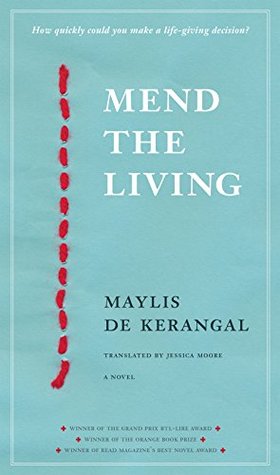
WITMonth Day 9 | The Heart by Maylis de Kerangal

When I bought Maylis de Kerangal's The Heart (translated as Mend the Living in the UK), I had only one impression of the book - this rare negative review from Tony Messenger's blog, that described the book as poorly written, boring, and filled with bizarre writing choices. I hesitated before buying The Heart for this reason, but ultimately my curiosity got the better of me... and the fact that the book was in the bargain bin and being sold for only $4 in the hardcover.

I started reading The Heart late on a Saturday night, intending to read only a few pages to get the taste of it. I fully expected to be disappointed - after all, a reader whose tastes and reviews I quite trust seemed to dislike it so much! - but as I read those early pages, I found myself instantly swept up in the rhythm. I had to force myself to stop reading after those first few pages in order to go to sleep.

It was somewhere in the middle of the night that a thought struck me: The Heart read like a millennial had written it. Or at least, it sounded somehow "millennial" to me. It sounded like how my writing would sound, if I wasn't just writing bad reviews on a sub-par blog. The pacing and the styling and rhythm and the almost loopy thinking... they all felt like they would be perfectly at home on a Tumblr post responding to some vague, random prompt. The writing felt like something many of my friends might write. And I liked it.

As I progressed in the novel, I discovered a few more interesting points of contrast between my interpretation and Tony's. Portions that filled in a minor character's backstory felt like little side-quests, rather than pointless distractions. The constant shifts in perspectives felt like a necessary way to describe the whole. As the story spun around Simon (whose heart is in question), I felt like I was growing to care about his world, if not him specifically.

The Heart, at its core, is a novel of the characters who surround Simon. It focuses to a significant degree on his mother Marianne, but as the narrative shifts from Simon's injury to Simon's death to Simon's "rebirth", so too does the focus, to the doctors treating Simon and eventually also those who wish to save other lives using his organs. It feels like a novel built of negative space; Simon is at The Heart's center, but he does not really exist within it.

There were a few things I outright disliked in The Heart. First, there is an odd objectification of women in a number of points throughout the book. There are full paragraphs that feel utterly unnecessary to either character development or story progression, particularly ones that focus on women. The novel felt sexist in places, which ended up throwing me out of the story more than once (though I managed to get back into it quickly, which was also pretty interesting). These are short, minor fragments, but they do cast a shadow on the book and prevent me from giving a whole-hearted endorsement (pun intended). I also found myself somewhat unimpressed by de Kerangal's constant descriptions of Simon's multi-racial background, with the fawning tone occasionally bordering a bit on fetishization. It may just be a cultural difference, but there was something about some of the descriptions that felt a bit off to me.

However, to the most important point: Perhaps you noticed that I skipped over an important bit of information at the beginning of this review. Where, you would be correct in asking, is the translator's name? Well, in the version that I read, the translator is Sam Taylor, who I think did a really great job of making the writing flow and keeping the book as engaging as it was. But when I went back to read Tony's review, I realized something interesting: the quoted passages did not match the ones that I had just read. In fact, the passages that Tony includes all felt awkward and stilted in portions compared to the gently rolling text I held in my hands.

It turns out that Mend the Living and The Heart are actually not the same book, exactly, instead being that (now rare) phenomenon of two distinct translations of a modern novel that were released at the same time in different countries. Mend the Living, despite having my personally preferred title, was translated by Jessica Moore. Though I have of course not read the entire translation, the contrast with the portions I read on Tony's blog make clear that Moore's translation creates a very different effect overall.

For example: In the passage describing Marianne's meeting with the parents of her son's friends (mostly uninjured in the accident that ultimately kills Simon), Moore's translation creates a very tight, stiff vibe. Lines like "the four of them are aware of how lucky they are, of their monster’s ball, because for them, it’s only breakage" feel like they are heavily crafted. Contrast that with Taylor's version: "all four of them are aware how lucky they are, how monstrously lucky, because their children are only a little broken". There are two main word-choice distinctions: "monster's ball" replaced with "monstrously lucky", and "it's only breakage" with "only a little broken". In both cases, I find myself preferring Taylor's word choice. Of course I have no idea what the original was, but the message here is clearly the same, as is the general style. Yet Moore's translation uses somewhat weird, rare words (breakage? monster's ball?), while Taylor spins the sentence to flow with an almost childlike appreciation. One of the translations feels like a very high-brow classic novel, while the other feels loose and modern.

Of course I am biased, having read only one of these translations and generally liked it, especially liking how fresh it felt and to my own generation's online writing style. But almost each of the examples that Tony cites sent me back to the pages of The Heart's translation, and appreciating how much smoother the text flowed there. It leads me to wonder what Moore's translation is like at large, particularly since this is a fairly rare example of a modern book having contrasting, contemporary translations. I certainly liked Taylor's approach, and appreciate it even more after comparing it to an alternative.

All in all, The Heart ended up surprising me. I fell in love with the writing style, I was (mostly) able to look past the weird/unnecessary/male-gaze-y bits, and I thought that the story was extremely moving on the whole. This is not the sort of novel to keep you on your toes, but it has its own sort of pulsing tension anyways. The end in particular felt like a thriller, as the tone and narrative largely move away from Simon. It's a book I wish I could have read in one sitting; even so, I am grateful that I read it at all.

Sunday, February 25, 2018

Dance on the Volcano by Marie Vieux-Chauvet | Review

Truthfully, Marie Vieux-Chauvet's Dance on the Volcano (tr. Kaiama L. Glover) feels like a few books in one. Here is a chunkster novel that tells the story of an individual woman, main character Minette, alongside an important portion of Haitian history. Like many books of this sort, Dance on the Volcano ends up feeling a little overwhelming at times (and a little poorly balanced between Minette's personal drama and the wide-reaching cultural implications of her personal life), but there's no doubt that overall this is a fine, fascinating novel and one well worth reading.

Dance on the Volcano sets its tone early. Minette, her younger sister Lise, her mother Jasmine, her effectively foster brother Joseph, and the entire cast of black (free) characters are swiftly placed in contrast to the island's whites. The plot begins with Minette (and her sister Lise, to a lesser degree) "discovered" by their white, Creole neighbor as the two teenage girls sing at home. Mme Acquaire is instantly in awe of their raw talent and decides to teach the girls in the early mornings, despite the general taboo against it. As Minette grows more and more talented, it becomes clear that her future is on the stage, and indeed Minette soon becomes an outright phenomenon as the first "colored" woman to sing on the white stage.

From here, Dance on the Volcano follows Minette's numerous struggles in becoming accepting as a successful stage singer. While there is little doubt at her talent, her color influences the entire conversation surrounding her art, indeed defining everything from her paycheck to her participation in particular concerts. Thus begins Minette's more general social awakening. Though still effectively a teenager, Minette begins to realize just how cruel the world around her is, simply on racial grounds. She learns secrets about her mother's past, she learns secrets about her brother's present, and she begins to wish for a more just world. She begins to fight for her own rights, using her immense talent as leverage against racism. She also becomes involved in efforts to rescue slaves, and to advocate (albeit privately) for their general emancipation. The story tracks much of Haiti's tumultuous history through Minette's eyes and experiences, often with tragic implications.

Curiously, another plotline begins to invade this already loaded story. Just as Minette begins her social awakening, she also experiences a sexual awakening. This story is the least engaging (by far) of the many threads running through Dance on the Volcano, with a particularly uncomfortable message about sexual/romantic desire overwhelming Minette's own beliefs and values. Minette's black, slave-owning, slave-beating lover is presented as a complex character with contradictory aims and motives, but his violence and general awfulness as a person made it very difficult for me to care about their relationship or about him at all. There was a sense that this romance was supposed to somehow emphasize the complexity of Haiti's slave-owning past, yet it ended up feeling like a waste of space that could have instead focused on Minette's own growth.

This is not the novel's only flaw. The writing is simplistic and at times grating, with awkward transitions from very plain prose to a more lyrical style. It also occasionally felt anachronistic, with some sentences sounding outright modern and others sounding much more like they'd been written in the 18th century. This also ends up affecting pacing, in a way that makes it generally less pleasant to read the novel in longer chunks.

Yet even with its flaws, I found it hard to get Dance on the Volcano out of my mind. I can't say that I loved it, but I feel like I learned a lot from it. That probably says more about my own (lack of) knowledge about Haitian history, yet I appreciated how Dance on the Volcano framed it through Minette's personal lens. The plot density may have made reading more difficult and may have bothered me at points (again, the romance subplot), but it also gave me a lot to consider. Whether I think it worked on a literary level does not change the fact that it inspired me to think about the topic of more complex racial identities and contradictions.

All in all, Dance on the Volcano is certainly a book worth reading and one I am grateful to have read. And after years of having Marie Vieux-Chauvet's writing recommended to me, it makes me all the more eager to get to Love, Anger, Madness.

Monday, August 21, 2017

WITMonth Day 21 | Cockroaches by Scholastique Mukasonga

It's time to talk about what is probably the best book I've read in the past year: Cockroaches.

I haven't gotten around to reviewing Scholastique Mukasonga's novel Our Lady of the Nile yet, but in a sentence: I liked it enough that I bought Cockroaches (translated by Jordan Stump) soon after it came out. Our Lady of the Nile was the first book I'd ever read specifically about Rwanda, and I finished it feeling like I had learned a lot. It's a book that shrinks the Rwandan genocide down to a small scale, displaces it, and blurs it somewhat. It was an insightful, powerful novel. How wrong I was to think I understood anything.

Cockroaches.

I grimaced at the title. I loathe cockroaches. Silly as it sounds, I felt like the book was warning me somehow. Bad content here. Stay away. A warning that had little to do, it turns out, with cockroaches, and significantly more to do with the strikingly clean descriptions of utterly horrific events. This isn't surprising, of course. Cockroaches isn't about the bugs, it's about the humans that other humans deem lower than the lowest creature - simply cockroaches. It's about how humans strip other humans of their humanity and how they use this to justify genocide.

Prior to Cockroaches, the only other story I had ever encountered about Rwanda and the Rwandan genocide was Mukasonga's previously published Our Lady of the Nile. That's it. I had heard stories from family members who had been to Rwanda; one described the memorial museum as "a Holocaust museum, but with Tutsis instead of Jews". I kept thinking of that while reading Cockroaches. Pieces of the memoir felt so familiar, reminders of every Holocaust story I'd encountered in my childhood (and adulthood...), yet this is also very clearly the story of a completely different genocide.

Or rather, I should note, this isn't quite the story of the Rwandan genocide itself as much as it's the story of how Rwanda became a country in which the 1994 genocide could even occur. Mukasonga makes clear from the very first page of the memoir that her survival is the exception: The book opens with a painful dedication to all those who lost their lives and their families, and to "the few who have the sorrow of surviving". In my view, this is the line that captures the essence of Cockroaches. This is a beautifully written book that uses simple, clear writing while conveying a terrible, painful, and gut-wrenching reality.

There's more to it, of course. Mukasonga gives voice to her lost family, but she also builds an entire world around them. Mukasonga never lets the reader forget that the genocide - which technically occurred in 1994 - begins much earlier, with a series of smaller events and horrors. Genocide never occurs in a day. What begins as forced relocation turns into total extermination. First certain individuals. Later, everyone. The elderly. Children. Babies.

Cockroaches is not an easy book. It's short, yes, and Mukasonga writes simply. It's the sort of book you can read through within a few hours, but this is far from a quick, breezy read. This is a book that enters your soul. It feels like a cockroach has crawled under your skin, itching and burning as it burrows into you. It's personal, but not manipulative in its emotions. Mukasonga's survival sorrow rings powerfully, such that I cannot imagine a reader leaving this book unmoved. For this granddaughter of Holocaust survivors (and great-granddaughter, -niece, -cousin, etc. of Holocaust victims), the book felt like a necessary awakening to learn more about those horrors that I haven't been exposed to as much. It felt like an education. And it felt like a painful reminder of how absolutely easy it is for humanity to fail, and fail again.

To quote Mukasonga: "I wish I could write this page with my tears."

Tuesday, August 15, 2017

WITMonth Day 15 | Madame Curie by Ève Curie

When I found Madame Curie in a used bookstore, it felt like a sign. Not only was this a beautifully bound biography of one of the greatest scientists in history, it was written by her daughter Ève Curie in French (tr. Vincent Sheean). Marie Curie, a woman in translation. Quite appropriate.

Even so, it took me a long time to get around to reading this biography. In general, I find that I need more time and focus for most biographies (for most nonfiction overall, honestly), something that often clashes with my work demands and limited reading time. I love nonfiction, but I find myself reading less and less of it in recent years (for entertainment, that is; I read plenty for work...). Once I started Madame Curie, however, it took two focused sittings and I was done with the book. Enthralled by the life of this woman I have read so much about, yet ultimately know so little of.

Because yes, most of us know that Marie Curie was Polish. But how did she get to France? How did she fall in love with the sciences? What guided her to the places she reached, where she would eventually become infamous?

Curiously - or perhaps not, given that the biography was written by Curie's publicly adoring younger daughter - Madame Curie does not linger much on the traditional puzzle pieces or complexities one would expect from a biography. Most of the book details her personal life, rather than the professional aspect. Ève raises the sexism that Marie faced as a rare woman in her field, but doesn't really focus on it. I found this fascinating, since modern biographical pieces on Marie Curie (such as those found in almost every "Great Women in Science" or whatever types of collections) tend to emphasize this point, from an explicitly modern perspective. Ève doesn't do that. Yes, she acknowledges some of what Marie experienced, but she offers few interpretations of her own.

Overall, Ève Curie proves to be an interesting biographer, since she is also a character within the book. It is fairly odd to read a book in which the author alternates between referring to herself in the third person and a few paragraphs later, recounting the object of her book (in this case, her mother) through a personal anecdote. It creates a weird dissonance that I didn't always like.

However, I think it sort of goes without saying that Madame Curie is the sort of book you read with little regard for the technical writing. Not that it's bad, but I honestly wouldn't rank this as an especially good biography. It's a great piece of history, it's a great emotional assessment of a woman frequently reduced only to her science, and it's a lovely exploration of Marie Curie's life. There's something very warm about the way Ève writes of her mother, even if it at times feels like she's whitewashing her own history a little.

And of course... there's the content. I can't help but love this book for its content. I have admired Marie Curie for years, of course, not simply as a woman in the sciences, but also as a clear example of a woman who didn't let anything stand in her way. Yet the image I had in my mind seems to have been far from who Marie Curie really was. Rather than  the wunderkind I'd always imagined, a woman who did everything in her youth and spent years afterwards simply fighting the system, Marie Curie who got a Master's at 26 (like I expect to!) and married the great love of her life at 27 (what was once considered old!) and achieved her doctorate over several years. Instead of the mythical all-capable goddess of my imagination, Marie Curie instead appears as a totally brilliant human. A human like me, perhaps. With its focus on Marie Curie as a person and not just a scientist, Madame Curie gave me the hope that perhaps I too can someday be this sort of scientist. In this regard, I cannot overstate how emotional Madame Curie left me, feeling as though I had been given a small gift.

As I said, this isn't the most technically brilliant of books. But Madame Curie is nonetheless important. Ève's perspective is unique and at-times significant, besides which there are few full-length biographies of Curie from which to choose. Madame Curie is a lovely, if oddly informal (and non-academic) biography of an incredible woman. And it meant so very much to me.

Sunday, June 4, 2017

Abandoned and archived | Malentendu à Moscou by Simone de Beauvoir

According to my Hebrew translation of Simone de Beauvoir's Malentendu à Moscou (translated into Hebrew by Nir Ratzkovsky), this very short novella was "inexplicably archived by the author" and only brought to light in 2013. The edition tries to make a strong case for while this novella is worthy of resurrection or attention. I imagine that from an academic perspective, it's quite interesting. But from a literary perspective?

I abandoned the book despite being over halfway through its very slim frame.

At this point it becomes necessary to ask why. Why abandon such a short book in the first place? Especially when I was clearly so far into it? The answer is quite simply: I was over halfway through, and all there was to the story was a tension that suggested that I didn't want to keep reading.

The novella tells of an aging couple that goes to visit the husband's daughter from a previous relationship in Moscow. The alternating segments tell of each spouse's assessment of their life and situation in Moscow. They ruminate about growing older. They consider their relationship (separately). They think about their aching bodies and the alcohol they're drinking for dinner. It gets absurdly repetitive, coupled with a stunning lack of communication between the couple. This lends a growing tension that something is going to happen, as does the novella's title. It's just that at a certain point, I no longer cared. Let something happen! I won't stick around to read it.

Part of this is in the writing. As I said, there's a deep repetitiveness to their vacation. Daily walks, complaints, and contemplations that loop and loop with hardly any adjustments. And while I'm often a fan of repetitiveness as a literary tool, here it just wasn't supplemented with anything to give it meaning. It felt more like a writing exercise than a genuine unfolding story, and I could understand why de Beauvoir archived it rather than publish it. A story that started with a clear idea, but then got lost in endless meandering.

Hence: I have abandoned and archived it myself. Perhaps next time I should stick to the works de Beauvoir wanted me to read...

Tuesday, May 16, 2017

I Wish Someone Were Waiting for Me Somewhere by Anna Gavalda | Review

I read Anna Gavalda's French Leave way back in 2011, having picked up that slim novella at a Border's going-out-of-business sale (a tragic day for my childhood nostalgia of the bookstore giant, a great day for collecting lots of books for little money). I wasn't all that impressed with the book, to be honest, finding it somewhat boring and fragmented in a not-exactly-enjoyable way. Even so, I would end up buying Gavalda's I Wish Someone Were Waiting for Me Somewhere (translated from French by Karen L. Marker) in 2014, during the first-ever WITMonth. And then it languished on my shelves for three years.


The truth is, I Wish Someone Were Waiting for Me Somewhere (hereby shortened to stories or this collection because the title is way too long) is a pretty great book. This short story collection was an exciting shift for me after a series of fairly disappointing single-author collections (in which style kept suffocating innovation or intrigue), largely because it is both delightfully short and wonderfully varied. Gavalda has a distinct enough style in each of the stories, but she plays around with different explorations of similar themes. Most of the stories are written in fairly conversational styles, but they managed to sound different and their topics varied widely enough that it didn't feel like I was rereading the same story again and again (as I had occasionally felt with Gail Hareven's most recent short story collection People Fail).

The stories range from young adult antics, to sexual escapades, to lost loves, to public tragedies, to rape, to anxiety, and more. While some of the stories made me roll my eyes (see: young adult antics), others had me on the edge of my seat, and others still had me crying softly for five minutes after the story ended. Enough of the stories wormed their way into my brain, touching me emotionally in a way that not all short stories are able to. Some just made me laugh.

The conversational, first-person will likely not be to every reader's taste. Neither will the sharp contrast between Gavalda's sly stories and the more emotionally daunting ones. To a certain degree, the uniformity of writing style compensates somewhat for the tone shifts between stories, but there remains an undercurrent of cynicism that seems to pervade every story, like Gavalda is highly aware of how her own voice is mixing with that of her characters. And while I hadn't really enjoyed it with French Leave, the brevity of these stories made sure that nothing got bogged down or too tangled. The stories don't feel especially long, but they're not quite brief either - that sweet spot of being "just right". For readers not opposed to conversational short-storytelling, this one is warmly recommended.