This is probably the greatest video I've ever seen (book related and otherwise). (hat tip, A Momentary Taste of Being)
"A Wrinkle In Time" In 90 Seconds from James Kennedy on Vimeo.

Tuesday, January 18, 2011
Monday, January 17, 2011
It should be called "Science Literature"
In a post about 2011 reading goals, Space Station Mir mentioned something worth noting:
Like every genre, sci-fi and fantasy have a lot of crappy pulp and some awesome literature. That's how it works. Not everything is amazing, the vast majority sucks and we need to do the dirty work of finding what we like, what we can call good, and we ought to give to others. So I'd like to be able to give Space Station Mir (and all other readers out there) a hand.
The goal is simple: to name (and justify) 20 powerhouse science fiction or fantasy or bizarre or non-standard-"literature" books that I feel definitely fall into the literature category ("Science and Fantasy Literature" - or SAFL). Maybe I'll even discover some good books along the way.
...I would like to dedicate most of it to fantasy and science fiction. I feel that I haven't been reading enough of the two genres that have often brought me the most pleasure and I am also on a mission to discover more high quality writing in the genres. [...] I hope to be able to pinpoint 10-20 science fiction/fantasy books that I would also consider literature.When I think about it, this sentiment ties into everything that's sad about these two (albeit different, but inexplicably tied) genres. For many readers, these are genres that bring us pleasure. At some point, though, there seems to be this feeling that sci-fi and fantasy are genres that aren't serious and are not "literature". I don't want to get into the definition of literature, though. It's a subject that crops up often in my posts and book thoughts, but every time I try to define it, I find myself failing to do it justice. Still, I can try, perhaps, to explain why I get so frustrated when I encounter things like this. Ultimately, literature is made up of good books and who's to say you don't have books of this kind that happen to take place in outer space, or have magic in them?
Like every genre, sci-fi and fantasy have a lot of crappy pulp and some awesome literature. That's how it works. Not everything is amazing, the vast majority sucks and we need to do the dirty work of finding what we like, what we can call good, and we ought to give to others. So I'd like to be able to give Space Station Mir (and all other readers out there) a hand.
The goal is simple: to name (and justify) 20 powerhouse science fiction or fantasy or bizarre or non-standard-"literature" books that I feel definitely fall into the literature category ("Science and Fantasy Literature" - or SAFL). Maybe I'll even discover some good books along the way.


Friday, January 14, 2011
Stieg Larsson and the Ape
I just finished reading The Reading Ape's wonderful response/analysis of Joan Acocella's recent New Yorker piece on the popularity of Stieg Larsson's Millennium trilogy*, and I really can't recommend the Ape's post enough. The Ape does a great job of pinpointing specific answers to Acocella's question of why Larsson's books are popular, ranging from characters (the oft-cited Lisbeth) to packaging (reasonably attractive in almost every edition I've encountered) to the genre (popular around the world). I wanted to touch on a few other points.
 Firstly, I have to wonder at Acocella's approach. Props are given for Larsson's storytelling abilities, but not much more. Acocella is right to say that storytelling is not enough in carrying a book and making it "quality", but I wouldn't dismiss Larsson's writing so quickly. It's not splendidly beautiful, true, but the sometimes awkward bluntness has its charm, as though the grittiness is part of the story itself.
 Acocella should not dismiss storytelling quite so quickly, either. Larsson's books, whether because of marketing or actually because of superior talent, don't comfortably fit in the crime/thriller category. Perhaps I say this because these are genres I typically don't read, but the Millennium books do a good job of telling a story and not making the reader feel dumber for it. Part of it, as the Ape points out, is the setting. Distance a book from your own existence and that can make it seem all the more interesting.
 Then the most basic matter of all: the popularity issue. Acocella seems at times to dismiss the popularity because of a perceived sense of, for lack of a better term, crappiness. It's as though Acocella commits one of the greatest book-commenting crimes in existence: assuming something to be unequivocally bad just because you didn't like it. Therefore, the popularity is a mystery, when it's incredibly, incredibly obvious: people enjoy reading these books. I enjoy, on a very basic level, reading these books. Acocella seems so surprised that people like a book that fits into a popular genre, that's got a character most find to be pretty kick-[...] awesome, and that is definitely easy to read. "But it's a bad book!" Maybe, but other readers found it to be a lot of fun. And so: popular.
The article has a lot more to it than these points that the Ape focuses on. Acocella writes a lot about Larsson himself, mostly raising strange conspiracy theories about whether or not he could have written the books and commenting rather casually on his personal and political lives (but in a very limited, carefully selected manner). It's an interesting article, but rather unsatisfying. Read the Ape's take on it instead.
* It should be noted that I have read only the first two books in the series, and neither was read in the English translation. In the interest of keeping this blog spoiler free, please refrain from mentioning anything from the second two books. Thank you.
 Firstly, I have to wonder at Acocella's approach. Props are given for Larsson's storytelling abilities, but not much more. Acocella is right to say that storytelling is not enough in carrying a book and making it "quality", but I wouldn't dismiss Larsson's writing so quickly. It's not splendidly beautiful, true, but the sometimes awkward bluntness has its charm, as though the grittiness is part of the story itself.
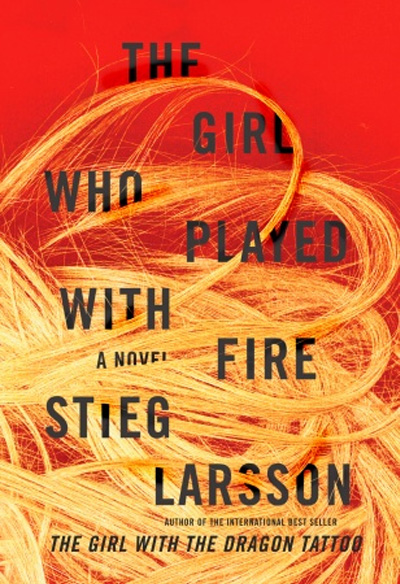 Acocella should not dismiss storytelling quite so quickly, either. Larsson's books, whether because of marketing or actually because of superior talent, don't comfortably fit in the crime/thriller category. Perhaps I say this because these are genres I typically don't read, but the Millennium books do a good job of telling a story and not making the reader feel dumber for it. Part of it, as the Ape points out, is the setting. Distance a book from your own existence and that can make it seem all the more interesting.
 Then the most basic matter of all: the popularity issue. Acocella seems at times to dismiss the popularity because of a perceived sense of, for lack of a better term, crappiness. It's as though Acocella commits one of the greatest book-commenting crimes in existence: assuming something to be unequivocally bad just because you didn't like it. Therefore, the popularity is a mystery, when it's incredibly, incredibly obvious: people enjoy reading these books. I enjoy, on a very basic level, reading these books. Acocella seems so surprised that people like a book that fits into a popular genre, that's got a character most find to be pretty kick-[...] awesome, and that is definitely easy to read. "But it's a bad book!" Maybe, but other readers found it to be a lot of fun. And so: popular.
The article has a lot more to it than these points that the Ape focuses on. Acocella writes a lot about Larsson himself, mostly raising strange conspiracy theories about whether or not he could have written the books and commenting rather casually on his personal and political lives (but in a very limited, carefully selected manner). It's an interesting article, but rather unsatisfying. Read the Ape's take on it instead.
* It should be noted that I have read only the first two books in the series, and neither was read in the English translation. In the interest of keeping this blog spoiler free, please refrain from mentioning anything from the second two books. Thank you.
Saturday, January 8, 2011
Still important
 |
| Still powerful, three years later |
"It's a book for boys and girls alike, teens and adults, readers and non-readers. Even as some don't appreciate it as I do, I think what's special about Asher's novel is that you leave it with a new understanding for a lot of things that you may never have thought of before."Since writing these words, I've read many many many reviews and write-ups about Thirteen Reasons Why. A lot of readers felt much as I did. Many, though, did not. There were readers who disliked the "blame game" angle of the book (also mentioned in my original post), readers who felt that the writing was sensationalist and unrealistic, readers who did not connect with the characters... and so on and so on.
A few weeks ago, I reclaimed Thirteen Reasons Why after having lent it out for about a year and a half (it sadly returned unread, though). My first move was to crack open the book from the beginning and read it straight through. Even though I knew the story from start to finish, remembered most of the individual stories and was more critical of the writing style than I had been the first time around (when I was of an age better suited to read the book), I found that I was still very affected by Thirteen Reasons Why.
I don't know why I expected to be disappointed by Thirteen Reasons Why, but I did. And so I'm glad I was disappointed by my lack of disappointment, that is pleased with how the book is still excellent and important in all the ways I remember.
Monday, January 3, 2011
Wolf Hall
 |
| Extraordinary |
One advantage Wolf Hall has over many other historical fiction texts (other than the excellent writing of Hilary Mantel, which is certainly going to lead me to read more of her books, though I need to remember to keep my expectations reasonably low...) is that Mantel takes a character previously shown in negative light (think A Man for All Seasons) and makes the reader absolutely, completely and totally fall into step (or love - whatever) with him. By the end of the book, I wanted nothing more than for Cromwell to manage my own affairs and then clap him on the back and say, "Well, if you're pretty much best friend/truster advisor to the king... I'm sure you can be best friends with me!"
It's not just Cromwell, though. It's the human way Mantel portrays everyone - the positive and negative sides of Henry VIII, Wolsey, Catherine, Anne and many other historical figures I've only ever encountered very vaguely. This isn't a historical text, to be certain, but it's not the typical historical fiction novel either (romance filled and, with no offence to good historical fiction, lame). It's refreshing.
The main criticism I'd encountered of Wolf Hall before reading it (and the one that made me hesitant to approach it) was the label "dense". While reading Wolf Hall, I understood where readers might get that impression, even if I did not. The book is long, certainly, and packed, but "dense" in my mind means heavily packed to the point that it does not flow well. Wolf Hall flowed. It positively bounced. Whether in the intensely entertaining scenes of historical relevance, or the simply brilliant dialogue, I wanted nothing more than to continue reading the book. And also finish it.
It's true that it's been a long, long time since I've read a good historical fiction book. Or a good classic. Wolf Hall appealed to me on both those fronts, in the weirdest of ways. It's a book that feels modernly old-fashioned, historically contemporary, and all-over well-crafted. It's a book that's truly "extraordinary" - not quite like anything I've ever read and most highly recommended.
Saturday, January 1, 2011
When an era is not a year
Last year I mentioned my increasing boredom with end-of-the-year lists. I mentioned my main dislike of them. I did not mention an additional unease I have with them: what exactly is a reading year?
Despite my online presence, reading for me is something entirely personal. It's marked by personal events, is dependent on personal emotions, and happens when I personally have the time for it. Our lives aren't dictated as much by years as we'd like to think, they're dictated by personal occasions and eras: when I had that job, when I went on that vacation, when I took that course, when this major change in my life happened...These time periods can be as short as a few days, or as long as several years.
I was reminded of this last year, when I was surprised to discover that my first book of 2009 had been The Master and Margarita. Until that point, when I'd tried to summarize my year, I'd been naming completely other favorites - and yet The Master and Margarita quickly turned into one of my all-time favorites. It was just read in a different time period so I kept missing it. The same applies to this year as well. The books I read during Sci-Fi Month (and in the weeks after) don't belong to this year - they belong to the era before February (and started in December 2009). Just like there is one book that belongs to the February era. And then dozens belong to the March through October era. And then the post-November era.
I couldn't give a top-ten list of the year. Or top five. Or even just top 1. Every small era that officially existed in 2010 (some rolled over from 2009, some will continue to 2011) is its own "year". The reader I was at that time was completely different, goals were set, reached and reset, and my reactions to some of these books were entirely altered by the personal settings I may have been in.
So I'm not looking forward to my 2011 "reading year". That does not exist. I'm eager to continue with my "Post-November" reading era, because so far it's had one spectacular book, two wonderful books and a few pleasant ones. I am not certain when this particular reading mood will shift, but I'm confident that 2011 (for all its worth) will contain some interesting reading eras.
*Happy 2011!
Despite my online presence, reading for me is something entirely personal. It's marked by personal events, is dependent on personal emotions, and happens when I personally have the time for it. Our lives aren't dictated as much by years as we'd like to think, they're dictated by personal occasions and eras: when I had that job, when I went on that vacation, when I took that course, when this major change in my life happened...These time periods can be as short as a few days, or as long as several years.
I was reminded of this last year, when I was surprised to discover that my first book of 2009 had been The Master and Margarita. Until that point, when I'd tried to summarize my year, I'd been naming completely other favorites - and yet The Master and Margarita quickly turned into one of my all-time favorites. It was just read in a different time period so I kept missing it. The same applies to this year as well. The books I read during Sci-Fi Month (and in the weeks after) don't belong to this year - they belong to the era before February (and started in December 2009). Just like there is one book that belongs to the February era. And then dozens belong to the March through October era. And then the post-November era.
I couldn't give a top-ten list of the year. Or top five. Or even just top 1. Every small era that officially existed in 2010 (some rolled over from 2009, some will continue to 2011) is its own "year". The reader I was at that time was completely different, goals were set, reached and reset, and my reactions to some of these books were entirely altered by the personal settings I may have been in.
So I'm not looking forward to my 2011 "reading year". That does not exist. I'm eager to continue with my "Post-November" reading era, because so far it's had one spectacular book, two wonderful books and a few pleasant ones. I am not certain when this particular reading mood will shift, but I'm confident that 2011 (for all its worth) will contain some interesting reading eras.
*Happy 2011!
Friday, December 31, 2010
5 quotes that serve as examples for why this book is incredible
The book in question: Wolf Hall.
Further information: This book will be finished by today. If I need to stay awake until tomorrow morning - I will finish this wonderful book to-day.
In no particular order:
Further information: This book will be finished by today. If I need to stay awake until tomorrow morning - I will finish this wonderful book to-day.
In no particular order:
1. [Cromwell to his son] "I once heard him say I looked like a murderer." Gregory says,"Did you not know?" p. 527It should be noted that only two of these quotes were pre-picked for this post. The remaining three were found just by opening the book to random pages. I suspect I could find an excellent quote from just about every page of this book. But that will be discussed a little later...
2. [following a Seymour family scandal, Cromwell to Anne Boleyn] "And the daughter? Jane, is it?" Anne sniggers. "Pasty-face? Gone down to Wiltshire. Her best move would be to follow the sister-in-law into a nunnery. Her sister Lizzie married well, but no one wants Milksop, and now no one will." p. 297
3. [to a newly married fifteen year-old who is not permitted to be with his equally young wife] "Be reasonable, my lord. Once you've done it, you'll want to do it all the time. For about three years. That's the way it goes." p. 518
4. So day by day, at his request and to amuse him, he would put a value on his master. Now the king has sent an army of clerks to do it. But he would like to take away their pens by force and write across their inventories: Thomas Wolsey is a man beyond price. p. 50
5. "Do you know what Chapuys is saying about you? That you keep two women in your household, dressed up as boys." "Do I?" [Cromwell] frowns. "Better, I suppose, than two boys dressed up as women. Now that would be opprobrious." p. 388
Wednesday, December 29, 2010
Book of the Month - really recommended?
It's not often that someone around me raises a bookish topic of discussion, but yesterday a question arose, one that got me thinking quite a bit. I was asked regarding an article that explained that when a bookstore has a list of "recommended reads", the books are not necessarily really recommended by the staff, that often these are simply books that publishers want to push. The well-read questioner was surprised by this and wanted to know if this was something well known.
My answer was, somewhat sadly, yes.
Publishers have their own reasoning behind what books they decide to massively publicize. I'm never going to be able to comment on what decisions are behind this but I can point out what I have noticed myself in this wide world. Look at Amazon's monthly recommended reads. Vine Members will easily be able to identify a large number of the books they were offered last month suddenly pumped and marketed as that month's "recommended reads". Really? Does staff at Amazon.com really think that these books are worth reading, or is it simply worth it for them to sell them?
One also notices rather quickly how sometimes rather well-established titles (by a few months) can make the lists. Why? Because the book has suddenly become popular (or has won an award) and is now worthy of being massively publicized. Recommended? Very possibly. Necessarily really the staff's recommended pick as best book of the month? No.
The original question posed to me was one born of innocence. When one is unaware of such publisher techniques, it's easy to believe that these are truly the "best" books. Imagine - most of us don't know a lot of things about the products we buy. The same can be said of the book industry. It's somewhat disturbing to learn for the first time that the books you buy based on bookstore (online or real, indie or giant) recommendations are mostly fueled by book exposure and publisher pushes.
Does this mean we stop paying attention to recommended reads? I don't think so. Good books make it to these lists. That's a fact. Not always, but sometimes. The lesson to be learned, though, is to take so-called "recommendations" with a grain of salt. Perhaps even several.
My answer was, somewhat sadly, yes.
Publishers have their own reasoning behind what books they decide to massively publicize. I'm never going to be able to comment on what decisions are behind this but I can point out what I have noticed myself in this wide world. Look at Amazon's monthly recommended reads. Vine Members will easily be able to identify a large number of the books they were offered last month suddenly pumped and marketed as that month's "recommended reads". Really? Does staff at Amazon.com really think that these books are worth reading, or is it simply worth it for them to sell them?
One also notices rather quickly how sometimes rather well-established titles (by a few months) can make the lists. Why? Because the book has suddenly become popular (or has won an award) and is now worthy of being massively publicized. Recommended? Very possibly. Necessarily really the staff's recommended pick as best book of the month? No.
The original question posed to me was one born of innocence. When one is unaware of such publisher techniques, it's easy to believe that these are truly the "best" books. Imagine - most of us don't know a lot of things about the products we buy. The same can be said of the book industry. It's somewhat disturbing to learn for the first time that the books you buy based on bookstore (online or real, indie or giant) recommendations are mostly fueled by book exposure and publisher pushes.
Does this mean we stop paying attention to recommended reads? I don't think so. Good books make it to these lists. That's a fact. Not always, but sometimes. The lesson to be learned, though, is to take so-called "recommendations" with a grain of salt. Perhaps even several.
Thursday, December 23, 2010
Bilinguals have it tough
Being bilingual has its downsides. I'll read a great book, look to share it with a world of readers and find that the book is, unsurprisingly, not offered in English. Unfortunately, one of the better books I've read in the last six months falls into this category. Though the author has actually been translated into English, I have only read his most recent novel from 2008 (and am currently reading a collection of short stories from several years ago). The author in question is Israeli author Amir Gutfreund, the not-yet-translated-into-English books in question are When Heroes Fly and The Shoreline Mansions.
Though When Heroes Fly is not a perfect book (way too long, random ending takes the book in a completely different direction, though I ultimately didn't mind too much), it's a winner. The book does what many modern Israeli novels try to do - show the development of the relatively young country alongside that of its characters. The children are conveniently born at such an age that they are meaningful ages for each of Israel's (many) wars - children for the victorious Six Days War, teens during the pain of the Yom Kippur War, and serving as soldiers in the 1982 Lebanon War. This puts them in the right place at the right time for many of Israel's major events, finally having them disenchanted or struggling adults in the more modern era.
Though I can easily find fault with the book (others have liked it a lot less than I), it's the kind of book that should be translated into English. Some good books can survive in their own languages just fine, but ones that do a good job of painting a portrait of their culture and nation deserve (to an extent...) the opportunity to spread that word. It's true that Israel is surprisingly well represented in the Anglo reading world, but it's disappointing that I have to wonder how long it will take Gutfreund's wonderful book to reach the Anglo-centric world. Our Holocaust is still in print (also - surprisingly) and seems to have been well received in the U.S. This makes me hope that the 667-paged heft of When Heroes Fly will reach readers soon.
In the meantime, I've started The Shoreline Mansions - and also stopped (for those wondering, this is the short story collection I mentioned a few days ago). Why would I set aside one of the best short story collections I've read in a long time? For the simple reason that I don't want it to end. I have stopped just about halfway, at the start of a story that has already caught my attention (and keeps nagging me back to the book). I was convinced that I needed to read more Gutfreund after loving When Heroes Fly - now five stories into this collection, I want to ensure that I have further Gutfreund before I continue. Our Holocaust seems like a good next destination.
And, thankfully, one I can discuss with you all.
 A treat from me to you: a translation of the opening of "Clocks", one of the short stories from The Shoreline Mansions. Gutfreund writes most of these stories from the side, having first person narrations telling the reader about the main characters. I admire his writing style and am impressed by how engaging it is. And the fact that the following story is not about the grandfather's death. So, for your reading pleasure, a small taste of this author's writing.
Though When Heroes Fly is not a perfect book (way too long, random ending takes the book in a completely different direction, though I ultimately didn't mind too much), it's a winner. The book does what many modern Israeli novels try to do - show the development of the relatively young country alongside that of its characters. The children are conveniently born at such an age that they are meaningful ages for each of Israel's (many) wars - children for the victorious Six Days War, teens during the pain of the Yom Kippur War, and serving as soldiers in the 1982 Lebanon War. This puts them in the right place at the right time for many of Israel's major events, finally having them disenchanted or struggling adults in the more modern era.
Though I can easily find fault with the book (others have liked it a lot less than I), it's the kind of book that should be translated into English. Some good books can survive in their own languages just fine, but ones that do a good job of painting a portrait of their culture and nation deserve (to an extent...) the opportunity to spread that word. It's true that Israel is surprisingly well represented in the Anglo reading world, but it's disappointing that I have to wonder how long it will take Gutfreund's wonderful book to reach the Anglo-centric world. Our Holocaust is still in print (also - surprisingly) and seems to have been well received in the U.S. This makes me hope that the 667-paged heft of When Heroes Fly will reach readers soon.
In the meantime, I've started The Shoreline Mansions - and also stopped (for those wondering, this is the short story collection I mentioned a few days ago). Why would I set aside one of the best short story collections I've read in a long time? For the simple reason that I don't want it to end. I have stopped just about halfway, at the start of a story that has already caught my attention (and keeps nagging me back to the book). I was convinced that I needed to read more Gutfreund after loving When Heroes Fly - now five stories into this collection, I want to ensure that I have further Gutfreund before I continue. Our Holocaust seems like a good next destination.
And, thankfully, one I can discuss with you all.
 A treat from me to you: a translation of the opening of "Clocks", one of the short stories from The Shoreline Mansions. Gutfreund writes most of these stories from the side, having first person narrations telling the reader about the main characters. I admire his writing style and am impressed by how engaging it is. And the fact that the following story is not about the grandfather's death. So, for your reading pleasure, a small taste of this author's writing.
Grandpa died. A man turns into memories.
In one moment, everything that would have been possible in a normal coming week will no longer be. From now until forever, the threads of our memories will escort us, one end at the moment of Grandpa's death and the other going with us, wherever we go. Grandpa will belong to us. With the years (they will come), the threads of our memories will get tangled, will tear, will rip. The memories we'll compare with each other in twenty years won't even resemble Grandpa.
Our mother doesn't cry. She sits on her chair in solemn clothes, gazing at the row of mourners.
The well-worn phrases -
"We liked him."
"Who would have believed?"
"He will be missed."
Sunday, December 19, 2010
Some days are for books
This weekend was the first in a long time that felt good for reading. True, I still haven't finished the collection of short stories I'd been reading fairly steadily the last week, but only because I don't yet have another book by the same author. I'm rather taken with the author - I'll finish only when I know I have where else to go to. Meanwhile, I read two fairly easy, enjoyable books over the weekend.
It's easy to dismiss easy reading. We often confuse "good" literature with "difficult" literature. It's not something so easily defined. It's not as if we say that any difficult book is excellent, but so many of the books we deem to be "classics" and "worth reading" are... difficult. Is it a backwards case? Do we comfort ourselves after reading difficult books, by saying that, "Well, it's a classic. It's an important read," or is simply that the more complex a book is, the better it is? Or none of the above? (probably the latter answer...)
I have nothing against hard books. True, it's easier to burn out when reading them, but there's a wonderful sense of reward when one finishes a long, complex book. I can't pretend I don't relish that feeling. And yet... sometimes a reader needs to relax. After months of struggling with reading (I've had little time or desire in the last two months to read very much, and as such I've read maybe 3 books), it's nice to get into a flow of reading.
Last weekend I began reading the lovely short story collection (I'll be writing more about it later, and will explain its anonymity) and reread a favorite book (that is still amazing - more on this later). I spent the week continuing to crawl through North and South, reading a few pages every evening. Finally, Friday and Saturday I sped through those two easy reads. Great works of art? Questionable. But they both helped clear my head and today I picked up the heft of Wolf Hall at the library. The librarian smiled as she handed it over and said, "This one needs to be back within the month. No renewals." Staring at the fat paperback as compared to my other (slim) choices I replied, "I guess I better start with it then..." We'll see how that plays out.
It's easy to dismiss easy reading. We often confuse "good" literature with "difficult" literature. It's not something so easily defined. It's not as if we say that any difficult book is excellent, but so many of the books we deem to be "classics" and "worth reading" are... difficult. Is it a backwards case? Do we comfort ourselves after reading difficult books, by saying that, "Well, it's a classic. It's an important read," or is simply that the more complex a book is, the better it is? Or none of the above? (probably the latter answer...)
I have nothing against hard books. True, it's easier to burn out when reading them, but there's a wonderful sense of reward when one finishes a long, complex book. I can't pretend I don't relish that feeling. And yet... sometimes a reader needs to relax. After months of struggling with reading (I've had little time or desire in the last two months to read very much, and as such I've read maybe 3 books), it's nice to get into a flow of reading.
Last weekend I began reading the lovely short story collection (I'll be writing more about it later, and will explain its anonymity) and reread a favorite book (that is still amazing - more on this later). I spent the week continuing to crawl through North and South, reading a few pages every evening. Finally, Friday and Saturday I sped through those two easy reads. Great works of art? Questionable. But they both helped clear my head and today I picked up the heft of Wolf Hall at the library. The librarian smiled as she handed it over and said, "This one needs to be back within the month. No renewals." Staring at the fat paperback as compared to my other (slim) choices I replied, "I guess I better start with it then..." We'll see how that plays out.
Tuesday, December 14, 2010
Homemade eCovers
Long story short: my operating system can no longer use Sony's eReader library program (and good riddance, too...), leading me inevitably to Calibre. By resetting my entire Reader to Calibre's way more convenient standards, I've been finding myself having a jolly good time with the new order. One aspect of this is finding covers for all my eBooks.
The problem is that almost all of the freely available fiction on the web (my only source for eBooks) is extremely old (thus the copyright has expired). A lot of these books don't have normal covers. Same for various free short stories and self-published stuff. This is where it gets fun. Books need covers. So what if there are no good options? Let me have a crack at it!
I don't have much (any) artistic talent. I don't have particularly complex picture editing programs. But here's a glimpse of some of the covers I've made the last couple of weeks, for your entertainment:
 My favorite homemade cover (original photo here):
And these two, that actually look a little like textbooks I've had in the past. It begs the question though, why I ever downloaded these books from Gutenberg... Picking out these pictures was cool, though (physics and chemistry), and it was plenty nice trying to decide exactly which color shade and font (sadly limited with the new operating system...) fit the book best.


This is fun.
The problem is that almost all of the freely available fiction on the web (my only source for eBooks) is extremely old (thus the copyright has expired). A lot of these books don't have normal covers. Same for various free short stories and self-published stuff. This is where it gets fun. Books need covers. So what if there are no good options? Let me have a crack at it!
I don't have much (any) artistic talent. I don't have particularly complex picture editing programs. But here's a glimpse of some of the covers I've made the last couple of weeks, for your entertainment:
 |
| Sci-fi/fantasy/other collection |
 |
| Favorite to make - short stories |
 |
| Mythology/folklore collection |
 My favorite homemade cover (original photo here):
 And these two, that actually look a little like textbooks I've had in the past. It begs the question though, why I ever downloaded these books from Gutenberg... Picking out these pictures was cool, though (physics and chemistry), and it was plenty nice trying to decide exactly which color shade and font (sadly limited with the new operating system...) fit the book best.


This is fun.
Wednesday, December 8, 2010
Distinguishable publishers
I respond to this New Dork Review of Books post about whether or not readers notice who publishes the book they're reading at a bit of a delay, but after starting to write a whole essay in the comments box underneath the post, I figured I should instead organize my thoughts properly and respond in kind.
Greg Zimmerman essentially wondered whether or not the publisher of the book you're reading affects whether or not you'll read it. It's a thoughtful, interesting post in which he concludes that there's one such publisher for him (McSweeney's), and later in the comments (after numerous readers named their own publishing favorites), that most readers have the one. Still, the ultimate conclusion seemed to be that readers don't actually pay too much attention to the publisher.
But I disagree. And I also agree.
Greg rightly raises the idea that readers can't name who published their favorite book of the year. This is true in the U.S. or Britain, where there are hundreds of publishers and publisher imprints to keep track of. It's true that most readers don't consciously pay attention to publishers. A reader won't reject a publisher because they're the same guys that published that piece of crap book last year. We're not aware enough for that. But to suggest that aside from one favored publisher we don't pay attention... I say: nonsense.
These are only three examples of publishers, but with each one it's fairly easy to identify the "brand" (so to speak). First up: Vintage. Easily distinguishable for me based on book shape, paper type and overall aesthetics, I have found that Vintage books are often good. And I have found that I'm also more likely to pick one up because of that previous sentence.
NYRB Classics: a little more obvious. This publisher makes certain its books all have the same general design and feel. Heavy cream paper, wonderfully distinct spines, brightly colored blurbs and titles and that most distinguishable title box on the front cover. So easy to spot on the shelf, even without the little trademark NYRB oval at the bottom. A 100% success rate with this publisher so far, and dozens of good words from various bloggers. How can I miss this one?
Lastly, one publisher that while not entirely identical in style (the way that NYRB books are...), every reader will always recognize. Who doesn't notice that small, often orange penguin peeking up at them from the spine? Who doesn't spot the placement of the penguin somewhere on the front cover, the words "Penguin Classic" stamped across the front, "Penguin Modern Classic" scrawled across the back, or even just the standard symbol glued anywhere on the cover? Always distinct, always obvious. You always know when it's this publisher, whether you like their translations and editions or whether you don't.
This game can be played with just about any publisher. The fact is that no matter what we tell ourselves, we recognize publisher brands. We typically know exactly who published a book as we hold it, turn its trademark pages, and bend its distinct cover. One only need look at how each reader has that favorite. And then another favorite. And then another.
Greg is right: most of us probably can't name the publisher of our favorite book from last year (actually, I can. Vintage: The Master and Margarita), but that doesn't mean we don't subconsciously care. I'll be more interested in anything NYRB or Open Letter publishes because I've had good experiences with them in the past. I know I love Oxford World Classics editions translations and annotations, even if their aesthetics aren't amazing. Penguin Classics can be a hit or a miss, but I do like Penguin's young adult imprints. Does this mean I'll buy every book by the publisher? Absolutely not. Do I take into account these things when debating whether or not to buy a book? Probably a lot more than I think.
A few more examples of easy-to-distinguish publishing houses:
Greg Zimmerman essentially wondered whether or not the publisher of the book you're reading affects whether or not you'll read it. It's a thoughtful, interesting post in which he concludes that there's one such publisher for him (McSweeney's), and later in the comments (after numerous readers named their own publishing favorites), that most readers have the one. Still, the ultimate conclusion seemed to be that readers don't actually pay too much attention to the publisher.
But I disagree. And I also agree.
Greg rightly raises the idea that readers can't name who published their favorite book of the year. This is true in the U.S. or Britain, where there are hundreds of publishers and publisher imprints to keep track of. It's true that most readers don't consciously pay attention to publishers. A reader won't reject a publisher because they're the same guys that published that piece of crap book last year. We're not aware enough for that. But to suggest that aside from one favored publisher we don't pay attention... I say: nonsense.
 |
| Vintage |
 |
| NYRB Classics |
 |
| Penguin |
This game can be played with just about any publisher. The fact is that no matter what we tell ourselves, we recognize publisher brands. We typically know exactly who published a book as we hold it, turn its trademark pages, and bend its distinct cover. One only need look at how each reader has that favorite. And then another favorite. And then another.
Greg is right: most of us probably can't name the publisher of our favorite book from last year (actually, I can. Vintage: The Master and Margarita), but that doesn't mean we don't subconsciously care. I'll be more interested in anything NYRB or Open Letter publishes because I've had good experiences with them in the past. I know I love Oxford World Classics editions translations and annotations, even if their aesthetics aren't amazing. Penguin Classics can be a hit or a miss, but I do like Penguin's young adult imprints. Does this mean I'll buy every book by the publisher? Absolutely not. Do I take into account these things when debating whether or not to buy a book? Probably a lot more than I think.
A few more examples of easy-to-distinguish publishing houses:
 |
| Open Letter |
 |
| Oxford World's Classics (old editions) |
 |
| Persephone Books |
Sunday, December 5, 2010
Young[er] folk
I don't know whether to be intrigued by this or disturbed by the potential for gimmicks (via Bookshelves of Doom).
I'm not saying there can't be young authors. I'm not saying there can't be amazing young authors. I've read some wonderful teen works (almost all have been shorter fiction - poetry and short stories), but it's rare. And anyways, that's what the internet is for. There's a lot to be said about teen authors, but right now I look at this story and feel uncertain. So I suppose this sounds like a cool, zingy idea for publishing, but boy does it also sound like one fat gimmick.
Medallion Press has started a new fiction book line called Ya-Ya, focused on “young adults writing for young adults.” The imprint will focus on authors aged 13-to-18-years-old. The line will publish books representing a variety of fiction genres in both print and eBook format.Huh. Much as I understand the desire of many young 13 year olds to get published and much as I hesitate to automatically dismiss young authors aged 17-18, I can't help feel like this is one grand-e gimmick, waiting to cash in. I know this may not apply to all, but it's kind of hard to write quality literature when you've barely even lived your life. More importantly, I think a large part of the creative process is the editing stage. If you're 13, chances are you haven't had much of an opportunity to mull over the "terrible" stuff (in your mind) you've written in order to fix and improve it. And that's a big part of what writing is.
I'm not saying there can't be young authors. I'm not saying there can't be amazing young authors. I've read some wonderful teen works (almost all have been shorter fiction - poetry and short stories), but it's rare. And anyways, that's what the internet is for. There's a lot to be said about teen authors, but right now I look at this story and feel uncertain. So I suppose this sounds like a cool, zingy idea for publishing, but boy does it also sound like one fat gimmick.
Friday, December 3, 2010
Pretty and pointless?
This is an interesting article:
Waldman isn't entirely accurate on one count: I don't think these novels are more likely to take place in foreign lands or be historical (those are separate genres that, true, are mostly defined by this kind of writing, but the writing is not exclusive to it). On the contrary. I think that a large portion of the so-called "literary" fiction genre is filled with this kind of writing. Gorgeous, flowing, positively enchanting... until you reach the end of the 400 paged book and have no idea what it was about, no connection to the flat characters, and no idea why this book has won dozens of accolades.
If this was rare, I'd forgive it. If it was obvious, I'd be even quicker to ignore it. The fact is, though, that this phenomenon repeats itself often... and we fall for it. Readers fall into these pretty, empty stories and it doesn't matter that there's little content and meat, we eat it up because we like the way the writing sounds.
Waldman's best point is made in the last paragraph: "Good writing can and should be beautiful, but it must never be only beautiful." Well said.
Though you won't find it in Webster's, there's a word to describe the kind of meticulously constructed writing that bores even its author. A "bore-geous" novel is one that is packed with gorgeous, finely wrought descriptions of places and people, with entire paragraphs extolling the slope of one character's nose, whole chapters describing another's perambulations through a city. These novels are often historical or set in foreign lands, their bore-geousness inspired by the author's anxiety about making an unfamiliar world feel convincing and true. It's not that the sentences aren't well-constructed, even lovely. They are. That's part of the problem. Bore-geousness happens when you are writing beautifully but pointlessly.I've never read anything by Ayelet Waldman - I cannot say if she writes bore-geously or if she does a good job of staying out of that pit. Still, I have to give her props for coining a wonderful term and also for pointing out a problem that I think is really hurting literature today.
Waldman isn't entirely accurate on one count: I don't think these novels are more likely to take place in foreign lands or be historical (those are separate genres that, true, are mostly defined by this kind of writing, but the writing is not exclusive to it). On the contrary. I think that a large portion of the so-called "literary" fiction genre is filled with this kind of writing. Gorgeous, flowing, positively enchanting... until you reach the end of the 400 paged book and have no idea what it was about, no connection to the flat characters, and no idea why this book has won dozens of accolades.
If this was rare, I'd forgive it. If it was obvious, I'd be even quicker to ignore it. The fact is, though, that this phenomenon repeats itself often... and we fall for it. Readers fall into these pretty, empty stories and it doesn't matter that there's little content and meat, we eat it up because we like the way the writing sounds.
Waldman's best point is made in the last paragraph: "Good writing can and should be beautiful, but it must never be only beautiful." Well said.
Monday, November 29, 2010
Before I revisit those mountains...
 |
| Did I hate or like this one? |
This voracious reader, well versed at the time in young adult appropriate sci-fi and fantasy books, was outraged. "What is this book?" I complained to the teacher. "There are so many amazing sci-fi and fantasy books out there, they have to pick this tacky, stupid looking book?" She sighed and nodded in agreement. "Yes, I really don't understand why we study this."
Retrospect tells me that my teacher probably disliked the book in part because I can't recall a single female character in it (so even if there were girls, fact is that I don't remember them!). A forgivable sin (to a degree...), but when teaching a class split half girls half boys, it really doesn't make sense to read a book like this. Then again, my complaints stemmed from an entirely different realm. I wanted to read books like The Giver again (I'd already read it at a different school the year before and had seen the impact it had on the class), or A Wrinkle in Time and books along those lines. What was this ancient book being thrust upon me? (Ancient being, of course, entirely in comparison to all my 10-11 years of life. Then again: 1967 publication year. Come on, guys.)
I remember a lot more from this book than I should. I remember some joke about "Jean-Paul" sounding like "Beanpole", evil tripods, steel caps... But I remember hating the book. Or at least saying I hated it. And then promptly reading the two sequels.
Here's where it starts to get fuzzy. Why would I read not one, but two sequels if I actively didn't like the book? I'm lead to believe that I probably liked the book reasonably enough (or was intrigued by the premise, or wanted to be friends with one of the characters - who knows), otherwise I wouldn't have bothered with sequels. It's strange though, the tricks memory can play on you. I look at the cover of The White Mountains (and subsequent sequels) and feel queasy. A hint at an ultimate disappointment? No, I remember being riveted at the end of the third book (by one particular, entirely spoiler-filled scene). Nausea due to the hideous covers? Hmm...
I'm looking forward to revisiting The White Mountains (and sequels). The fact is that I barely remember anything from them (some flashes here and there), so it's like coming anew. Maybe I'll see what my teacher couldn't as to why we read this over other sci-fi books (though I doubt it...). Maybe I'll find a great sci-fi classic. Or maybe I'll realize that I hated this book for good reason. We'll see.
Saturday, November 27, 2010
Good literature is not disappearing
I've discussed this in the past, but there's this myth in publishing (and in the literary world in general) that there was once a literary golden age and that we are now far away from it, in a world where literature is allegedly disappearing and that quality means nothing, all that matters is sales and profits. When I want to shoot this claim down, I always find myself lacking concrete ways to explain myself. Then I found this quote:
Except when you start to think about it a little more in depth, it makes no sense. Not that such a golden age could exist, but rather the realization that it hasn't. Not yet, at least. Or maybe it's been going on all around us. Or something like that.
My favorite example of this is in Of Human Bondage. Philip laments how Mildred reads trashy books. Based on the publication date of Of Human Bondage and Wharton's own time, I'd have to guess that she's referencing the bygone days that are sadly mentioned in Of Human Bondage. Not proof against a golden age, perhaps, but evidence. Hints. A nice reference point.
So generations of authors and readers have felt that an age of quality literature was coming to an end. Today we see the dawning of an eReader age and mark that as the doom of literature as we know it. I don't just mean books, I mean literature. I have read many a blog posts about how technology is ruining our ability to enjoy quality literature, how soon all books are going to be gimmicky or "enhanced eBooks", distracting us further with extras that aren't actually books. Who knows - maybe these fears are founded. But I for one doubt that quality literature will cease to exist (just as I don't believe that print books will ever disappear).
Is good literature getting hard to find? Maybe. Does that mean it no longer exists? Absolutely not. I may not read many new excellent super-hyped novels these days, but I have read several excellent new novels from around the globe in a variety of genres, regardless the praise and attention they've received. A reader just needs to know how to look. Just as we find numerous excellent books from the time Wharton complained about the death of quality literature, the next generations will find our gems. We need not stress so much.
"That view [that books must stand or fall on its own merit] is as extinct as the post-chaise and the packet-ship--it belongs to the time when people read books. Nobody does that now; the reviewer was the first to set the example, and the public were only too thankful to follow it. At first they read the reviews; now they read only the publishers' extracts from them. Even these are rapidly being replaced by paragraphs borrowed from the vocabulary of commerce. I often have to look twice before I am sure if I am reading a department-store advertisement or the announcement of a new batch of literature."Modern complaint? No, this would be from "Expiation" by Edith Wharton (a gracious tip of my hat to Levi Stahl of Ivebeenreadinglately for posting this). There are two fascinating points in the entire quoted passage Levi Stahl chooses to highlight. The first is what I have displayed above - the so-called golden age of literature and lovers of literature - and the other is the matter of publishing crap. Both stem from the same general idea that there was once this wonderful age for literature, where people read only the very best books and publishing was a glorious industry that fulfilled the wishes of its noble customers and that's how the greatest books ever were published. And they lived happily ever after.
Except when you start to think about it a little more in depth, it makes no sense. Not that such a golden age could exist, but rather the realization that it hasn't. Not yet, at least. Or maybe it's been going on all around us. Or something like that.
My favorite example of this is in Of Human Bondage. Philip laments how Mildred reads trashy books. Based on the publication date of Of Human Bondage and Wharton's own time, I'd have to guess that she's referencing the bygone days that are sadly mentioned in Of Human Bondage. Not proof against a golden age, perhaps, but evidence. Hints. A nice reference point.
So generations of authors and readers have felt that an age of quality literature was coming to an end. Today we see the dawning of an eReader age and mark that as the doom of literature as we know it. I don't just mean books, I mean literature. I have read many a blog posts about how technology is ruining our ability to enjoy quality literature, how soon all books are going to be gimmicky or "enhanced eBooks", distracting us further with extras that aren't actually books. Who knows - maybe these fears are founded. But I for one doubt that quality literature will cease to exist (just as I don't believe that print books will ever disappear).
Is good literature getting hard to find? Maybe. Does that mean it no longer exists? Absolutely not. I may not read many new excellent super-hyped novels these days, but I have read several excellent new novels from around the globe in a variety of genres, regardless the praise and attention they've received. A reader just needs to know how to look. Just as we find numerous excellent books from the time Wharton complained about the death of quality literature, the next generations will find our gems. We need not stress so much.
Tuesday, November 23, 2010
Divided over Daniel
 |
| Which plot is your favorite? |
Yeah, the one that most people think isn't so hot. Allow me to elaborate.
Daniel Deronda is not my favorite of the three Eliot novels I've completed thus far. It cannot compare to the concise excellence of Silas Marner. Not that it isn't very good as well, just that it's absolutely impossible to compare the two works (and I enjoyed Silas Marner a smidgen more...). There's something special about this fat novel, though. It is, to be quite frank, the exact opposite of Silas Marner. Where the latter is a small, compact book and perfectly sculpted, Daniel Deronda is overflowing, even bloated. More specifically, it's redundantly large in the eyes of many readers.
Daniel Deronda is one of those books with two entirely different plots going on within its pages: the Gwendolen sections and the Jewish sections. In the eyes of most readers, it's the Gwendolen story that holds the book. Commenter LilyDale over at the Guardian wrote almost 2 years ago the following (often echoed) statement:
"The problem is not that the Jewish sections are Jewish, it's that they're bad -- boring, didactic, unsubtle -- while Gwendolen's sections are some of Eliot's best work."The thing is, I don't really agree. Yes, Gwen's part of the book is the more dramatic one if looked at a certain way. It's got a lot more action, a lot more story and a lot more... well, drama. But it's Daniel's search for understanding in Judaism that makes Daniel Deronda an interesting book. It really is a bit of a slow read, but I must disagree: the Jewish sections are far from boring in the strictest sense of the word. Unsubtle, perhaps, but there is something fascinating in the blatantness Eliot gives that story.
I am well aware of the fact that part of my fascination with this book is my interest in Eliot's interest in Zionism and Judaism. It's easy to forget that the book was published in the 1870s, not that long before the Dreyfus affair and in the midst of Jewish integration in the general European world. Is the writing clunkier than Eliot's mastery in Silas Marner? Quite. Does it matter? Well... to many it does. As that old Guardian article points out, the book is a divisive one. Many readers express dismissal of the entire Jewish story, preferring Gwendolen's story by a wide margin.
There's so much to this book. Positive, negative... I can think of many parts that made me cringe, scenes that had me at the edge of my seat, and moments that made me wonder why it had taken me so long to get to George Eliot. It seems a shame that most readers would rather Daniel Deronda be something it is not - half the book and heavily edited. At the end of the day, it's a good book (or two books, depending on how you look at it...). Enough said.
For now...
Wednesday, November 17, 2010


Saturday, November 13, 2010
Memories
 |
| Forgotten and forgettable |
Frindle? Kid renames the pen a "frindle", right? A power struggle with the teacher? I think, not sure. Liked the book a lot. Love That Dog? Written in weird prose, I think, and absolutely terrible. Hated it. Donna Jo Napoli's books - each reasonably good, none that really jump out. Louis Sachar? Can pretty much do no wrong. Just Ella - some loophole at the end, no? Whatever - great story, a lot of fun.
Anybody sensing a pattern as to what is remembered here?
It begs the question, though: how well must we remember books? And what counts as remembering a book? As I read Madeleine L'Engle's An Acceptable Time (another sequel in the Time Quartet/Quintet/Trilogy, if Many Waters is excluded...), I once again felt that I must have read the book at some point (I do believe a friend lent it to me...), but I could not remember anything. Not one scene, not one moment. I remembered vaguely that there was a character who was kind of evil and that's about it. Turns out the book is still fairly forgettable, even nine years down the line.
An Acceptable Time is the exception. I couldn't remember anything about the book, but with so many other kids books, I can vaguely recall scenes and certainly how I felt about it. Place this alongside my strengthening memory of books I've read in recent years. Is the difference the time? I don't think so. Books I've read more recently I've also summarized and reviewed in my own personal journals (or online). I'm not surprised that I've forgotten these books, but rather that the emotions tied to them are so strong. The mind is a fascinating thing.
Friday, November 5, 2010
Lessons from L'Engle, part 1
One of the most influential books on my childhood was definitely A Wrinkle in Time by Madeleine L'Engle. I need only count the number of times a day I find myself thinking about the characters, the plot, the friend I grew close to due to our shared interest in L'Engle's Time Quartet, and various quotes from the book. Perhaps with the exception of Harry Potter (and perhaps even without!), no book has ever been so important to me. Certainly not in the same way.
A Wrinkle in Time influences how I read even today. Science fiction space travels? Dimensions? Time, space, shifts and moves... All of my understanding - all of my imagining - stems from one "children's" book. When I read nonfiction about dimensions and theories of the shape of the universe, it's L'Engle's world that comes to mind. L'Engle's was not the first sci-fi book I read, but it was the first to make me wonder how much of the book's content was actually true. Few books today inspire me so.
There is one scene in A Wrinkle in Time that I remember most vividly. It is not my favorite scene, it is not the most dramatic, and it's definitely not the best written, but it's the most interesting two pages I think I've ever read. The kids - Meg, Calvin and Charles Wallace - are receiving an explanation of the "tesseract". I won't spoil the surrounding scene (which, in addition to the quote below is curiously fascinating) for those who haven't read this excellent book (I encourage you, though, to run out and read it immediately!), but ultimately this is an explanation of plausible space travel in L'Engle's world.
A Wrinkle in Time influences how I read even today. Science fiction space travels? Dimensions? Time, space, shifts and moves... All of my understanding - all of my imagining - stems from one "children's" book. When I read nonfiction about dimensions and theories of the shape of the universe, it's L'Engle's world that comes to mind. L'Engle's was not the first sci-fi book I read, but it was the first to make me wonder how much of the book's content was actually true. Few books today inspire me so.
There is one scene in A Wrinkle in Time that I remember most vividly. It is not my favorite scene, it is not the most dramatic, and it's definitely not the best written, but it's the most interesting two pages I think I've ever read. The kids - Meg, Calvin and Charles Wallace - are receiving an explanation of the "tesseract". I won't spoil the surrounding scene (which, in addition to the quote below is curiously fascinating) for those who haven't read this excellent book (I encourage you, though, to run out and read it immediately!), but ultimately this is an explanation of plausible space travel in L'Engle's world.
"You see," Mrs. Whatsit said, "if a very small insect were to move from the section of skirt in Mrs. Who's right hand to that in her left, it would be quite a long walk for him if he had to walk straight across." Swiftly Mrs. Who brought her hands, still holding the skirt, together. "Now, you see," Mrs. Whatsit said, "he would be there, without that long trip. That is how we travel".As a child, I found these lines to be interesting. Cool, even, with the little drawings of hands bringing the skirt together. With time, though, the scene seemed to grow more and more. Today it stands in my mind as clearly as if I read it daily. The description following this scene, where the children are asked "What is the first dimension?" leading through to the fifth is uniquely L'Engle - though science discusses various similar topics on occasion, I have found that dimensions are always defined in my mind word for word as L'Engle described them. When reading Flatland (I have been slowly, slowly, slowly reading that small book, every month or so taking in a little alongside my other reads. Eventually I will finish it. Quite nice, actually.), my imagination kept showing me three children and three women discussing dimensions. The children are lines. The women are cubes.
Subscribe to:
Posts (Atom)