Friday, August 10, 2018

WITMonth Day 10 | Stats (part 2)

Introduction
Much as I love the cold, hard data behind the general publishing stats when it comes to women in translation (spoiler alert: I love very little about them), there's only so much that publishing can tell us. True, publishers are a fairly major gatekeeper when it comes to the existence of women in translation (indeed, perhaps the only gatekeeper... and the reason I'll be visiting this topic again later this month), but there are many stages from the moment a book is published to the point at which it reaches the reader.

One of these is literary publications and media. Much as we would love to think that nothing affects our tastes and interests, the fact is that marketing does work. This is certainly true of book marketing, with review outlets, bloggers, and the media at large playing a huge part in how books ultimately become hits or misses. Even among indie presses, the way a book is promoted can heavily shape the way it will be sold/recommended in the future.

And so I decided to again check the status of literary reviews, to see whether the situation has improved for women in translation since 2016 (when I last checked this metric). It's pie chart time!

Methodology
Journals and review sites were selected partially on the basis of visibility within the literary community and recommendations (not a particularly scientific metric, I know), as well as ease of data collection (i.e. chronological posting, well-labeled reviews). Due to the relative limitations in translation-focused literary reviews, this may lead to certain bias simply because of the smaller range of options. This analysis is not nearly as comprehensive as that of VIDA, but is inspired by their work. All assessments done manually, so of course there is the possibility that I have made some mistake - please let me know if this is the case and I will happily make any corrections!

Results

In 2016, The Guardian presented me with a bit of a conundrum. That was the year of Elena Ferrante, with several articles going back and forth as to her identity (remember that?) and her literary merits, and a time in which Asymptote Journal had a weekly feature in the "Fiction in Translation" tag. Ultimately, I found that of reviews, 22% had been of books by women writers in translation, even as the general Fiction in Translation tag had more features and pieces about women writers (30%). This year, the metric is flipped, with only 22% of the general features, reviews, and so on about women writers in translation, but among reviews alone, that number goes up to 29%. Neither percentage, I should note is particularly good. (I should also point out that I have a very strong suspicion as to why women writers are relatively better represented now in reviews - Nicholas Lezard who used to have a column in The Guardian's book pages no longer writes there, and that column featured perhaps three women over the course of the three two I looked at it...)

The reason I start with The Guardian now (and the reason I started with it in 2016 as well) is because I can think of no other newspaper with such a prominent literary review that easily and clearly labels its forays into translated literature, while also not having a paywall. More than that, The Guardian also prominently features online, is frequently shared, and is regarded quite highly as a general book page. Think of the exposure a book reviewed in the NYT or The Guardian has as compared to a book reviewed in a niche journal - the impact of widespread publicity is huge. That The Guardian is still reviewing and featuring so few women writers in translation in their pages is deeply disappointing.


I next looked at two of the major "niche" literature in translation journals, Words Without Borders (which I had checked in 2016) and World Literature Today. While neither journal has quite the reach of a site like The Guardian, they nonetheless have tremendous influence within certain spheres and represent a lot of the brilliant content related to literature in translation. Here, I was pleasantly surprised by review rates. While Words Without Borders does not publish nearly as many reviews as it does original translations or excerpts, it is still a commanding voice when it comes to literature in translation and perhaps the first resource that most readers think of when seeking voices in translation. That their reviews are solidly split between women and men writers is absolutely thrilling, particularly in light of their mediocre rates in 2016. WWB have long supported the women in translation movement and this support is not simply words, as is evidenced both by the numbers and the improvement over time. They have made an active effort to seek out women writers from all over the world, publish them at equal rate as men writers, and, it would appear, also review them at equal rates. This is wonderful.

World Literature Today, meanwhile, (which has significantly more reviews over the same one-year period) is a more complicated situation. 36% is the frustrating zone of "I see that you're slightly better than average, but is this really all I'll settle for?", where ultimately - this is still not a great rate, but it's just a teensy bit better than the industry standard of 30%. It's where WWB was two years ago. With a stunning 83 reviews over a one-year period (significantly more than any other review outlet I examined), WLT has tremendous potential to shift the focus to a more balanced playing field and give exposure to dozens of women writers in translation. I hope they improve on this matter in the future, following in WWB's footsteps.


The next tier was popular online reviews, sites clearly associated with literature in translation that also publish reviews, again ones that I had looked at in 2016. Here, neither result is particularly thrilling. Three Percent is the blog-arm of publisher Open Letter (and where I get all the amazing raw data for my publishing stat posts!), which itself publishes a fair amount of women in translation (but has never reached 50% in a single year I've counted, always clocking in somewhere between 30-40%). The dissonance between a blog praised for its role in the women in translation movement (by virtue of their database, and I'll admit that having gender added has made my life significantly easier than back in 2013 when I went through title by title and added author genders myself!) and a 17% rate of review of books by women writers in translation is jarring, and it should be, especially since that number reflects a significant drop from 2016's 31%. It indicates an additional gender bias beyond the publishing imbalance, one that I do not think reflects well on any publication or review.

And then again, we have a flip: Asymptote, which had a 22% rate in 2016, has now moderately improved that rate to 29%. Neither rate is particularly good, of course, and again there's this significant conceptual gap between how Asymptote present themselves in terms of the women in translation project and how they actually review books.


Finally, I took to Twitter to ask for recommendations of literary journals that review international titles. I ultimately chose three journals for my assessment (again, mostly based on scope, comfort, and accessibility): Latin American Literature Today, Literary Review, and Reading in Translation. None of the three presented with particularly thrilling rates of review, again serving as a disappointing reminder that the bias against women writers in translation (or women writers in languages other than English, more accurately) is pervasive and widespread. It's not a few bad apples; the entire orchard is tilted.

Discussion
I won't pretend that I'm not largely disappointed by rates that I see. Words Without Borders is a thrilling exception, but it should not be an exception. Having parity is not an unreasonable demand, nor is expecting literary journals to more carefully curate which books they promote. Considering the degree of unknown books I encountered in the last three entries (particularly the Literary Review, which included a lot of nonfiction) and how dominated literature in translation is by independent presses, this is not simply the fault of pushy marketing executives at corporate publishers. Every review we write is a choice of a single book out of hundreds published each year, and journals may choose whether they review significantly more works by men writers than by women. It may not be easy, but one simply has to look at WWB to see how it's done - no fuss, no issue, no grandstanding. Just interesting, thoughtful, and insightful reviews of books by women writers at equal rates as men writers. It's that easy.


Raw data


Thursday, August 9, 2018

WITMonth Day 9 | The Heart by Maylis de Kerangal

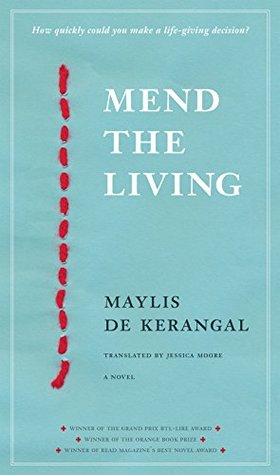
When I bought Maylis de Kerangal's The Heart (translated as Mend the Living in the UK), I had only one impression of the book - this rare negative review from Tony Messenger's blog, that described the book as poorly written, boring, and filled with bizarre writing choices. I hesitated before buying The Heart for this reason, but ultimately my curiosity got the better of me... and the fact that the book was in the bargain bin and being sold for only $4 in the hardcover.

I started reading The Heart late on a Saturday night, intending to read only a few pages to get the taste of it. I fully expected to be disappointed - after all, a reader whose tastes and reviews I quite trust seemed to dislike it so much! - but as I read those early pages, I found myself instantly swept up in the rhythm. I had to force myself to stop reading after those first few pages in order to go to sleep.

It was somewhere in the middle of the night that a thought struck me: The Heart read like a millennial had written it. Or at least, it sounded somehow "millennial" to me. It sounded like how my writing would sound, if I wasn't just writing bad reviews on a sub-par blog. The pacing and the styling and rhythm and the almost loopy thinking... they all felt like they would be perfectly at home on a Tumblr post responding to some vague, random prompt. The writing felt like something many of my friends might write. And I liked it.

As I progressed in the novel, I discovered a few more interesting points of contrast between my interpretation and Tony's. Portions that filled in a minor character's backstory felt like little side-quests, rather than pointless distractions. The constant shifts in perspectives felt like a necessary way to describe the whole. As the story spun around Simon (whose heart is in question), I felt like I was growing to care about his world, if not him specifically.

The Heart, at its core, is a novel of the characters who surround Simon. It focuses to a significant degree on his mother Marianne, but as the narrative shifts from Simon's injury to Simon's death to Simon's "rebirth", so too does the focus, to the doctors treating Simon and eventually also those who wish to save other lives using his organs. It feels like a novel built of negative space; Simon is at The Heart's center, but he does not really exist within it.

There were a few things I outright disliked in The Heart. First, there is an odd objectification of women in a number of points throughout the book. There are full paragraphs that feel utterly unnecessary to either character development or story progression, particularly ones that focus on women. The novel felt sexist in places, which ended up throwing me out of the story more than once (though I managed to get back into it quickly, which was also pretty interesting). These are short, minor fragments, but they do cast a shadow on the book and prevent me from giving a whole-hearted endorsement (pun intended). I also found myself somewhat unimpressed by de Kerangal's constant descriptions of Simon's multi-racial background, with the fawning tone occasionally bordering a bit on fetishization. It may just be a cultural difference, but there was something about some of the descriptions that felt a bit off to me.

However, to the most important point: Perhaps you noticed that I skipped over an important bit of information at the beginning of this review. Where, you would be correct in asking, is the translator's name? Well, in the version that I read, the translator is Sam Taylor, who I think did a really great job of making the writing flow and keeping the book as engaging as it was. But when I went back to read Tony's review, I realized something interesting: the quoted passages did not match the ones that I had just read. In fact, the passages that Tony includes all felt awkward and stilted in portions compared to the gently rolling text I held in my hands.

It turns out that Mend the Living and The Heart are actually not the same book, exactly, instead being that (now rare) phenomenon of two distinct translations of a modern novel that were released at the same time in different countries. Mend the Living, despite having my personally preferred title, was translated by Jessica Moore. Though I have of course not read the entire translation, the contrast with the portions I read on Tony's blog make clear that Moore's translation creates a very different effect overall.

For example: In the passage describing Marianne's meeting with the parents of her son's friends (mostly uninjured in the accident that ultimately kills Simon), Moore's translation creates a very tight, stiff vibe. Lines like "the four of them are aware of how lucky they are, of their monster’s ball, because for them, it’s only breakage" feel like they are heavily crafted. Contrast that with Taylor's version: "all four of them are aware how lucky they are, how monstrously lucky, because their children are only a little broken". There are two main word-choice distinctions: "monster's ball" replaced with "monstrously lucky", and "it's only breakage" with "only a little broken". In both cases, I find myself preferring Taylor's word choice. Of course I have no idea what the original was, but the message here is clearly the same, as is the general style. Yet Moore's translation uses somewhat weird, rare words (breakage? monster's ball?), while Taylor spins the sentence to flow with an almost childlike appreciation. One of the translations feels like a very high-brow classic novel, while the other feels loose and modern.

Of course I am biased, having read only one of these translations and generally liked it, especially liking how fresh it felt and to my own generation's online writing style. But almost each of the examples that Tony cites sent me back to the pages of The Heart's translation, and appreciating how much smoother the text flowed there. It leads me to wonder what Moore's translation is like at large, particularly since this is a fairly rare example of a modern book having contrasting, contemporary translations. I certainly liked Taylor's approach, and appreciate it even more after comparing it to an alternative.

All in all, The Heart ended up surprising me. I fell in love with the writing style, I was (mostly) able to look past the weird/unnecessary/male-gaze-y bits, and I thought that the story was extremely moving on the whole. This is not the sort of novel to keep you on your toes, but it has its own sort of pulsing tension anyways. The end in particular felt like a thriller, as the tone and narrative largely move away from Simon. It's a book I wish I could have read in one sitting; even so, I am grateful that I read it at all.

Wednesday, August 8, 2018

WITMonth Day 8 | Reading the world challenge (part 4)

Part 4, here we go! As always, remember that not every country is represented, nor that every country representation is necessarily in novel format! Links provided where I have them. Of course, if you have any recommendations for any of the missing countries (or missing languages), please let me know!

  • Japan (Japanese): Yoko Ogawa - Hotel Iris
  • Jordan - MISSING
  • Kazakhstan - MISSING
  • Korea, South (Korean): Bae Suah - A Greater Music
  • Korea, North - MISSING
  • Kuwait (Arabic): Fatimah Yousif al-Ali - "The Ringing Body"
  • Kyrgyzstan - MISSING
  • Laos - MISSING
  • Latvia (Latvian): Aspazija - Poems
  • Lebanon (Arabic): Hoda Barakat - The Stone of Laughter
  • Lesotho - MISSING
  • Libya (Arabic): Laila Neihoum - Poems
  • Liechtenstsein - MISSING
  • Lithuania (Lithuanian): Giedra Radvilavičiūtė - Those Whom I Would Like to Meet Again
  • Luxembourg (French): Anise Koltz - At the Edge of Night
  • Macedonia (Macedonian): Lidija Dimkovska - A Spare Life
  • Madagascar (French): Bao Ralambo - "Blastomycosis"
  • Malaysia - MISSING
  • Maldives - MISSING
  • Mali - MISSING
  • Malta (Maltese): lare Azzopardi - "Green Line"
  • Mauritius (French): Nathacha Appanah - The Last Brother
  • Mexico (Spanish): Cristina Rivera Garza - The Iliac Crest
  • Moldova - MISSING
  • Monaco - MISSING
  • Mongolia - MISSING
  • Montenegro - MISSING
  • Morocco (Arabic): Leila Abouzeid - Year of the Elephant
  • Morocco (Tashelhit): Mririda n-Ayt Attiq - Tassawt Voices
  • Mozambique (Portuguese): Paulina Chiziane - The First Wife
  • Myanmar (Burmese): Nu Nu Yi - Smile as they Bow
  • Nepal (Nepali): Jhamak Ghimire - A Flower in the Midst of Thorns
  • Netherlands, The (Dutch): Tonke Dragt - The Letter for the King
  • Nicaragua (Spanish): Gioconda Belli - The Scroll of Seduction
  • Niger - MISSING
  • Nigeria - MISSING
  • Norway (Norwegian): Hanne Ørstavik - Love
  • Oman (Arabic): Jokha Alharthi - Celestial Bodies
As you can see, there are still a lot of gaps in this list! Many countries and languages remain unexplored. As always, any recommendations are most welcome, especially since a full version of this list will eventually be published more conveniently. In the meantime, however... happy reading!

Tuesday, August 7, 2018

WITMonth Day 7 | 10 Recommended Nonfiction Books


Typically when we talk about women in translation, we focus on fiction. For me, this mostly stems from the fact that Three Percent database on which I base my statistics is fiction/poetry focused (and thus these are most of the titles to which I'm exposed!), and that I typically personally prefer reading fiction to nonfiction. That being said, nonfiction is a fascinating slice of literature and should not be forgotten! Women writers are often underrepresented in nonfiction writing overall (particularly when it comes to history, science, and politics), and certainly when combined with the women in translation gap, it's worth promoting a few nonfiction books by women in translation!

  1. The Second Sex - Simone de Beauvoir, tr. Constance Borde and Sheila Malovany-Chevallier: A classic of feminist literature that is often regarded as one of the foremost critical texts of the 20th century.
  2. Secondhand Time: The Last of the Soviets - Svetlana Alexievich, tr. Bela Shayevich: Not a Nobel Prize winner for nothing, Alexievich has long been praised for her oral histories, bringing in individual voices as parts of a breathing tapestry of living history.
  3. Turkey: The Insane and the Melancholy - Ece Temelkuran, tr. Zeynep Beler: A fascinating modern history of Turkey, its political turmoils, and hope for its future.
  4. Cockroaches - Scholastique Mukasonga, tr. Jordan Stump: A brutal, beautiful, and unforgettable account of the Rwandan genocide.
  5. Now and the at the Hour of Our Death - Susana Moreira Marques, tr. Julia Sanches: A unique account of end of life care, and the end of life.
  6. Tell Me How It Ends: An Essay in Forty Questions - Valeria Luiselli, tr. Lizzie Davis and Valeria Luiselli: Written across both English and Spanish, translated and retranslated, this extraordinarily timely account of undocumented children in the U.S. facing deportation looks to the heart of a problem too often dehumanized.
  7. What Are the Blind Men Dreaming? - Noemi Jaffe, tr. Julia Sanches and Ellen Elias-Bursać: Mother, daughter, and granddaughter each grappled - in her own words and language - with the memory of surviving the Holocaust, moving on and staying behind.
  8. In Other Words - Jhumpa Lahiri, tr. Ann Goldstein: The acclaimed U.S. author switches languages for a book-length meditation on language, translation, identity, and love itself. 
  9. In Praise of Black Women - Simone Schwarz-Bart, tr. Rose-Myriam Rejouis, Val Vinokurov, and Stephanie K. Daval: An encyclopedia of black women throughout history, spanning prehistoric queens through modern world leaders across several volumes.
  10. Translation as Transhumance - Mireille Gansel, tr. Ros Schwartz: Further meditations on translations as they relate to humanity, culture, and history.
Those are just a few nonfiction titles! As you might have seen, this list is incomplete - where, after all, are the women in translation writing about the sciences? Writers from Asia? From South America? No list will ever be truly encompassing, so help fill in the blanks! What are your favorite nonfiction titles by women writers in translation?

Monday, August 6, 2018

WITMonth Day 6 | Writers, not translators | Thoughts

One of my WITMonth rules of conduct is that I don't police how other readers interpret the month, but I also won't change my understanding of what WITMonth stands for. This means that I'll often find readers/publishers/whatever sharing books in the tag that I feel have absolutely nothing to do with the actual message of WITMonth or the women in translation project at large. For instance, readers who share books by Anglo women writers translated in a wide range of languages - not really what I'm fighting for.

But the most common misunderstanding about WITMonth centers around the ambiguity of the phrase "women in translation". After all, "women in STEM" means women who partake in STEM subjects. Therefore, shouldn't "women in translation" refer to women who translate? And so, many translators and publishers in particular understand this to be an equal part of the women in translation project.

Now to be clear: I am obviously not against the promotion of women translators. I'm pretty much pro-translators under any circumstances! But the simple fact is that women translators make up just around half of all translations into English in the US. While that is far from the "overwhelming majority of translators" that many (sexist) readers have attempted to tout in an effort to discredit the women in translation movement (also as though women translators must only translate books by women, and vice versa!), it is still hardly an imbalance. And when compared to the huge imbalance when it comes to actually translating women writers, I simply do not find myself as emotionally invested.

There are two additional layers to this that I want to address.

The first is the question of a gender gap when it comes to translating women writers. A cursory glance at the data regarding translator gender shows that women translators are more likely to translate women writers than men; this ultimately isn't so surprising, but it does not bode well in terms of reaching gender parity. Translations shouldn't have to depend on the translator gender, nor should the task of translating women writers fall entirely to women translators, as though women alone are capable of relating to (and thus working on) books by women writers. If we do not expect the same standard for men writers (and we do not), then we shouldn't have to for women either.

The second issue is more complicated and more critical in my mind (in both meanings of the word). One of my greatest frustrations - and sensations of failure regarding the women in translation project - is the fact that too many people use WITMonth to promote women translating men writers. And this is entirely too common, particularly among publishers who have very few women writers in their catalogs. I have seen multiple cases of publishers sharing "Happy #WITMonth!" style posts with photos of their women-translated texts, when literally all six of the books in the photo were written by men. It did not even seem to occur to the publishers that there might be something wrong with the photo, so entrenched is the understanding that women writers in translation are not the "norm".

I've seen this countless times over the past few years: The moment I am not explicit about seeking books by women writers in translation (or even if I am!), people immediately recommend books by men writers and only books by men writers. The default remains staunchly male (and typically European and white, unless otherwise stated). It is disheartening, to say the least. That people co-opt the "women in translation" movement to apply it to translators and thus get away with not actually promoting a single woman writer in translation feels like a double slap to the face.

As I said earlier: I won't police how people interpret and celebrate WITMonth. I have no problem with the promotion of women translators. But I do have a problem with the use of WITMonth to promote men authors under the cover of supporting women translators, who are not exactly underrepresented (though there is another conversation in here that I am unqualified to have). And I further have a problem equating the two matters, as though women translators and women writers face the same struggles and discrimination (both face struggles; they are not the same). In my mind, WITMonth will continue to remain focused on women writers in translation. It's okay if WITMonth means something else to other people, but let's not forget where the imbalance truly is: Women writers remain sidelined and in the extreme minority when it comes to translations into English (and other languages). This is what I would like to focus on.

Sunday, August 5, 2018

WITMonth Day 5 | The Country Road by Regina Ullmann | Brief thoughts

I had tried to read Regina Ullmann's The Country Road (tr. Kurt Beals) once before, about a year ago. The initial title story rather bored me, and I soon found myself drifting away. Like so many of the titles I review here, I set the book aside for a later date, assuming that the problem was me and not the book. As I revisited more and more books from that period of abandonment in recent months, liking several, The Country Road seemed like a good candidate for a renewed effort. Let's see, I thought, how the book fares this time, with a fresh mind.

It turns out I was even less forgiving of the book this time. Because while yes, technically I finished the book, I was bored by just about every short story. (I almost typed "episode", which I think sums up my thoughts on this book rather well.) I ended up skipping over the ends of just about half of the stories. I disliked the writing. I disliked the frames of most of the stories. I disliked the airy conclusions and concepts.

I disliked this book, and I truly was not expecting to. There's a degree to which I'm still not sure what it was about The Country Road that meant that I actively disliked it, rather than just being passively disinterested. This was a book that felt like work, and not the sort of rewarding work that is ultimately worth it. No, The Country Road was the sort of work that you realize, as you're doing it, that you don't want to be doing, there's no reason you should be doing it, and honestly... who even gave this task?

Not to my taste, certainly. Oh well.

Saturday, August 4, 2018

WITMonth Day 4 | The other translation gap (into English)

Today's post comes courtesy of Twitter user @asyndetic! I asked on Twitter if there were any topics that anyone wanted covered for WITMonth:

And to be honest, it's a great question, one that I've only ever briefly touched upon in the years that WITMonth has been running. The reason I've never been able to answer it is that... I don't have any solid, evidence-based explanations. As a scientist, I find it difficult to make claims without having the data to back me up. Here, in a field in which I only have anecdotal evidence, can I really claim to be accurately representing reality?

But... this isn't biochemistry. Let's discuss the anecdotal evidence, shall we?

If I'm going to be honest, I observed this phenomenon years ago, long before I ever started thinking about women in translation. It all began with one of the first books I read translated into Hebrew, Philippe Claudel's Brodeck (a man in translation, of course). I adored the book, and almost the instant I finished reading it, I rushed to Amazon to write my review. Except... the book was preorder only. I was surprised - after all, Israel always gets everything just a little bit delayed, if at all (see: movies, music, fashion...). The same thing happened with the next book I read, which was only translated a year or so later. I quickly realized that while most books translated into Hebrew were from English (and often within months of publication in the US), many of those from languages other than English actually weren't available in English at all. Many remain untranslated into English to this day.

Here's the thing: Just about every language other than English that I've ever looked into has significantly higher rates of publishing translations than English does. Now, a lot of that stems from translations from English (just take a quick look at the Instagram WITMonth feed, which is full of German readers promoting books by Anglo women... more on that later this month), but it's not exclusive. Bilingual (or even monolingual, non-English speaking) readers have been telling me for years the same thing I have always felt: When you grow up surrounded by translations, there's just nothing weird about it. In fact, monolingual English speakers often ask me how I "got into" translations, and the honest answer is that I didn't. I read in English growing up, and I read in Hebrew growing up. I always knew that there were other books out there that weren't available in English. I always knew there were more options that weren't necessarily available in one language or the other.

That old adage of "3% of books published per year are translations"? That "3%" is an absurdly low ratio. Literature in translation remains a niche, dismissed "genre", almost. Most readers don't even consider whether they are reading literature in translation, even if they are the most socially aware readers ever. Just look at how stagnant my efforts are to get more feminist readers to take part in the women in translation project. Look at how diversity efforts are almost always focused on Anglo writers, to the point where many readers don't even realize how many books in translation already exist.

So to the initial question: How is that English falls behind? I think it's a two-part answer.

ONE: I think that in general, the English-language publishing and reading worlds remained closed off to literature in translation. While a handful of books and authors are "permitted" to break into the mainstream every year, this remains a niche field with a niche readership. There is limited awareness at large.

TWO: Women writers remain less trusted than men writers when it comes to "risk". Not many men authors have reached the automatic translation state either, to be clear; there are perhaps a handful of men writers like Haruki Murakami or Amos Oz who are translated the moment they publish a new book. But women writers seem to have to prove themselves far more for translations. In a world in which too few books are translated into English in the first place, it often seems to take longer for women writers to get translated or recognized.

This is all anecdotal, of course. Even speculative. It's very difficult to gauge how and why exactly English falls behind so egregiously when it comes to translating women writers; it's harder still to understand how it does so even as other languages succeed. Yet it's important to remember that other languages have other struggles, too. The minimal data I have collected from Hebrew, French, and German (most of it anecdotal or partial) shows that in translations from languages other than English, women writers from around the world still fare extremely poorly, even as global translation rates themselves are relatively higher. It is worth remembering that many countries and languages have their own biases against women writers, whether translated from English, translated from other languages, or native-written, as well as deeply entrenched sexism when it comes to women's literature at all. It is also worth remembering that many languages have significant translation gaps between each other, simply for lack of adequate translators (e.g. Hebrew and Korean!). These are all topics that I will someday, hopefully, explore more quantitatively and fully.

But for now, one thing is clear: Just as there is a translation gap between women and men into English, there is a global gap when it comes to actually publishing more literature in translation. As we work to make room for more women in translation in our cultural consciousness, it is worth remembering just how big a fight this really is.

Friday, August 3, 2018

WITMonth Day 3 | 10 Recommended New Releases


This WITMonth, I'll be trying something new by posting lists of "10 Recommended" (number may vary!) for a wide range of genres, designations, and topics, comprising of titles that either I have heard of or recommendations I received for those specific categories based on the WITMonth Recommendation Survey I conducted a few months ago. As WITMonth begins and people get their TBRs/library holds/bookstore orders organized, I think the first recommendation list should, quite obviously, be of new releases! Each of the following titles is newly published/translated in 2018. While not all of these titles are necessarily available in equal measure across different English-language countries (and certainly are not necessarily available in other languages/countries), this will hopefully be a convenient place to start for a lot of readers!

  1. Disoriental - Négar Djavadi, tr. Tina Kover: One of the biggest hits of the year so far in terms of women writers in translation, Disoriental has been garnering praise from across a wide range of reviewers, bloggers, and readers alike. 
  2. Soviet Milk - Nora Ikstena, tr. Margita Gailitis: A slim, grim, and almost universally admired work about the Soviet Baltics that seems guaranteed to leave a mark on its readers.
  3. Brother in Ice - Alicia Kopf, tr. Mara Faye Lethem: A somewhat divisive genre-bending book that has nonetheless been on the radar of many readers this year.
  4. La Bastarda - Trifonia Melibea Obono, tr. Lawrence Schimel: This short novel is guaranteed to make its reader think and explore new worlds, with its unique status as the first novel by a woman writer to be translated out of Equatorial Guinea, and one exploring a queer coming-of-age at that.
  5. Celestial Bodies - Jokha Alharthi, tr. Marilyn Booth: For another trip to a relatively unexplored country, Celestial Bodies takes readers to Oman and describes the lives of three sisters.
  6. Convenience Store Woman - Sayaka Murata, tr. Ginny Tapley Takemori: Already gathering praise from delighted readers and newfound fans, Convenience Store Woman seems primed to be a summer hit.
  7. Fish Soup - Margarita García Robayo, tr. Charlotte Coombe: An internationally admired and prize-winning Colombian author's short works translated into English, to great acclaim.
  8. The Chandelier - Clarice Lispector, tr. Benjamin Moser & Magdalena Edwards: The classic Brazilian author with a new (old) release.
  9. Waiting for Tomorrow - Nathacha Appanah, tr. Geoffrey Strachan: This novel of culture and family that quietly been gaining traction among book bloggers and readers, with praise for the writing and storytelling.
  10. Little Reunions - Eileen Chang, tr. Jane Weizhen Pan & Martin Merz: A seemingly autobiographically-inspired novel from the iconic, beloved author.
But of course... this list is only a taste of the new books by women writers in translation released in the past year! While there are still distinctly too few books by women writers translated into English (and other languages), there are plenty more - you can find some of them here, in the 2018 WITMonth database! Happy reading!

Thursday, August 2, 2018

WITMonth Day 2 | Stats (part 1)

Introduction
There is a sense that statistic posts are useless when it comes to the women in translation project. Indeed, if you check my "stats" tag on this blog, you'll notice that I entirely avoided the concept in 2017, opting instead to focus on reviews and lower-key discussion posts during WITMonth. Yet here we are in 2018. The Fifth Annual #WITMonth.

I began this project with statistics. Frankly, it was only by seeing the numbers in black against white that made me realize just how pervasive the problem was. It wasn't just my reading that was skewed, the entire system seemed entirely biased against women. The statistics helped me realize that something more had to be done, and with the help of several other members of this community, WITMonth was born.

There is a sense that statistic posts are useless.

I look at the statistics from 2017. I look at the statistics from 2015. I look at the statistics from 2014. From 2013 (the first year for which I conducted a comprehensive analysis). The numbers are largely static. In fact, the numbers are depressingly static, with little variation even within the various metrics I showcase.

After five years of advocating for this cause, I find myself feeling, not for the first time, that the work I do here is useless. After all, the most prominent publishers continue to insist that there is no real problem, at least the problem isn't theirs, at least the problem isn't really a problem. Others simply ignore the matter, as though by dismissing reader concerns, they can dismiss the problem entirely (I will discuss this further later in the month). But the numbers don't lie.

Methodology
As with previous years, I rely on the excellent work of Three Percent, using their database (now updated to include author and translator gender). All analyses my own.

Results
The first metric I always check is the simplest: what is the basic breakdown of books in translation, by men and women (and other).


As you can see, balance is still a far way off, with women comprising only 31% of new translations into English.  

The second basic metric I like to check is a regional assessment. As you can see below, the general skew towards translations of European literature remains pervasive. Not only does Europe make up more than half of all translations, it also showcases just how stark the divide is between publication of books by men and women, as well as the fact that excuses such as "there aren't many women writers over there" is simply a false, racist argument (and I have heard such excuses many times; I will continue to reject them offhand).


Another notable observation from this chart is the depressingly low rate of translations emerging from African countries. While this can somewhat be explained by the fact that some African writers use English as their primary language, it is still a huge oversight from the industry at large. There is also a missed opportunity here to explore a wider range of languages, not simply French or Arabic - Africa is a continent teeming with diversity of language and culture. There are countless older (and newer) texts that reflect this diversity, and not simply by men writers. These works deserve as much attention as classics from all other countries and cultures.

It is also worth noting a lack of diversity within certain continental designations. Recall that Asia is a huge, hugely populous continent, spanning several discretely different regions and cultures. Yet the literature translated out of these regions remains oddly homogeneous, with very few books published out of Southeast Asian or Central Asian countries. Curiously, women writers in translation were actually somewhat better represented in this regard, with two Indonesian titles translated (more interestingly, these were among the only non-European books published by AmazonCrossing - we'll get to that in a moment), an Armenian title, and a Saudi Arabian book as well. Yet the baffling absence of Indian books published in English remains from year to year, especially noticeable in the almost complete lack of Indian women writers getting translated/published.

Since I've already mentioned it, one of the other metrics I like to look at is AmazonCrossing's place in publishing. What was once a relatively ignored publisher of literature in translation has recently become a powerhouse, consistently publishing the highest number of books in translation from year to year. AmazonCrossing is also consistently one of the few publishers to publish more women writers than men writers in translation; 2017 is no exception. Yet what is so utterly shocking about AmazonCrossing's role in publishing women writers in translation is how much worse the landscape would be without them. Without AmazonCrossing, share of women writers in translation out of all translations dips from that already-not-so-great 31% to 28%; men writers are relatively "strengthened" from 65% to 69%. This becomes easily apparent when looking at how large a fraction AmazonCrossing represents for men versus women, as you can see in the chart below. One publisher is responsible for more than 20% of the books by women writers. That's... not okay.


If we look at publishers in general, the same old story emerges. AmazonCrossing is one of only two publishers within the top ten publishers that reaches or crosses the 50% mark. The other is the significantly smaller press Deep Vellum.


Here, I find myself needing to point out an added injustice of the awful statistics. Of course it's easy to see the absurd imbalances in publishing when laid out so starkly, not simply among smaller independent presses but also among the most established translators of literature in translation. But what is most upsetting in this chart (for me, at least) is that several of the publishers here with some of the worst publication rates have frequently attempted to capitalize on the women in translation project for their own sales, in what feels like cynicism at its worst. Moreover, the fact that certain publishers among the yearly top ten continue to refuse to engage in the conversation at all (indeed, often dismissing it outright) is similarly disappointing, as their ratios almost stubbornly refuse to balance out between men and women writers. There comes a point when I can no longer excuse the lack of improvement as simple ignorance; there are publishers that are well aware of the fact that they do not publish women writers, and they do not appear to care. This is a problem.

Discussion
Here is what it is truly angering about every one of the charts above - they look almost identical to the charts I've published from previous years. Publishers like Dalkey Archive, Seagull Books, New Directions, and NYRB have had extremely low rate of publishing women writers in translation (indeed, of publishing women writers at all) for several years now. AmazonCrossing has been the primary support system for publishing women writers in translation for several years now. The base rate of translation of books by women writers has hovered around 30% for several years now. The completely disproportionate preference for publishing books by European writers rather than literally any other place on Earth has existed for several years now. Nothing of what I am sharing is new.

It could be argued that if there is nothing new in my data, I should not publish. Certainly, if this was a scientific paper of the sort I write at work, there would be nothing to report and I would have saved myself the effort of this work. Yet what we're talking about here is a distinctly static problem that is, shockingly enough, not getting better. Women writers in translation may be getting more attention these days as a result of the broader range of WITMonth and the women in translation project at large (and I'll discuss this point more in depth in part 2 of the stats posts), but for writers who have yet to be translated, the situation is not improving. 

There is still significant bias against women writers in translation. There are still sexist publishers. (Yes, sexist publishers. While there's plenty of unconscious bias, there is also a lot of plainspoken sexism. Do not hide from it.) We are still being cheated out of countless brilliant books by women writers that simply aren't getting their due.

After five years, something has to change.

Wednesday, August 1, 2018

WITMonth Day 1 | Year five begins!


Year five. Year five!

Happy WITMonth, everybody! If you're here, you're most likely interested in joining in on WITMonth this year... and for good reason, too! As you probably already know, far too few women (and trans and nb) writers are translated into English, or across different languages (other than translations from English). Despite the wide range and brilliance of women writers from around the world, readers (particularly English-language readers) are too often limited in the scope of books and works by women writers to which we are exposed. WITMonth seeks to correct that.

As in previous years, I will try to keep a steady flow of posts, updates, reviews, recommendation lists and more, here on the blog (as well as on Instagram and Twitter, under @readwit and @read_wit accordingly). As in previous years, I welcome all conversation, debate, and discussion about the problems women in translation face today, as well as potential solutions.

From a big-picture perspective, I have two main goals this year. As some of you might recall, I wrote a post a few months ago about how I felt the WIT and feminist movements needed to have a greater overlap. This remains my top priority for WITMonth as well, with the hope that more and more feminist readers who do not typically read many translations or works from non-English sources will broaden their horizons to include all parts of the world. This is something I feel very strongly about and will continue to push for.

My second goal is for international readers such as myself - acknowledge the importance of reading books by women writers in our own non-English languages! Every year, readers from around the world will ask me if WITMonth is only for English-language readers. I always find myself struggling to explain that no, it's not, but also, no, translations of extremely popular American women writers into different languages is not what I mean when I talk about women in translation. While I'm not sure how much reading I'll get done this year, I do hope to be able to reach out to more readers/translators to begin a wider effort to promote those works by women writers that have not yet been translated.

And with that... August has just begun, sleepily and calmly. WITMonth is on its way and there is so much to look forward to this month. Let's go!

Tuesday, July 3, 2018

Exclusion is a choice | Bias in "Best of" lists

Several days ago, Catherine Taylor published an interesting review of Boyd Tonkin's 100 Best Novels in Translation, pointing out and critiquing the fact that in a list spanning the years 1600-2000, Tonkin had included only 14 novels by women writers in translation. Then, a few days later, Sawad Hussain tweeted Tonkin's defense of this imbalance: "One of the hot topics was the eye-watering lack female authors in the '100 Best Novels in #Translation' . Boyd said that we had to take into consideration the centuries of systematic exclusion of women from the institution of publishing, leaving him with not much to choose from.. He said that he would have had to skew the project to the 2nd half of the 20th century in order to get a good amount of female authors in translation to choose from."

Hussain continued by asking: "But my question is, even if, women in translation have been marginalized, doesn't that mean the books that DID [...] make it through, have probably been interrogated to a FAR high degree than any male authored novel at that time, and so, the work is maybe...possibly...more than likely...of a higher calibre and should have been considered? #womenintranslation @translatewomen"

Tonkin's response - and Hussain's dismantling of it - both seem fairly reasonable. Tonkin acknowledges that women writers have long been marginalized and removed from the canon; this in itself seems like progress. But as Hussain points out, it is very easy to poke holes in this argument. Women have long been marginalized, it's true, but their novels have thus had to pass significantly more stringent tests in order to be considered canon-worthy.

Tonkin's second argument - that he would have had to prioritize the second half of the 20th century in order to achieve a more gender-balanced list - also fails to pass muster. Since, as we all know, women did not simply begin writing after 1950 but rather have been writing fascinating, important, and worthy novels since literally the beginning of the novel-writing tradition itself (hello The Tale of Genji),  it seems rather unlikely that Tonkin would really have had to skew the list any more than I imagine it already is. Moreover, Tonkin even displays bias in drawing the definitions of his list - why, indeed, should the novel be judged only from the 17th century, when the first novel (written shockingly enough by a woman... in translation!) was written in the 11th? And given how biased translations are in general in terms of actually rediscovering lost classics, wouldn't he have been better off giving more weight to the brilliant women of the 20th century that he ultimately passed over for no apparent reason?

Here's that blunt truth: Exclusion is a choice. I'm not saying that it's easy to make a list of 100 Best Novels in Translation with 50% women writers and have it fully align with the standard canon, because it isn't. In fact, it's impossible, because the canon is inherently exclusionary. But when crafting a new canon, isn't the whole point to be introducing and promoting new and diverse works? If in creating a new list of titles in translation, you fail to give space to exactly the writers that would be surprising and exciting for a diverse readership, what exactly are you achieving?

Tonkin claims that he couldn't include more women into his list because of existing bias. He's right that bias has long existed and has shaped the canon extensively, but he is absolutely wrong to have let that guide his own choices without more serious criticism or active effort. His response to criticism further demonstrates a fundamental misunderstanding of why the canon is so problematic, so entrenched, and so ultimately pointless, and why attempts like his to "redraw" it end up so disappointing. As noble as his recognition of the problem is, it's simply not enough. We can do better.

I suppose we'll just have to make our own list.

Thursday, June 21, 2018

WIT+ meets Pride Month | Queer women, nonbinary, and trans writers in translation

Happy Pride Month!

If you've been following this blog for a while, you'll know that one of the main tenants of the women in translation project is that it is broadly inclusive. This means that the title "women in translation" is also fairly misleading - while the project title singles out women specifically, it also includes all trans and non-binary identifying authors. With WITMonth getting closer and Pride month nearing its end, this seemed like a good opportunity to not simply remind readers of the necessity in reading queer writers in translation (in general), but also to highlight a few recently published/publicized prominent (and less prominent!) queer women, nonbinary, and trans writers in translation, as well as select titles that specifically address queer identity.

Note: I have not personally read all of the titles or authors recommended below (indeed, most are on my TBR!). If there are any issues with a title below (or additional comments/notes/corrections), please let me know and I will include that information.

Qui Miaojin: One of the best known lesbian writers out of Taiwan and a Taiwanese queer icon in general, Qui Miaojin wrote cult favorite novels such as Last Words from Montmartre and Notes of a Crocodile (tr. Ari Larissa Heinrich and Bonnie Huie, respectively) exploring lesbian identity and relationships, before her early death.

Trifonia Melibea Obono: Not only is La Bastarda (tr. Lawrence Schimel) the first (very short) novel by a woman writer to be translated out of Equatorial Guinea, Trifonia Melibea Obono explores what it means to come of age through an explicitly queer lens.

Renee Vivien: A 19th-century lesbian poet who was vocal and open about her sexuality, Renee Vivien was perhaps largely forgotten by history until recently, with her works translated in A Crown of Violets (tr. Samantha Pious). She was also well known as a translator of Sappho's poetry.

Raquel Salas Rivera: A writer who translates themself from Spanish, Raquel Salas Rivera frames much of their poetry through a distinctly regional lens. They are currently serving as Poet Laureate of Philadelphia.

Anne Garréta: An author whose books Sphinx and Not One Day (tr. Emma Ramadan) touch explicitly on queer identity and relationships, Anne Garréta is well known for her exploration of genderqueer characterization and experimental writing.

Madame Nielsen: A Danish writer and artist who recently came out as trans, Madame Nielsen is best known for once having had herself declared dead and for the recently translated The Endless Summer (tr. Gaye Kynoch).

Catalina de Erauso: A Basque writer, explorer, and soldier, Catalina de Erauso is best known for their autobiography detailing their swashbuckling, cross-dressing and gender-nonconforming adventures in South America.

Négar Djavadi: Négar Djavadi's recently translated Disoriental (tr. Tina Kover) explores politics, Iranian history, family, and bisexuality.

Nhã Thuyên: Nhã Thuyên is a Vietnamese poet and writer whose works exploring gender, identity, and more have been translated in Words Without Borders. Their poetry will soon be published in the Tilted Axis Press' Translating Feminisms chapbooks which you can help fund here.

Sappho: While certainly not a recent release or discovery, no list of queer WIT+ is complete without the original Sapphist herself. Most of what remains of Sappho's poetry is in the form of fragments (with many different translations), but her prominence as one of the great, classic lesbian poets remains.

The truth is that there will never be an exhaustive list of queer women in translation. There are new books being published every day around the world that tackle queer identity, in every language and from every country. And this is a good thing! This list (of which I have read very little myself... and here I'd like to give a huge shoutout to Twitter and to Samantha Pious in particular for help in compiling this list) is meant more as a starting point for a range of queer and genderqueer books in translation, most of them recently released. There are dozens of other recommendations that I received that did not make it into this list today, but will appear in the general WITMonth recommendation list ahead of August. There will always be other lists and other titles and other authors. We should hope for more.

Wednesday, June 6, 2018

Gaps in history | The Rest is Noise | Review

I used to read a lot more nonfiction and history-focused books. As a kid, I loved reading books that dove into a specific topic and described them from top to bottom, getting into all the small details. And I don't even mean kid-lit history books; by the age of eleven, I was reading thick, dark tomes about the rise of white racism in the US, the history of Korea, Russian military tactics, British royal succession, and so on. Just as soon as I was capable of physically holding heavy books (thanks Harry Potter and the Goblet of Fire!), I was reading them, enaging with a broad range of topics but ultimately always falling back on history. I loved history, you see.

But at some point, my interests shifted, and there were many years in which I read very little nonfiction at all. Yes, there would be a few books a year, but they'd either be memoirs or contemporary texts (often feminist in nature). In recent years, with the WIT project, I've started reading a lot more historical feminist texts; still not quite history.

It was in those many years of nonfiction non-existence that The Rest is Noise languished on my shelves. And I do mean many years, as I bought the book back in 2012. When I purchased it, I was so certain that I would read it immediately. A history of 20th century classical music! Highly acclaimed! Fat and bursting with historical goodness!

So yes, it would take me six years to get around to reading The Rest is Noise. Interestingly, I ended up reading the book in one of the least musical periods of my life (or at least, least classical-music periods). If I used to listen to classical music for at least eight hours a week, these days I might listen to two hours a month. Times have changed (and also my workmates really hate classical music...). This meant that there were little references or musical cues that I found myself simply... not remembering. Since I read the book over Shabbat, I also couldn't check for them. It created this fascinating experience, in which I was reading all about music and couldn't actually engage with it. Probably the exact opposite effect of what Alex Ross was going for.

The problem with The Rest is Noise is ultimately that it proved incapable of fulfilling its own mission. The book's subtitle "Listening to the Twentieth Century" makes a very clear promise - to listen to the 20th century... - yet the book heavily focuses on the first half. You might reasonably argue that classical music has been on a decline in recent decades, but the fact is that a lot of unique and powerful classical music has emerged since 1960, and much of it goes unmentioned by Ross. His focus on the canonic composers means that readers can't even be exposed to something new; the book prefers to focus on that which is already known.

It also fails in regards to its treatment of women. You see, women almost don't exist in The Rest is Noise, and if they do, they're typically wives or muses or Alma Mahler, okay it's almost all Alma Mahler. There are only a handful (literally!) of women composers name-dropped throughout the entire book, only one prior to 1960, and the rest in a fairly rushed manner at the end. 

Now, you might again attempt to argue: "Sure, there are a few women composers, but none of them are famous! None of these women are particularly well known!" To which I say... you're right! But shouldn't a book that styles itself a history of 20th century at least attempt to rectify this awareness gap? To his credit, Ross does basically this with regards to black composers, devoting a chapter to the topic. It's a shallow recognition of the fact that yes, black composers have also always existed, but at least it's there. Women are largely left behind.

There are other odd gaps. Ross frequently points to the Jewishness of many of the 20th century's greatest composers, yet at no point tries to connect between this fact and Jewish culture. More often than not, a composer's Jewishness is used as a reminder that they had to flee Europe and that a chapter on WWII-classical music is coming up. It felt like an odd omission. Jewish culture is deeply musical, moreover it is a culture that strongly promotes education and intense work in order to best study. Of course a culture of this sort, when partially (or wholly) secularized, would become a dominant force in composing! (See also: 20th century Jewish scientists.)

What's frustrating is that I could very clearly see how Ross (and other readers, presumably) viewed his book. Here is a man, writing passionately about the topic that he loves most. Which is great! I'm glad that he was able to write this book. But the blunt truth is that this is not the book that I wanted to read. There was plenty here that I found fascinating, oh yes, and it made me crave a similar sort of text summarizing jazz's history, but it also made me grateful that I already own Anna Beer's Sounds and Sweet Airs: The Forgotten Women of Classical Music. Because while Ross is comfortable overlooking a lot of pieces of history, I'm not really interested in reading it. A book doesn't have to be bad to be a disappointment, or at least not what I'm looking for. A lot has changed since 2012.

Thursday, May 31, 2018

#WITMonth 2018 resources and goals!

It's that time of year again! The birds are chirping, the sky is blue, the breeze is magical, and WITMonth is just around the corner!

This year, like previous years, the goals remain simple: Read, review, and discuss books by women writers in translation! Support women writers in translation! Try to find solutions for the lack of women writers in translation! 

Of course, as with previous years, the hope is that we will expand our horizons as widely as possible. This, to me, means reading women writers in translation from all across the globe (not just Western Europe or South Korea or Argentina), from all sorts of backgrounds (religious, cultural, ethnic, etc.), who identify in all sorts of ways (queer, disabled, etc.), writing in all sorts of genres and designations (sci-fi, thrillers, romance, young adult, graphic novels, etc.) and reflect all sorts of lives (not just middle class). While it is often challenging to find WIT in each of these categories, one of my goals for this year is to help connect readers with as many choices as possible in each of these (and other) categories.

To do so, I've decided to try something new: Clear, exciting, and decidedly diverse reading lists for WITMonth! The idea behind these lists is to make it as easy as possible for every reader to find the sorts of books that are likely to interest them. This means, for example, compiling lists of genre titles too often ignored by most literature-in-translation blogs/reviews/awards. It means compiling broad, encompassing lists of classics by women in translation. It means having recommendation lists on hand for teens, for kids, for visually-impaired or otherwise disabled readers who rely on audiobooks, for readers seeking queer writers and narratives, lovers of graphic novels, and so on.

This is not a simple undertaking, complicated moreso by the fact that I am only one reader who has not had the chance to read all that many books in her lifetime! And so I have opened a survey, which will run for the next few weeks, with the express purpose of hearing what books you would want to see promoted on a "Top 10" sort of list. This is your chance to list all of your favorite women in translation, across a variety of groups and categories. Check it out!

Additionally, I am again compiling a list of titles by women in translation released since WITMonth of last year through WITMonth 2018! The list is so far at 145 titles (with only a couple publishing redundancies), and will likely be growing as we get closer to August. As with last year, if you spot any titles you think are missing from the list, let me know and I'll add them as promptly as I can.

And as with previous years... what would WITMonth be without a banner? Because we've now reached year five (!!!!!), I have decided to go a little wild with the banners and have a few different options below (as always, displaying my very poor graphic design skills, but whatever), which you may freely use (or make your own...):


If you have any requests, thoughts, ideas, or whatever, please let me know. In the meantime... get cracking on the survey, share it (and preferably this post!), and let's get ready for August! WITMonth, here we come!

Sunday, April 22, 2018

WIT, the feminist movement, and awareness

In the four years I've worked on the women in translation project, I'll admit that my goals, aspirations, and thoughts have evolved somewhat. In 2014, the day before the inaugural WITMonth began, I posted an essay about women in literature in general. The fight, as I saw it then, was about convincing readers of translated literature that women writers were worthy of the same space and recognition as men.

Four years later, I can tentatively state that I believe that the message has gotten across. The literature in translation community is quite small, and though many editors and publishers still haven't made any significant strides to correct their sexist approaches and biases, enough have. And more importantly, readers have clearly embraced the movement to promote more women writers in translation, with WITMonth growing from year to year. While the ratios have yet to change in any significant way, there is a clear effort on the part of many newer, younger publishers to produce only balanced catalogs. I am confident that we will begin to see the statistical progress in the next few years.

And so the goalposts have moved, just a bit. If four years ago I hoped that someone - anyone! - would just become aware of the problem, I have recently realized that this problem is actually far deeper than just the literature in translation community. In places where I would expect some awareness or acknowledgement of the lack of women writers in translation, of the marginalization that women creating works (or writing feminist criticism) in languages other than English face on a larger scale, I find a tremendous, very obvious gap.

My gut has been telling me for several years that the problem of women in translation belongs, in large part, to the global lack of literature in translation available in the English-speaking world. Most countries in the world import a lot of literature (much of it from English, though this is a different matter worth discussing another time), with translations subsequently normalized. English is perhaps not unique in its assumption of lingual-cultural dominance, but it certainly ends up getting away with it on a far greater scale than most other languages. The reasons for this are vast and complicated and I will not get into them at this time. However, one thing remains certain: most native English speakers, across the board, struggle to engage with art that is not originally in English, whether it is music, film, television, or books.

It's only in recent years that I've discovered that this almost willful ignorance extends to circles I naively imagined to be more aware. Intellectuals and academics aren't more prone to reading literature in translation; on the contrary, I have found many to often use that (often irrelevant) line about how "something gets lost in translation". Among feminists - even self-identified intersectional feminists - the awareness gap seems even wider.

More problematic still is the fact that many of these so-called intersectional feminists (and can feminism really be intersectional without being international...?) will even maintain that Anglo-American cultural norms are default. I have (on multiple occasions) had to argue with "intersectional" feminists that applying USian cultural norms on another culture is not only inaccurate, it may at times be entirely contrary. Not every conversation will sound the same way in a different culture. Not every feminist act will apply to every culture. And many acts that Anglo-American feminists might scoff at as "not really feminist" may actually be remarkably radical and/or outright rebellious for another culture.

Of course this ignorance applies to literature as well. As much as certain feminists do make a point to read literature in translation, you'd be hard-pressed to find most prominent feminist critics discussing and giving weight to exactly the women who most need a space in which to be heard. When I asked feminist-identifying folk on Twitter whether they read literature in translation, a surprisingly high number of respondents said they wish they read more women in translation, but felt as though they were never exposed to those books or struggled to find them in libraries/bookstores. Several noted that with so much literary hype surrounding new Anglo releases, it was hard to make time for women in translation, who are rarely hyped to the same degree (with the rare exception, as with men in translation).

It ends up being frustrating on two fronts. The first is the feeling that I have to fight for intersectionality to include internationalism, even though this is a fundamental tenant of the concept. With literature playing such an important role in terms of introducing readers to new concepts, the oversight here feels particularly egregious. I shouldn't have to explain to readers who fight for "diversity in YA" that USian kids also need to be introduced to kids from other countries, whose culture is different from theirs (and written to match that culture, and not an Anglo-American readership). I shouldn't have to explain to feminist critics that queer feminist theory is markedly different in languages that have inherently gendered words. This should be obvious.

The second front is the sense that would-be readers - those who aren't averse to anything in translation because "something gets lost in translation" - are missing out on so many opportunities to read brilliant women who are translated because these books are never promoted to remotely the same degree as lesser books in English. (For the record, I have found this to be true also in Hebrew, where translations from English almost always win out over translations from any other language. Hype is inevitable.) Most books by women in translation are published either by smaller presses or AmazonCrossing (which, due to a lot of reasons, doesn't always end up with the best translations or do a lot of self-promotion, even if some of their books are excellent; on the other hand, they also publish a lot of genre lit, so that's something!). These books are, for various reasons, not getting into the hands of readers. They are getting lost, and readers are losing.

There's a lot that we can do to improve the situation. For me, it comes back to that original WITMonth goal: raise awareness. But it is no longer my goal to raise awareness within a closed community of those who already read literature in translation in a targeted, directed way. I now want to reach all readers and raise awareness of individual books, getting them into the hands of as many prospective readers as possible (see: #WITreviews). I now want to raise awareness among intersectional feminists, to see them embrace internationalism in the way that anti-racism has become a core tenant of the movement. I now want to raise awareness among feminist critics and academics, particularly in light of how many fascinating-seeming feminist theory papers I have stumbled across in my searches that have never been translated into English.

None of this is easy. It wasn't easy getting WITMonth off the ground, either. But I firmly believe that in a few years from now, I will be able to look back and say that I have achieved my perhaps-too-ambitious goals. Certainly, I will be able to look back with a sense of pride that I have tried.

Sunday, April 15, 2018

A True Novel by Minae Mizumura | Review

It feels redundant to review a book that has been praised to the skies by so many readers and critics far more eloquent than myself. I'm coming to the party so late that I can hardly imagine which readers are left unaware of this "Wuthering Heights remake" (I'll explain the quotations in a moment), and of its lingering impact. Doesn't everyone already know that A True Novel (tr. Juliet Winters Carpenter) is a masterpiece of modern Japanese literature? Doesn't everyone already know that it is worth looking past the novel's length and reading it? Doesn't everyone already know, far better than I do, that this is a true novel, a truly good novel?

On the surface, I knew each of these claims when I began to read A True Novel. Like so many other titles on my shelf (particularly the longer ones...), A True Novel had spent a long time languishing before I bothered to actually read it. Sure, some of that had to do with the length, but the real reason I was put off every time was that allusion to Wuthering Heights. Because goodness, I hated Wuthering Heights. It's one of those novels that somehow even got worse in my memory as time went by (rather than simply fading away). A True Novel's blurbs all insist on reminding me that this is a Japanese reworking of that classic tale, and didn't you know that this is a reworking of Wuthering Heights, and oh! You should read this because it's an adaptation of Wuthering Heights.

So I started reading, hesistantly, and found myself baffled. The first part of the novel does not remotely resemble Wuthering Heights; in fact, it's more like autofiction, with Minae Mizumura detailing a cross-cultural youth in the US and a later literary career. It was an odd, slightly off-kilter opening to a book that promised something entirely different. I kept waiting to see what Mizumura must be hinting at, the references I must be missing... but it soon became clear that this was simply a very long, elaborate introduction. Indeed, A True Novel turns out to have multiple layers to its story - a story being told, then retold, then retold, then conveyed to the reader. Yet the submersion feels gradual, possibly because this introduction ends up taking so long. And is then followed by another introduction. And then another that leads to the actual story. And not long after, I realized I had finally gotten to the point at which that Wuthering Heights parallel came from.

Here's why A True Novel works so well: By the time I finally realized how this narrative echoed Wuthering Heights, I didn't care. Sure, the cast characters had shifted several times before the resolution focused on the "main" narrative. (Several hundred pages, in fact.) And yes, once the story itself began, it was easy to recognize how Mizumura had planted the "Wuthering Heights" seeds earlier. It just didn't matter anymore, because I was hooked. Each introduction had felt like one, but once the pieces fell into place, I recognized how this novel was progressing and I didn't want it to stop. I fell in, breathlessly, and was swept up.

A True Novel certainly has several callbacks to Wuthering Heights, but to market it as the "Japanese Wuthering Heights" is to undersell the novel by an almost catastrophic degree (and not simply because I don't love the original). A True Novel contains within its pages a unique take on the story-within-a-story model, one that manages to make each layer even more worthwhile by being just meta enough to make the withdrawal its own almost-story, challenging how stories are told and the concept of narration itself (in parts). Remarkable still is the fact that A True Novel does all of this without ever straying into the dull gray zone of having technical innovation at the cost of narrative and writing. The writing threw me off a bit, at first, with a sort of straight-forward roundedness that I couldn't quite place as being either modern or old-fashioned; it's somehow both simultaneously. Whatever it is, I enjoyed it a lot.

Bottom line: A True Novel does a lot of wonderful things within its (many) pages. It's not only an expansive modern history of Japan, but also a personal drama/tragedy and even a meta narrative about storytelling. It's written in a convincing style and ultimately kept me absolutely hooked. It's intelligent and clever (yes, those are different things!), emotionally engaging (even in the most Wuthering Heights-like plot moments that had me on occasion wanting to slap the characters, but with much less vitriol against the novel itself than Brontë's text), and well-written.

If like me, you've been put off by the length or the Wuthering Heights comparisons, do me a favor: Pick up the book and just start reading. Just start. I think, like in my case, you'll find yourself finishing the book before long...

It by Inger Christensen | Review

I basically put it on my reading list the day after I finished reading Inger Christensen's phenomenal alphabet. I positively raved about alphabet, and even four years later, I stand by those words. That poetry book (book, I emphasized then and again now, not collection) took my breath away (literally, at times) and enchanted me. It was gorgeous and intelligent and perfectly translated by Susanna Nied and I loved every piece of it. Obviously, I would have to read every one of Christensen's books available in English! And again one translated by Nied! So I promptly placed an order for it.

Not quite it
Here is the uncomfortable truth: I began it in the summer of 2014, certain that I would again fall in love with Christensen's words and unique writing style. But I didn't. In fact, I found myself largely bored and disconnected from the text, recognizing much of the technicality that made alphabet so wonderful, but none of the passionate beauty. I set the book aside, fully expecting to return to it within a few days. It (somehow) ended up in the back of my closet (?) and I forgot about it until three weeks ago, when I found it hidden underneath a pile of misfolded shirts.

The bookmark was still buried where I had remembered it being, around a third of the way through. I flipped through the earlier "poems" halfheartedly, seeing the blockish texts that had so turned me off back in the day. But I decided to resume reading, and more importantly I decided to resume reading the book from the point I had stopped. I didn't go back and reread the earlier portion of the book, despite the fact that it is as clearly a whole text as alphabet was. Yet something told me that it would be better to leave the past there, and move forward.

Getting back into the rhythm of the text was difficult. The first few poems felt disjointed, a reminder that I was effectively reading this book from the middle (though I was surprised by how strong a sense from the first part I still had, lodged away in my memory). Some of the context was clearly missing, but not so much that I couldn't keep reading. That, of course, is the beauty of poetry (even book-length, narrative-style poetry) - the vibe, for me, always wins out. How do the poems make me feel? Does the writing move me? Does the writing inspire me? Does the writing transport me? Amuse me? Enrapture me?

Even given this second chance, it largely failed in this regard. Certain poems or segments were gorgeous, trembling with power and eloquence and a sharp eye for reality. And occasionally the loopiness of the writing revisiting certain themes and phrases again and again made me feel like I was getting close to understanding what Christensen was trying to tell me, deep down. But I was never able to move past a general disinterest. For a book designed around a concept, it never got its rhythm down entirely. Most of the repetitions ended up feeling trite and dull; this was made worse by the fact that I didn't connect to some of the themes in the first place, and then having them rehashed over and over ended up leaving me even cooler on the book than beforehand.

It's not that it is bad, because it's not. As a concept, there's a lot to admire in Christensen's definition-breaking writing. There is also no doubt that Christensen had the eye for describing beautifully powerful scenes and images (the "happiness" poems were particularly moving, in my view), and it is all fantastically rendered into English by Susanna Nied. I imagine that had I read this as an independent work, I might have rated it just a bit higher - still not a great book, but a worthwhile poetry book. Yet I had already read alphabet, I already knew that Christensen would someday hone the raw talents displayed in it (a relatively early work) and go far beyond.

There is not so much of Christensen's work available in English, however, that I can ultimately be so picky. I may not have loved it, but I still found plenty to admire within its pages. There is no doubt that Christensen was a stellar poetry experimentalist and her works deserve far greater fame. There is also no doubt that even with this relative disappointment, I will be seeking out Christensen's few other works translated into English. Even if they don't come close to alphabet, they're still much more likely to leave me musing and inspired in all sorts of ways...