Tuesday, August 25, 2020

נשים בתרגום

 (NOTE: An English summary of this data will be shared in a separate post.)


"חודש נשים בתרגום"


"נשים בתרגום" זה לא מושג מוכר בישראל, ואפשר להבין למה.


מה משמעות המושג הזה? למה הכוונה? האם מתייחס לנשים בתוכן הסיפור? סופרות? מתרגמות? ומה עם סופרות א-בינריות? 


"נשים בתרגום" מתאר ספרות מתורגמת שנכתבה במקור על ידי נשים. המושג מגיע מאנגלית, Women in Translation, בעקבות מחקרים שנעשו על תרגומים ספרותיים שהראו כי נשים מהוות רק כ-30% מכלל התרגומים החדשים לאנגלית של ספרות יפה ושירה. כשמוסיפים תרגומי ספרי עיון, קלאסיקות, וספרות ילדים/נוער, אחוז הסופרות יורד לכ-25%. אך המושג "נשים בתרגום" אינו משקף את כל הסיפור. 


קודם כל, בהמשך לטעות הנפוצה: ״נשים בתרגום״ מתייחס לסופרות, לא למתרגמות. עבודת התרגום היא אכן עבודה מאתגרת במיוחד, אך כוונת הפרויקט היא למשוך את תשומת הלב לקולן של הסופרות וסיפוריהן.


בנוסף, לא מדובר רק בנשים! "נשים בתרגום" גם מעודד ומפרסם ספרות מאת סופרים/ות א-בינאריים/ות או סופרים טרנסים שבוחרים להכלל. 


ולבסוף, כשאנחנו מדברים על ״נשים בתרגום״ בהקשר הישראלי, אנחנו לא באמת מדברים על תרגומים מכל השפות באופן שווה. כי בעצם - הכוונה היא דווקא לספרות שמתורגמת משפות שאינן אנגלית.


אז מהו בעצם חודש נשים בתרגום? כל שנה במהלך חודש אוגוסט אנחנו מכירים, מפרסמים וחוגגים את הספרות הנפלאה הזו.


(הערת אגב: אמנם אני יזמתי את הפרויקט בראשיתו, ואני כמובן דוברת עברית, אך המושג ״נשים בתרגום״ ראה אור לראשונה בעברית בבלוגים ספרותיים שהגיעו לפרויקט דרך קהילת הספרות דוברת האנגלית, לא דרכי!)


בשנה שעברה, התראיינתי אצל דפנה לוי במוסף הספרותי "המוסך". זו הייתה בעיניי אחת השיחות המעניינות ביותר בנושא נשים בתרגום שהשתתפתי בהן, ולא רק כי סוף סוף הייתה לי הזדמנות לדבר גם על נושאים הקשורים לישראל באופן ספציפי, אלא שהכתבה מהווה מבוא מקיף ומעמיק לכל פרויקט ״נשים בתרגום״ בשנים האחרונות.


עכשיו הגיע הזמן לדבר על המצב בישראל. 


אנשים בארץ בדרך כלל מצביעים על הצלחתן של מספר מצומצם של סופרות דוברות אנגלית כסימן לכך שפרויקט "נשים בתרגום" חסר משמעות. "תראי עד כמה ג'יי קיי רולינג מוצלחת! מה פתאום צריך חודש נשים בתרגום?" (וכן, זו תמיד הדוגמא...) אמירות כאלה מפספסות את מהות הפרויקט.


נחזור רגע להגדרת נשים בתרגום בהקשר של ספרות מתורגמת לאנגלית. אצל קוראים דוברי אנגלית ישנה נטייה לקרוא מעט מאוד ספרות מתורגמת, והמעט שיוצא לאור אינו זוכה לקהל רחב. אבל בהקשר העברי, ערבי, לטבי, סיני, אינדונזי, מלאיאלאם, לא-משנה-באיזה-שפה-מדברים-חוץ-מאנגלית, יש פער עצום כשבוחנים את שפת המקור של הספרות המתורגמת. נכון, בעברית יש מלא תרגומים... אך כמעט כולם מאנגלית. 


בהחלט צריך להתייחס לפערים מגדריים ותרבותיים בספרות שמתורגמת מאנגלית. לא סתם קיימים באנגלית ארגונים שלמים לקידום סופרות (למשל, VIDA או ReadWomen) וכמובן שיש גם פערים אחרים, למשל בקידום סופרים/ות שחורים/ות, ספרות מהגרים, ספרות עמים ילידים, ספרות מעמד פועלים, ספרות קווירית וכו'. ובכל זאת.


כמה ספרות מתורגמת באמת קיימת בעברית?


בשנה שעברה, אספתי מידע לגבי כל הפרסומים של מספר הוצאות לאור בישראל: עם עובד, הספרייה החדשה, תשע נשמות, אחוזת בית, עליית גג, בבל, ו-כנרת, זמורה-ביתן, דביר.


פרסומים לפי שפה, 2018


הדבר הראשון שבולט לעין: לא חסרים תרגומים מאנגלית. להפך - תרגומים מאנגלית שולטים בשוק הישראלי. סך הכל, 41% מהספרים שיצאו לאור ב-2018 בהוצאות אלו נכתבו במקור בעברית, 41% נכתבו במקור באנגלית, ו-18% מכל שאר שפות העולם (כאשר ספר אחד - שנכתב במקור בקוריאנית - בעצם תורגם מהתרגום לאנגלית, לא מקוריאנית באופן ישיר). אם נתייחס לספרות מתורגמת כקבוצה עצמאית, אנגלית מייצגת 69% מכלל הספרות המתורגמת לעברית.


חשוב לציין כי במידה מסוימת בחרתי במוציאים לאור האלה כי ידעתי שהם מפרסמים "יותר" ספרות בינ"ל ולא רק תרגומים מאנגלית. בהוצאה הגדולה ביותר שבדקתי, שגם מאוד מייצגת את ה"מיינסטרים" הישראלי (כנרת, זמורה-ביתן, דביר), האחוזים דווקא נטו עוד יותר לכיוון תרגומים מאנגלית, כאשר 48% מכלל הספרים שיצאו לאור ב-2018 היו תרגומים מאנגלית, 44% ספרות מקור מעברית, ו-8% משאר שפות העולם.


הדומיננטיות של אנגלית בהקשר של תרגומים לעברית לא מפתיעה אך כן מאכזבת. ספרות אמורה לחשוף אותנו להשקפות עולם שונות, למצבים שונים, לסיפורים שונים. איך אנחנו אמורים להבין את העולם אם אנחנו כל הזמן נחשפים רק לארה"ב ואנגליה?


מה ההבדלים המגדריים?


נתחיל מהשאלה: כמה ספרים מאת נשים או גברים יוצאים לאור בישראל בכל שנה? מתוך מבחר המו"לים שבדקתי, ב-2018 מדובר בפער מפתיע: כ-57% מכל הספרים שיצאו לאור נכתבו על ידי גברים, 41% על ידי נשים, ו-2% ספרים שנכתבו על ידי גברים ונשים ביחד ("משולב"). לא ציפיתי להבדל כזה גדול - בעבר התרשמתי שהמצב בישראל מאוד שוויוני בין סופרות לסופרים. מאיפה הפער מגיע?


בחרתי לחלק את הנתונים לקבוצות. קודם כל, הסתכלתי אך ורק על ספרים שנכתבו במקור בעברית - שם הפער קטן יותר, כאשר 54% סופרים, 44% סופרות, ו-2% משולב. אחוזי התרגומים מאנגלית הם לפי אותה עקומה - 56% סופרים, 41% סופרות, 3% משולב. תרגומים מכל שאר השפות שאינן אנגלית נראו לגמרי אחרת. כאן, רק שליש (33%) מהספרים נכתבו על ידי נשים, כאשר 65% נכתבו על ידי גברים ו-2% משולב.


ספרות מקור + מתורגמת


ספרות מתורגמת (כולל אנגלית)


ספרות מתורגמת (ללא אנגלית)


פערים קיימים גם בחתכים אחרים, כמו ז'אנר. הגדרתי כמה ז'אנרים כלליים כדי לנסות להבין אם יש פערים בין נושאים מסוימים... ואכן יש. ז'אנרים כמו ספרות ילדים, ספרות נוער, וסיפורת/ספרות יפה לרוב כללו אחוז גבוה יותר של סופרות (לדוגמא, נוער) או אחוזים מאוד דומים של סופרים וסופרות (ילדים וסיפורת), לפחות בעברית. כלומר מכיוון שרוב הספרים שיוצאים לאור בישראל שייכים לז'אנר ספרות יפה/סיפורת, לא מפתיע שתמיד חשתי שהמצב בעברית די שוויוני - 51% מסיפורת מקור נכתבה על ידי נשים.


אחוז סופרות מתוך פרסומים בעברית (מקור)


אבל כן חשוב לשים לב לז'אנרים החריגים מבחינת פערים מגדריים, ספציפית עיון ושירה. שני הז'אנרים האלה מהווים עולם ומלואו בספרות מקור וספרות מתורגמת. בשירה למשל, רק 17% מהפרסומים הם מאת נשים (פירושו של דבר - ספר בודד); איך ייתכן כי ב-2018 נתון כזה מייצג את כל ספרי השירה מאת נשים ממבחר מו"לים מובילים בישראל? בעיון - הז'אנר השני בגודלו בישראל - רק 27% מהספרים נכתבו על ידי נשים. האמנם נשים באמת לא כותבות בז'אנרים האלה? או שאולי סתם פספסתי משהו? אלו שאלות להמשך.


אותה מגמה נראית גם בתרגומים מאנגלית, שם שוב קיים פער עצום בעיון (רק 16% סופרות, מתוך 25 ספרים סה״כ). בהתחשב במעמד של ספרי עיון (ביוגרפיה, היסטוריה, מדע פופולרי, ועוד), יש חשיבות חברתית מקיפה לפער המגדרי. המשמעות של צמצום פרסום סופרות היא שקוראים ישראלים אינם נחשפים להשקפות עולם שונות (שלא נדבר על זה שכמעט כל הספרים נכתבו על ידי גברים לבנים ולא משקפים את העולם דובר האנגלית בשום פנים ואופן).  


מעודד לראות שלמרות המחסומים העומדים בפני סופרות דוברות אנגלית, הן דווקא מתורגמות לעברית במידה שוויונית. בהחלט דבר שצריך להתגאות בו. בנוסף, מעניין אך לא מפתיע לראות כי מעט ספרי הרומנטיקה שפורסמו נכתבו על ידי נשים. מצד שני, לא ברור למה כולם נכתבו במקור באנגלית.


אחוז סופרות מתוך תרגומים מאנגלית


המצב נהיה מעט הזוי כשמנתחים את הנתונים של שאר שפות העולם. למרות שקיימים ספרים מתורגמים בסוגי ז'אנרים שונים (כמו מתח, עיון, ושירה), ייצוג סופרות בז'אנרים אלה פשוט לא קיים. כפי שניתן לראות בטבלה בהמשך, יש מעט ספרים מתורגמים בסך הכל, אבל בכל זאת מדובר בפערים בולטים ובלתי נתפסים. והפער בז'אנר המוביל בתרגומים בינ"ל הוא לא פחות מרגיז - רק 35% מסיפורת מתורגמת מכלל שפות העולם שאינן אנגלית, נכתבו על ידי נשים. 
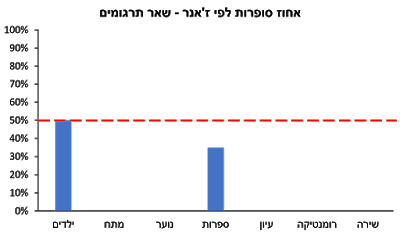

אחוז סופרות מתוך תרגומים (ללא אנגלית)


פירוט מגדרי של כלל התרגומים משפות שאינן אנגלית


הנתונים אולי שונים מעט בקרב מו"לים אחרים או בשנה האחרונה. אבל לאור העובדה שהנתונים שאספתי דומים מאוד לאלה משנת 2017 (שלא פרסמתי כאן), סביר להניח שהמגמות שציינתי לעיל מייצגות די טוב את עולם הספרות הישראלי ככלל.

אני מאוד מקווה שנוכל ללמוד מהממצאים הנ"ל לגבי הפערים - גם מבחינת תרגומים משפות שונות וגם מבחינת מגדר - במטרה להרחיב את מגוון הספרים שיוצאים לאור בישראל מדי שנה. בסופו של דבר, נרצה שהנוף הספרותי שלנו ישקף את העולם שבו אנו חיים. יש כל כך הרבה ספרים מכל העולם, ובוודאי שגם המון, המון סופרות מוכשרות, מעניינות ומרגשות. העולם עצום ומדהים - למה שלא נחשף לכולו גם בעברית?


Monday, August 24, 2020

WITMonth Day 24 | Where are the nonfiction women in translation? | Brief thoughts

I've written before about the astonishing gaps among academic publishers in publishing women writers in translation. My first exposure to the problem was through the original Three Percent database analysis, among fiction titles, but once I began to compile my own data, I realized that academic presses have massive gaps in publishing women in translation. 

I've touched on this topic a few times throughout the month, directly and indirectly, mostly when discussing accessibility. Academic publishers are notoriously expensive and their books are often harder to find in public libraries, eLibraries, or local bookstores. Their topics are typically also deemed less "accessible", due to crossing different nonfiction subgenres and topics. Academic presses excel in nonfiction, and for this reason I have recently had to add an asterisk to the typically cited "women writers represent 30% of translations into English" - the original statistics I compiled from the Three Percent database do not take these into account. And sadly, academic presses publish masses of nonfiction in translation that is overwhelmingly (75-85%) by men writers. This is a data gap we must not forget.

Nonfiction is often left on the wayside when we talk about literature in translation, but it shouldn't be, and certainly not in the context of women in translation. Beyond a sort of cultural prestige that nonfiction can carry (in my mind, at least), nonfiction often shapes our understanding of the world by defining it. Nonfiction is where philosophical, political, scientific, historical, and literary debate and discourse is carried out, which itself plays a role in cementing certain views or perspectives. If these are consistently the views or interpretations of men (with the exception of the rare memoir or feminist text), we are limiting ourselves in our perspectives. Similarly, if these are all Western European writers, there are likely countless histories, lessons, and conclusions that we are simply not exposed to. Isn't academia supposed to cross borders and open our eyes as much as possible? Why aren't English-language academic presses representing the true scope and diversity of academic research across the world? And why are women so lacking in these?

Sunday, August 23, 2020

WITMonth Day 23 | Night by Sulochana Manandhar | Minireview

When Tilted Axis Press announced their first Translating Feminisms series during WITMonth back in 2018, it was obvious that I needed to back it, for all the reasons. This set of four poetry chapbooks is no longer fully available, with two out of print, and it has had a curiously quiet impact on the literary community despite its successful campaign. Interestingly, the two chapbooks that are out of print were also the two that I preferred less; as a whole, I found the collections to be somewhat uneven. But let's focus on my favorite of the four, a book I genuinely fell in love with: Sulochana Manandhar's Night, translated from Nepali by Muna Gurung.

I can't claim to have read much Nepali literature. Or, frankly, any, prior to Night. This tiny, 38-page chapbook sums up the whole of my literary travels to Nepal, and a decent chunk of the book is the introduction and translator notes (which were very insightful!). And though I didn't review it at the time, Night was actually one of the more memorable books I read in 2019 and it's one that continued to hum in my mind in the past year since I read it.

All of the ways I have to describe Night revolve around music, somehow. It sings, it hums, its tone is resonant. Lyricism is a word that is overused in literary review and oddly doesn't apply here - Night isn't especially lyrical because it isn't especially verbose. Every poem feels gorgeously clear and calm and just the length it needs to be. The theme of night - sleep and dreams and darkness - is woven throughout each of the poems, threading each individual piece together into this (still-tiny) whole. Everything about the collection feels... just right. Rereading individual poems from it again stirs that feeling that Night is a perfect piece of music.

I don't know if Tilted Axis Press intend to reprint the whole of the first Translating Feminisms series, especially now that they are crowdfunding Translating Feminisms 2 (which will feature women and nonbinary writers from Indonesia, the Philippines, and hopefully Tibet; the campaign is currently ongoing), but I at least hope that Night will remain in print for a long time. That it will sell out soon and lead to a full-length translation of the original book (since the current chapbook is only a selection of the original "Night" poems, a little less than half). I would really, really love to be able to read much more of Sulochana Manandhar's poetry and writing. I hope I get the chance soon.

Saturday, August 22, 2020

WITMonth Day 22 | Mirrors, windows, and doors

I'm not sure when I first learned about the concept of mirrors versus windows in literature or from who, but it's somehow become central to my reading in recent years. At its core, "mirrors versus windows" suggests that there are two types of stories, culturally: Mirrors reflect your experiences and provide insight through resemblance to something familiar to you, while windows provide insight into other experiences and cultures which are different from your own.

I've thought about this dichotomy a lot recently. What is the women in translation project, after all, if not a persistent plea for more windows into new worlds? Yet at the same time, isn't part of my argument that any window will inevitably also reflect aspects of your experiences? Glass is maybe not the best mirror, but it can definitely serve as one. And what about stories that aren't designed for certain readers? What about stories that demand work in crossing a clear cultural threshold?

I've spent much of this past month dancing around this question from multiple angles, if not expressly. My initial goal for WITMonth this year was to broaden my own reading to countries, continents, and cultures with which I was less familiar, and I have thus far found myself exposed to so many different worlds and experiences than I was expecting. Some experiences have been wholly positive, but I inevitably also often find myself confused or ambivalent about certain books. Take my main criticism of Ambai's A Kitchen in the Corner of the House, that the book does not provide enough context for an uneducated English-language audience - am I not simply complaining that I don't know enough about Tamil/Indian culture to be able to appreciate the book? Am I not revealing my own shortcomings, rather than that of the book itself? Does my appreciation of the breadth of history Chantal T. Spitz introduces in Island of Shattered Dreams not give too much weight to her work by virtue of it attempting to tell Tahiti's story to a foreign audience? Does this make me a literary tourist? Are these bad things?

I increasingly find myself thinking in terms of three categories of cultural reading, rather than two: Mirrors, windows, and doors.

  1. Mirrors: These can be direct or indirect. I might read a book that is directly reflective of experiences I have had and is utterly familiar, but I also might find mirrors in stories that are otherwise distant. A family epic, for instance, may have its own cultural touchstones, but little things that can bind together different cultures in a way that will make a totally "window"ed story feel familiar and reflective.
  2. Windows: These are stories that provide a glimpse into another world, openly and intentionally. They acknowledge that they are distant and separated by a wall, while still playing out in full view of that distant reader. Windows can serve as introductions to new cultures and experiences, often in a clearly defined way.
  3. Doors: A door is a fixed object. You typically cannot immediately see beyond it. But you can open it and cross a threshold into someone else's home and experience. The invitation for you to enter is there, but the story is still written to happen beyond four, closed walls, without necessarily assuming that you will enter entirely or that you will engage once inside. Doors give you insight into the world as someone else lives it, no changes made.
The women in translation project is always going to be about crossing cultures; works written in one language are always going to be different than what they may have been had they been written in another. To focus for a moment on the concept of translation at large, every single book we read in translation (from any language into any language, even including translations from English) is going to provide some bridge across different cultures, even if these are similar. And the things we write for one audience is never going to be the same as what we may write for another. As I wrote earlier in the month, different languages have different power and influence. Every work that crosses a border inherently has to address that cultural gap, whether expressly (windows) or in its distance (doors). 

The mirror/window/door theory is maybe only one fraction of literature (after all, not everything has to be about culture or personal experiences!), but when we talk so much about the unique value of women writers in translation, it feels like an important reminder. To take an example from one of the last books I read, I may not be half-Angolan half-Portuguese like Djamilia Pereira de Almeida's main character Mila or have the same relationship with my hair as that protagonist in That Hair (a book that I imagine will be much more of a mirror for Black women in culturally white countries, while for me it serves as a window), but I can see myself in her questions about identity across different borders and between different aspects of one's self. A book like A Kitchen in the Corner of the House may be a slightly confusing door for me, but it still leaves me with the option of exploring the "house" as a whole and learning more about Ambai and the culture from which she wrote. And Island of Shattered Dreams serves as a reminder that windows still come attached to houses with doors, making me want to "enter" and learn so much more about Tahitian culture. 

I am lucky to be able to access these stories and books. I am lucky to be able to learn as I do. Truthfully, I realized a long time ago that I will never be able to travel everywhere on Earth, nor speak to people from all sorts of different backgrounds. All I can do is try to listen where I can, which is a huge part of why I value literature in translation so much and literature by women writers in translation especially, particularly when the stories are doors more than they are windows (even if it's more difficult for me as a reader!). As my reading takes me ever further from my own culture and background, I am inevitably going to hit some walls in terms of what I know and understand. But isn't that the point of doors, to help me make it through? 

Friday, August 21, 2020

WITMonth Day 21 | Island of Shattered Dreams by Chantal T. Spitz | Review

I first heard of Chantal T. Spitz at the wonderful, inaugural Translating Women conference last year. Spitz's English-language translator Jean Anderson presented a paper about cross-cultural literature, representing Pacific literature in a way that I had never before heard. I'm not in the literary field, after all, and the Translating Women conference was my first experience attending a literary academic-style conference; I've attended other literary events and plenty of scientific conferences, but nothing like this. For me, Anderson's presentation was one of the most fascinating and memorable of the conference as a whole. In the course of the talk, she discussed Spitz (as well as other, untranslated writers), and I jotted down in my notes "French is 'not her language', but the language she writes in due to school and education". Moreover, I was fascinated by the idea of exploring Tahitian and Pacific literature, since these are regions of the world I know very little about. I ultimately ordered Island of Shattered Dreams a few months later and read it just at the onset of August.

It would be unfair to say that I devoured Island of Shattered Dreams in one rapturous swell, though I did. It would also be unfair to say that I've been thinking about the short novel extensively since finishing reading it, though I have. These both feel unfair because they don't do enough to emphasize just how strongly Island of Shattered Dreams made me feel, nor how strongly I feel that more readers should be seeking this translation out. From a technical standpoint, Island of Shattered Dreams manages to do so much in so few pages (157), and with an extraordinary balance. Poetry, lyricism, history, politics, and romance all intertwine to form a tiny epic that never feels incomplete. Simply saying "oh, this book is wonderful!" or "I couldn't put it down!" seems like underselling.

The novel - which carries with it a unique meta-context that becomes more apparent and important by the story's end, which I won't get into because I quite enjoyed how it unfolded - follows an Indigenous Tahitian family, initially focused on Tematua and his great love Emere (whose mother is Indigenous and father a white Englishman), later shifting focus to their children: Terii, Eritapeta, and Tetiare. The fluid passage of time is beautifully framed by Tematua: "As Tematua foresaw in his heart, time is rushing out of control", precisely at the cusp of the novel's focus change. Island of Shattered Dreams covers a significant portion of the 20th century without it feeling like an overly drawn out narrative, and the tight family saga means that the novel's overall flow is never impeded. 

Yet this very sentence I just quoted also defines a second, critical theme in Island of Shattered Dreams, since the quote does not end where I stopped it. The full quote is actually "As Tematua foresaw in his heart, time is rushing out of control, troubling people's minds and surreptitiously filling their hearts with shame for the Mā’ohi world and admiration for the pale reflections of the foreigners' world." Ultimately, Island of Shattered Dreams must also be read as a novel about Tahiti/French Polynesia at large: its cultural shifts, its status as an island outpost for a massive colonial power, and various racial/cultural complexities that come attached with both. 

Emere's story is particularly central in this, as she is the not only the product of a mixed-race relationship, she is also caught between cultures and the love both of her parents have for her in that context. Her mother Toofa "hadn't prepared her daughter for the difficulties of life on the outlying islands. She had wanted an easy, modern lifestyle for her, hoping that the man who married her would provide her with a housekeeper and every comfort." Toofa remains rooted to joining the white, Western world (which goes on to influence her grandchildren too), yet accepts Emere's choice leave this society behind and marry Tematua. It's a balance that ripples throughout the remainder of the novel, a reminder of the family's complex history and one that shapes the drama in the book's final chapters.

It's impossible for me to ignore how much I learned from Island of Shattered Dreams. Learning from literature is obviously wonderful and part of the point, but I can't help but feel disheartened by how much I end up relying on fiction to teach me things that I probably should have known earlier. I knew absolutely nothing about French Polynesia or Tahiti prior to reading Island of Shattered Dreams; it's just about exactly on the opposite side of the world from my own home and with no shared language, so this isn't particularly surprising. Still, I left Island of Shattered Dreams wanting to learn more about France's colonial history in the region and its power today. Much like the anthology Indigenous Literatures of Micronesia left me hungry to learn and read other books, so too does Island of Shattered Dreams make me wonder about the island today (Island of Shattered Dreams was published in 1991, which makes it as old as I am, aka not exactly young anymore...). What does Tahitian literature look like today? Will any more of it get translated into English? Spitz's other works are themselves still unavailable in English translation - are these also to remain out of grasp for English-language readers?

And I'm left with more questions, hearkening back to Spitz's remark about writing in French. There are several Mā’ohi words and phrases throughout the novel and Spitz even opens her novel in Mā’ohi. Spitz has already made her words "more accessible" to Western readers by writing them in the colonial French, a language that is bountifully translated from across the world. Yet Island of Shattered Dreams does not appear to have been translated between most languages. It is certainly not available in my native Hebrew, nor, to the best of my Googling, does it appear to have been translated into German, Spanish, Portuguese, or Japanese. Why not? The supposed language barrier (had Spitz written her work entirely in Mā’ohi)  has been "helpfully" removed by the author herself. What more is needed?

I've written all these words without getting to the heart of my response to Island of Shattered Dreams which is, quite simply, that I loved it. I loved the writing. I loved the fluidity. I loved the poetry. I loved the warmth with which Spitz describes her world and life, new-to-me yet so far from being new (and it never feels like an introduction, it feels like... life). Most importantly, I loved the love that is central to so very much of the novel. To use what Anderson explains in her translator note as a Mā’ohi cultural touchstone which I was obviously unfamiliar with until reading the book, I felt Island of Shattered Dreams deep within my belly, that place from which emotions truly do rise (even if this is not how it's usually described in either of my languages). I could not set this book aside for a moment, sitting outside to read under a perfect summer sky, drinking in the book from when the morning air was still cool until the hot noonday sun reached my reading nook. Alongside all of the rest that makes it a valuable work, Island of Shattered Dreams is a beautiful story brimming with all sorts of different forms of love and a love of storytelling (once oral, now put to print) at its very core. How could I not fall in love myself?

Thursday, August 20, 2020

WITMonth Day 20 | Opportunity, not obligation | Video

I've seen some posts lately that have made me want to remind everyone that WITMonth is an opportunity to boost and support women writers in translation, not any sort of obligation as a reader, blogger, reviewer, etc. And this opportunity isn't just limited to August, either!


VIDEO TRANSCRIPT:

Hey everyone! So we're 2/3s of the way through August and I wanted to check in on a very specific topic and talk about opportunity, not obligation. So basically, as WITMonth has grown from year to year, there are more and more people getting involved which is amazing and wonderful and so exciting to see, but one of the things that happens is that I'll see more people sort of getting nervous about the fact that they can't take part in WITMonth or won't be able to finish a book or review a book or post or whatever it may be. 

And I just want to remind readers that the point of WITMonth is really the engagement and it's thinking about the issue, it's thinking about the topic, it's thinking "how many books by women writers from around the world have I really read and how many of those are reflective of different languages and different cultures and different backgrounds? What can I do with my own reading?"

And that obviously involves reading books (and I really recommend reading books by women writers in translation, obviously!), but it doesn't have to mean any one specific thing, and of course, you know, #WITForever, it doesn't have to just be in August, so if you're feeling like you didn't really take part in WITMonth this year because you weren't able to read a book or write a review or take part in a readathon or whatever it may be, rest assured! You have definitely taken part. Just by watching this video, YOU are taking part in WITMonth.

I hope everyone's having an amazing time reading wonderful (and maybe less wonderful?) books and thinking about what it means to really read the world... and have a great rest of the month!

Wednesday, August 19, 2020

#WITMonth Day 19 | The Restless by Gerty Dambury | Review

I was not expecting The Restless to be what it was. Gerty Dambury's novel (translated from French by Judith G. Miller) somehow struck me as the sort of book I'd need to slog through, something that would be experimental in a frustrating-but-understandably-important way. I have no idea where that idea even came from or why I was initially so put off from the book. Maybe (as always...) the fault is in my own perceptions of the meta-framing - the Feminist Press cover shows a brown-shaded old-fashioned classroom, rows of empty seats. The back cover blurb leads with a little girl's concern over her teacher's disappearance. Somehow - bafflingly - I created some sort of story in mind of what The Restless would be and concluded that I would struggle to read the book. Oh, how wrong I was.

I positively devoured The Restless. 

At 237 pages, The Restless is neither a short nor particularly long book, but it's somehow massive and brisk at the same time. The best word I can think to describe it is "crackling". And okay, maybe part of my association with that word is because I accidentally got the book wet a year back when I bought it and it dried in such a way that the spine crackles whenever you flip the pages, but goodness if it doesn't apply to the inside as well. The Restless is indeed experimental in a lot of senses, using an honestly pretty strange quadrille framing technique, with alternating narration and constant perspective shifts. That most of the narrators are dead is definitely another weird factor, but my goodness it works. There's so much about this novel that could go wrong, and yet it all works so well.

At the center of The Restless is Émilienne, the young girl "struggling with the sudden disappearance of her teacher and father", per the cover description. Émilienne defines the novel through her insistence on sitting outside of her house, waiting for her father to return home. Her older siblings look on with worry and fear, narrating the dance that outlines the novel as a whole. Émilienne tells her story in bits, but is also in the process of an abstract conversation with dead neighbors and semi-strangers, characters whose lives intertwine or at times barely brush each other. The dead constantly jostle each for their stage, arguing in little asides and scenes. Together, this mish-mash of different characters tells the story of several pivotal days in Guadeloupe's history, starting from a worker's strike and leading into widespread rioting and violence in May 1967. Thus alongside the story of Émilienne's family history and personal narrative arc (and oh, I do so love a good childhood arc!), Dambury paints a striking portrait of Guadeloupe as a complex whole.

These different threads frequently tug at each other, but the balance is shockingly good. Dambury has the rare ability to pack her story with dozens of characters and plot pieces and keep things tight. The Restless never feels like it's unsure of where it's going or what the point of the novel is. There's always that crackle, something tense and fully confident, both in the writing and the plotting itself. The writing never lets you forget that this book is telling a wide story that is at the same time fully focused on Émilienne. It's relentless. It's excellent.

The Restless has, unfortunately, not gotten very much attention in English, nor has its author. As of publishing this review, Gerty Dambury does not have a Wikipedia page in English and The Restless appears to be her only work translated into English. Dambury, it turns out, is predominantly a playwright, and it occurs me now that this may explain The Restless's pacing, tension, and excellent storytelling balance. I would absolutely love to read/experience more of Dambury's writing, but in the meantime I'd be satisfied to see her gain a wider audience in English through The Restless. A wonderful, special book that I'm so glad I ended up reading.

Tuesday, August 18, 2020

WITMonth Day 18 | New Daughters of Africa and WITMonth | Thoughts

I've been working my way through the absolutely phenomenal New Daughters of Africa for the past several months now. I'm 2/3 of the way through, reading in bursts and am repeatedly in awe of everything the book does. Truly. But I'm also frequently reminded of the one thing the book does fairly poorly: women in translation.

This brilliant, inclusive, expansive, international, and wholly diverse collection does so much so well, and yet women writers in translation are almost entirely invisible from the account. To the best of my assessment, there are exactly 7 women writers in translation featured in the collection (one of whom is credited with her co-author, but the translator is oddly ignored). By my count, there are an additional 4 writers who also write/publish in other languages with no translator credit for the included pieces. This is a grand total of 11 writers out of 211 authors (that I counted). In other words: 5%.

I don't want to fault Margaret Busby for mostly focusing on British authors or somehow fault English-language writers for getting a stage. Black women writers are sidelined enough without that and it is absolutely not my intention to suggest that the featured writers don't deserve their spotlight. Once again, I want to emphasize how astoundingly wonderful this collection is - after all, not everything has to be all WIT all the time for it to be of value, even during WITMonth! And there is such value in Busby's collection.


Orange flags represent the seven writers in translation, the blue flags the four additional women writers known to write in languages other than English.


And yet it's a perfect reflection of so much of what I've been talking about here lately. New Daughters of Africa is such a good collection of African and African-descended women writers from across the continent that its Anglo-centrism is baffling. The lack of Afro-Brazilian voices was something that struck me while reading, during one of the rare Afro-Caribbean stories. Afro-Latinx writers generally felt missing from the book in a very real way, not just as an abstract meta-assessment; I literally found myself flipping through to see if the writers happened to be clumped elsewhere in the book (alas, no). Perhaps it's explicitly because New Daughters of Africa does such a good job in offering so many different voices, stories, perspectives, and narratives that it becomes all the more obvious which are missing or underrepresented.

Then there's the last gap, which is almost invisible and which I'm somewhat hesitant to raise. Despite featuring many writers still working out of the African continent, there is not a single work or writer featured or mentioned as writing in a non-colonial language (and again, almost all are specifically English-language writers). Nothing from Igbo, Amharic, Malagasy, Swahili, honestly this list can go on and on with languages of varying literary traditions and scope, where none were even mentioned (to the best of my reading, at least). To reiterate what I wrote the other day: Authors are at liberty to write in whatever language they choose, but it does have an impact on the way stories are conveyed. And as readers, constantly being exposed to stories that have been written with a very specific frame or audience in mind also shapes our perceptions. Writing in other languages and translations have value for all sorts of reasons. For good and for bad, New Daughters of Africa highlights so much of what I've been writing about this past week: It's not only the power dynamics between different languages, but regional/cultural publishing disparities and even the tremendous difficulty in simply finding books by women writers in translation, when even a wonderful resource such as this can't quite bridge the gap. 

I'm loving New Daughters of Africa. I wholeheartedly recommend it to every single WITMonth reader who is looking for something vast and extraordinary to read, even if only 5% of the book is in translation. The book - like Indigenous Literatures of Micronesia - doesn't have to be a full work of/by women in translation in order to represent everything the project stands for. But I also think it's the perfect encapsulation of how women in translation is not a struggle that is separate from other literary movements or efforts. Black women writers in translation deserve more and while I would absolutely love to see a Daughters of Africa in Translation collection someday to balance this, I would have much rather just seen the original collection reflecting writing by all of Africa's daughters, not just those writing in English. 

Monday, August 17, 2020

WITMonth Day 17 | A Kitchen in the Corner of the House by Ambai | Review

 It's an odd thing to retroactively compare a book to another that you read later, and yet this is what happened to me with Ambai's A Kitchen in the Corner of the House (tr. from Tamil by Lakshmi Holmström). Not long after reading this collection of short stories, I read the multi-author collection Spark of Light: Short Stories by Women Writers of Odisha. In essence, there is very little that connects these two books other than the fact that they are both short story collections by Indian women writers, except of course we need to remember that Tamil and Odia are two completely different languages representing completely different parts of India (which, you know, is huge), they don't even belong to the same language family. Perhaps I would have had the same feeling had I read a short story collection from China or Senegal or Haiti as well. Either way, reading Spark of Light seemed to cement some of my struggles with A Kitchen in the Corner of the House. And I did ultimately struggle with this one quite a bit, even as I recognized a lot of good in it as well.

I'll start with the positives: I loved some of the stories in this collection. I loved the cool writing style. I loved many of the journey stories. I loved how Ambai centered her stories around women's experiences in many different ways. There are some fiercely feminist stories in this collection, as well as stories that reflect changing cultures and societies. As one of the back-cover blurbs note, Ambai does a brilliant job of conveying women's anger in the face of injustice. There's a lot to appreciate here.

The problems begin when judging the book as a whole. First, like many collections, A Kitchen in the Corner of the House doesn't find a very good balance between stories sounding individual enough to stand out and stories flowing together. Short story collections are so often frustrating for this reason, with stories either sounding too similar or too apart. At first, I thought that Kitchen... did a pretty decent job of this balance, but the stories and characters began to blur as I got deeper into the book. This was one of the early points of contrast I found with Spark of Light; that collection is comprised of short stories by different authors and their individual voices carried the book admirably. Kitchen... started to lose me around halfway through, with stories that felt narratively repetitive (if not actually on a plot level). 

The next problem was another retroactive contrast with Spark of Light: the story topics themselves. There are several parallels in terms of stories conveying women's domestic/personal struggles in both collections, but Ambai's oddly seemed less consequential. Ambai's stories are often experimental or slightly shifted in terms of their narrative frame, which leads some to end abruptly or never quite reach their point. I can understand the literary value behind this, but it ends up creating a collection that's much less satisfying than it could be. Many of the stories hover around certain themes without fully landing on them, and this too led me to feel like Kitchen... was somewhat incomplete. The clean lines and conclusions of Spark of Light - which also includes some more experimental stories, yes? - felt like a sharp contrast.

But the biggest problem I had with Kitchen... was ultimately in its lack of context. I have long argued and will continue to argue that readers do not need to be spoonfed when it comes to books from cultures or backgrounds that are different from their own. Moreover, who's to decide whether something is new or unfamiliar to a certain reader, right? I may be unfamiliar with Indian literary traditions, history, religion, or myths, but that doesn't mean that every reader is. Except... except that in translation, the point is often that a book is being brought across different cultures where the reader can't be expected to understand everything. 

And so A Kitchen in the Corner of the House has basically no context beyond the literal text. There is no introduction, there is no afterword, there are no translator notes, there are no footnotes, and even the author biography is not exactly extensive. For a book that includes so many regional, linguistic, and cultural references, this felt like a huge oversight. I tried to supplement what I could through Wikipedia, but this felt like a classic example where a well-written introduction regarding Ambai's writing style, feminism, and academic approach would have hugely benefited the book as a whole. Even just a brief afterword may have tied the collection together a bit better, giving some degree of context to the stories. Worst of all, rather than wanting to read/learn more, I felt like Kitchen... existed in some sort of isolated dimension that didn't invite greater interest. Something critical was missing. 

I came away from the book feeling a little baffled and unhappy. As I already noted, some of the stories were great - memorable, strong writing, powerful in their perspective - but others seemed to float in and out of my consciousness. I ended up skimming quite a few that just weren't doing it for me. And no matter how much I wanted to understand the collection, I felt like I wasn't fully able to, and that kept me from fully appreciating it too. Is it possible that other, more clever readers will understand A Kitchen in the Corner of the House without any sort of extensive introduction or spoonfeeding? Sure, it's possible. But it still feels like a missed opportunity and something that should be an option for the book, even as an external supplement. It still feels like the book - as a whole - just wasn't complete in a lot of ways, not in its context, not in its flow between stories, and not in its own overarching message. I ultimately liked A Kitchen in the Corner of the House, I can rank it as a decently good read and recommend it to some readers. But it's not an easy recommendation. And even with the positives, I find myself somewhat disappointed.

Sunday, August 16, 2020

WITMonth Day 16 | Languages and power | Thoughts

One of the frequent critiques WITMonth faces is in its centering of Anglo-American/English-language cultural expectations. Why, some international readers argue, do I center Anglo culture in demanding that translations not include books originally written in English? I've addressed these points in the past (and will address them more fully in the near future), but today I want to focus on something that spins off from this question: How do we address the power imbalances between different languages? How do we address the power imbalances in translation that follow the status of different languages? And what does it ultimately mean for readers?

Languages reflect culture in more ways than one. As a native bilingual myself who grew up in a multilingual household (among my grandparents and parents, there are six native languages alone; including the different languages learned by family members or spoken by friends or my surroundings, the number crosses 10), I have long been aware of the ways that different languages reflect the cultures of those speaking those languages, not to mention the ways in which multilingualism itself shapes subcultures. I have subsequently had the great pleasure of being exposed to many different languages throughout my lifetime, though I unfortunately have not had the opportunity to really learn most. 

When we talk about literature in translation - or literature more broadly - not all languages are created equal, nor is their origin. French - a language with ~80 million native speakers - is the language with the most translations into English, yet these are overwhelmingly from France itself (despite ~274 million fluent French speakers estimated worldwide). Meanwhile, Hindi - a language with ~322 million native speakers - barely rates in terms of translations into English that are publicized in the English-only speaking world (i.e. the US, UK, etc.). These sorts of power imbalances are evident in translation to other languages as well, where English-language literature is often a dominating force.

What often ends up happening is that languages with less power - typically those spoken by fewer people, or with a "lesser" cultural impact (in English, at least) - don't get translated. Or, rather, they often don't get written in the first place. In countless regions across the world, colonial languages (and not just European, though obviously these dominate in some regions more than others) are favored over native/local languages because they are likely to garner greater readership and indeed exposure. So you're likely to have read several Nigerian writers in English, but have probably never read a work translated from Yoruba (~40 million native speakers). In this same way, most English-language readers have read works by Indian writers, yet no works translated from Indian languages. As always, the problem is only exacerbated for women writers, who face even greater hurdles in getting published, publicized, and translated than men. 

And it's not just English, of course. French, Chinese, Spanish, Arabic, Russian, and Portuguese have lessened the power of countless local languages in different places around the world in some degree or other, not necessarily in the same ways. The process also predates the modern era, with languages frequently dying out over time (though nothing is quite on the scale of our current linguistic mass extinction). When we (I) talk about reading more works by African women writers in translation, that mostly means reading works written in French. For the Caribbean or Latin America, it often means works written in French, Spanish, or Portuguese (occasionally also Dutch). Sometimes, this is the result of generations of colonial rule (Latin America); sometimes, it's the effect of relatively modern, swift homogenization efforts (China). 

Writers are, of course, at perfect liberty to choose the language in which they want to write. I will not look down on any author who chooses to write in a more popular language because it means their work is more likely to be read widely. I will, however, note that gendered power imbalances often mean that women are the ones who choose to write in languages other than their own. To take the example of Yoruba that I mentioned earlier, literally every single author listed on Wikipedia as "Yoruba-language writers" is a man. It's a pattern I've found across many different languages and cultures. It doesn't mean that there aren't women writing in different native languages (again: see this year's 50 Day Countdown), but fewer than I would expect or hope for.

As readers - particularly as readers who obviously do not have access to every single language on Earth - we have limited control over the books that we can read, by virtue of availability. As I've said before many times in reference to the lack of women writers in translation (in English and elsewhere): Readers cannot be expected to love books that they haven't read, and they cannot be expected to read books that they cannot access. As a reader who does have the option of reading in English, for example, I'm exposed to a lot more literature than I would be if I only read books translated into Hebrew. English - even as a secondary language, even as an overly dominant colonial language - has immense power. 

But if we're going to talk about the lack of women in translation, we have to understand the sources of the problem, and this is absolutely one of them. We also have to be able to address the ways in which different languages are treated in translation, acknowledging the at-times racist power structures that elevate certain languages far above others (e.g. Norwegian is more translated into English than Marathi) and how these affect women writers in particular. 

We have to be able to talk about what it means to read works that were written in an author's second language, whether it's English or not, to address the way this often shapes an author's popularity or cultural impact. And this is especially important because the language that we write in shapes the work itself. A story that is written from within a certain culture or community and is assumed to be for that culture or community is not going to be the same as a story that is written for an external audience. Moreover, writing changes across different languages and comfort levels per language. I'm a native bilingual and my writing does not sound the same in English and Hebrew, by virtue of the books I've read and the respective literary styles that guide each language. And I'm not even a writer!

Ultimately, we need to remember this one point: Languages have power and unfortunately that power has enormous influence on the books that we read. Whether viewing this matter through an English-language lens (this is a blog in English, after all...) or through the lens of any other native language, we need to be able to pause and ask ourselves why we're exposed to certain books and not others, why we're familiar with certain languages and not others, and why we ultimately have a literary landscape that favors some types of writers over others. And we need to do this both in the context of recognizing where women in translation reside as a group, as well as the imbalances among women writers in translation.

Saturday, August 15, 2020

WITMonth Day 15 | Kuessipan by Naomi Fontaine | Review

I rarely remember how a book gets on my radar, but when I find a small gem that doesn't seem to have gotten much attention, I find myself wishing I could remember who deserves that credit. How did I first hear of Naomi Fontaine, a French-Canadian First Nations writer? What made me look up Kuessipan (tr. from French by David Homel)? What eventually led me to actually buy it? Even though it was all within the past year or so, I no longer remember.

Yet I'm grateful to whoever it was, dear anonymous reader. Kuessipan is a tiny book that I could easily have not connected with, and I wonder if I was almost expecting to not enjoy it. I have often found myself struggling to enjoy vignette-style novellas, feeling as though they're neither the style of poetry that I typically like nor fiction-y enough. Kuessipan was teed up for my disappointment, and yet. And yet! I liked it a lot.

Part of what worked, I think, was that I ended up reading Kuessipan as an almost wholly poetic book. Not poetry, but poetic. Something in its rhythm didn't feel like it was trying to build a structured narrative, nor was it especially loose. Each vignette felt well and intentionally crafted, with care and detail. The pieces flowed into each other naturally. The book - generally speaking - flowed, and this perhaps is also what made it feel so much more poetic than a standard novella. 

There's a part of me that also wonders if Kuessipan simply doesn't feel more consequential than the average vignette-style novella. Stark, clean writing isn't a rarity for novellas (isn't it kind of the point?), nor is plotlessness with powerful resonance, but I feel most novellas don't really manage to tell an epic in such sparsity. Fontaine's writing covers so much and so many in a way that makes it feel like a much longer book than it really is (and it really is tiny, barely 99 pages). Part of Kuessipan is a coming-of-age story, part is a cultural history, part is a contemporary snapshot, and yet these different pieces fit together smoothly. Fontaine includes many different pieces of Innu life (based on her own experiences, I have to assume), whether in describing community life or traditional history. Some are painful - substance abuse is a recurring theme - and others almost wistful, casting their eye toward things like salmon fishing or hunting or nomadic wandering. Fontaine writes of young motherhood, childhood, and leaving home with the same sensitivity as in describing death, old age, or memory. 

Kuessipan does not feel like a linear work. As I write this review, I find myself flipping back through different vignettes and segments. The poetic nature of the writing means that these don't feel out of place in any order, even though I quite liked how things fit together and grew when read in sequence. But something about the out-of-time nature of the work makes it feel like it has a slightly longer impact. Novellas and poetry can often get lost in one's memory, if only because the power is in the emotional response. Kuessipan certainly doesn't feel like it has the strongest plot-based hook, but the clarity of its writing and storytelling is remarkably memorable. Even without clinging to specific phrases or segments, I have found myself thinking about the book quite a bit in the months since I read it. Kuessipan is yet another in a long line of books that deserves far more attention than its received. I - for my part - eagerly await the opportunity to read more of Fontaine's writing in English translation in the near future.

Friday, August 14, 2020

WITMonth Day 14 | How to find books by women writers in translation

Last week, I wrote about accessibility and availability for books by women writers in translation. There, I mostly focused on the sorts of barriers that prevent works in translation - and especially works by women writers in translation - from getting into the hands of many readers. But one of the things that I didn't really address was the question of discovery. Of course the question of literal availability is huge in ensuring that books reach readers, but how are readers supposed to know about these books in the first place?

I've heard a lot about this over the past few years, especially as WITMonth has grown. Twitter, Instagram, and Booktube are full of readers who are exposed to the women in translation project through someone else's passionate involvement, and then begins their own journey of reading more books by women writers in translation. One of the most common first steps is trying to find that initial path in: What books even qualify? Who are the women writers in translation that are available? How do you find them?

It's not trivial. Like with almost every "minority" in literary publishing, the problem isn't that the books don't exist or can't exist, but that they're not given nearly the same space, attention, marketing, and fame as the straight, white, Anglo "default". Things like bookstore or library displays go a long way in exposing readers to new books. Things like Buzzfeed lists and viral recommendation threads also do a lot. 

But let's say you're new to this. You're not on Twitter, you're not on Instagram, and you mostly do your bookshopping at major chains or online outlets. Where, you may ask, are the women writers in translation? Here are some ways to find the very most popular women writers in translation:

  1. Look over the 100 Best WIT! Yes, some shameless self-promotion here, but this list was crowdfunded by a couple hundred folks from around the world and reflect some of the most popular contemporary titles in the world of literary translation.
  2. Check out some of the heavy-hitter publishers in terms of popular books by women in translation. Europa Editions, for example, has published some of the most best-selling WIT in recent history, including Elena Ferrante, Muriel Barbery, and Mieko Kawakami. While not all publishers of popular women writers in translation necessarily publish a lot, many do.
  3. Use Goodreads for groups and lists of books by women in translation! There are all sorts of different options which can help a newer reader find appropriate books.
  4. Follow sites like Book Riot and LitHub, which both occasionally feature works by women writers in translation and have some great lists on hand.
But what about readers who are already familiar with these, as well as other, more specific blogs, sites, and outlets? What about readers seeking books from outside of Europe's dominant literary influence? What about readers seeking books from different genres or backgrounds? Well, you too have several options!
  1. Always go back to the original international literature sources as well: Words Without Borders, Asymptote, Three Percent, and literary journals like Modern Poetry in Translation or Two Lines, as well as many others (of course).
  2. Peruse the annual WITMonth new releases list, which I try to compile from a lot of different sources and covering a lot of different genres and literary designations.
  3. Lovers of speculative fiction (sci-fi, fantasy, and adjacent genres) are strongly advised to check out Rachel Cordasco's phenomenal SF in Translation site. While there's sadly too few WIT in speculative fiction, there are some great options on the site, as well as a really organized resource for finding reviews and such for any books you may be interested in.
  4. This may, again, seem like a bit of shameless self-promotion, but check out this and last year's 50 Day Countdown(s) to WITMonth. Between the two lists, you can find literally dozens of writers from across the world, some of whom are definitely big names and others who are decidedly not!
  5. And for the top-tier difficulty level, seek out the tiniest publishers of literature in translation! Academic presses, obscure poetry publishers, publishing houses from different countries (who may still publish works in your native language, whether English or otherwise!), online publishers, and so on! It can be arduous work to find women writers in translation, but there are some extraordinary gems to be found if you put that effort in.
Right now, the bottom line is this: Readers need to work to find books by women writers in translation. Despite the occasional outlier, the biggest publishing events of the year rarely promote works by women in translation and rarely give space to their voices. This is largely why WITMonth exists - August is our opportunity to loudly make this space and promote these books. At the end of the day as I've said before, the two greatest resources I can offer new readers wanting to find more women writers in translation is Twitter and Instagram. The #WITMonth tags on both sites (as well as #womenintranslation year-round!) are extraordinary resources for seeing which women writers in translation readers from all across the world are passionate about. 

And... well, there are also some projects in the works to make this whole process of finding books by women writers in translation a little easier. But I'm getting ahead of myself...

Thursday, August 13, 2020

WITMonth Day 13 | The Future Has an Appointment with the Dawn by Tanella Boni | Minireview

I first learned of Tanella Boni through A Rain of Words, which I finally reviewed earlier this month. Boni's poems jumped out at me enough that she was one of the authors I featured in last year's 50 Day Countdown, one of relatively few poets that I featured in the list. I don't quite remember when it was that someone (can't remember who, either, ack!) pointed out to me that a full length book of hers actually was published in English, but it immediately jumped to the top of my "must buy" list. And once I received my copy of The Future Has an Appointment with the Dawn, it was pretty clearly bumped to the top of my reading list.

I read The Future Has an Appointment with the Dawn in a single sitting. It's not a poetry collection, but a poetry book, that rare, single piece that fits together so very neatly and tightly that I'm not sure why there aren't more such works. (I imagine because they're so hard to pull off well?) Reading Boni's writing (translated by Todd Fredson) reminded me of reading Inger Christensen (tr. Susanna Nied), not because the styles are necessarily similar (though both have a certain thematic clarity that I think complement each other nicely), but because like Alphabet, The Future Has an Appointment with the Dawn left me fairly breathless. It's the sort of breathlessness that comes from wanting to swallow the words whole, pausing, reflecting, but needing to keep reading, always needing to keep reading. Some lines biting so strongly you recoil, some lines so beautiful you can't find your next breath, all of it flowing in the best way.

I've said it before and I'll say it again: I cannot review poetry. What can I say here? I loved The Future Has an Appointment with the Dawn. It's one of the better single poetry books I've read in ages, ranking up there with my favorites. Not just the language, not just the structure, not just the use of breaks and pauses and recurring motifs, not just the flow, and not just the emotions. All of these things together. If I liked Boni beforehand from a sample of her poetry and knew I wanted to read more of her writing, I can now say that I want to read all of her works. I want to be able to bask in her poetry, whether individual, isolated poems or whole works like this. Whatever she's written, I want it.

Wednesday, August 12, 2020

WITMonth Day 12 | Regional and cultural disparities in a complicated world

There's been an interesting recurring question that's come up since I published my personal WITMonth plans, in which I announced my intention to read and discuss books from specific regions of the world during August. In comments and elsewhere, some readers have asked me why I prepared banners for certain author groups and not others. Where were Latin American women? Where were non-South Asian writers? It's a legitimate question and I think it's time to address it.

Last week, I posted the full list of this year's 50 Day Countdown. Like last year's list, every choice this year was deliberate and pointed. Last year, I sought to have a list that was thoroughly comprised of women of color, without a single white European woman writer. While it's true that not all European writers are made "equal" in terms of industry attention and care, the status of most women writers from outside of Europe is significantly worse off. This year, I wanted to focus on women of African descent specifically (partly inspired by Margaret Busby's New Daughters of Africa, a book I'll be discussing more in depth in the future), but soon realized that it's not just African or African-descent women writers in translation who are often underserved. Indigenous women writers - particularly those writing in indigenous languages - are also a rare sight in translation, even when coming from the closest possible literary traditions (see: Canadian First Nations French-language writers). South and Southeast Asian writers are similarly starkly undertranslated as compared with East Asian writers. And Middle Eastern and Caribbean writers are also often left in the wayside.

And so this year's WITMonth countdown and plan were born. 

It's hard for me to give a clear name for my focus. "Underrepresented in English" is incomplete, after all - many of the writers in the 50 Day Countdown and those I'm reading this month are currently living and working out of Europe. A decent proportion are mixed race writers who specifically write about racial and cultural identity. As I've already mentioned this month, French is the most-translated-into-English language and is a dominant language among African writers (thanks, colonialism?), yet African women writers are extraordinarily rare in translation. 

Similarly, my focus on writers from the Americas is blatantly skewed. To put it bluntly: I'm not particularly interested in white Latin American women writers this year. While recognizing that within a US-specific context some Latin American writers share a certain status and while continuing to recognize that like all women in translation, all Latin American WIT are underrepresented on a big-picture scale, there's no denying that Latin America has its own vast diversity which is rarely reflected in translation. Frankly, the most obvious example of this is the fact that Argentina is the Latin American country with the most translations into English, and Argentina is overwhelmingly a country of white European immigrants. Even among the most popular Mexican writers, a not-small proportion are writers of wholly white European background. The Americas have so many voices from so many different backgrounds, yet like with so many other examples, we're not truly given access to most.

It's a recurring pattern. Take Indian women writers, for example. Setting aside the fact that most of the highly-publicized-in-English Indian writers write in English, I've long known that I've read works by far too few Indian women writers. Except I soon realized that I didn't even know of Indian women writers from the vast majority of different Indian languages. India is a massive and massively diverse country (subcontinent!), with literally a dozen different languages with over 30 million native speakers! The fact that the only Indian language I had read full-length works from was Bengali was something that I was deeply unhappy about; I'm glad that I've had the chance to correct this somewhat of late (having read a work translated from Tamil and a collection from Odia), but this is nowhere near where I want to be. There actually are many works translated into English and published across India, but they're just often unavailable to different international audiences. (This is true of a surprising amount of countries where English is a common bridge language, and if anyone in the industry wants to do something about it... please?) 

Meanwhile, like with the imbalances within Latin America, can we really say that this is comparable to the amount of books by women writers translated from Korean and Japanese? Not to diminish from these works - again, there are huge cultural barriers that already place these works at a far greater disadvantage relative to works by white European writers! - but the skew feels large enough that I personally decided to wait a few more weeks with some of the Japanese and Korean women writers currently on my reading list. (And there are plenty.) 

So what have I been reading? Black women writers, mostly, and I've been trying to boost up my reading list even further. Indian women writers as well, trying to get my hands on different writers from different languages and backgrounds. (Instagram has been amazing for this, there are a bunch of wonderful Bookstagrammers promoting incredible-looking books by Indian women writers!) I've tried to spread out into regions I'm really unfamiliar with, like Tahiti (Chantal T. Spitz's Island of Shattered Dreams, which I hope to review soon) and Micronesia at large (albeit not exactly a work filled with women in translation, but still very much within the spirit of: Indigenous Literatures from Micronesia). I'm hoping to read more works from women writers from across the Arab world (taking much inspiration from ArabLit, as usual). And yes, I'd like to make sure that my reading remains varied among these groups, whether in terms of promoting queer women writers from around the world or just voices from all sorts of different backgrounds (religious, socio-economic, cultural, physical, etc.).

My goal isn’t to define or judge anyone else's reading choices. For a lot of readers Latin American and East Asian writers aren’t dominant voices in any meaningful way. White European women writers in translation are still absolutely underrepresented relative to the broader literary landscape. Every time we recognize that and recognize the biases within this conversation, we're taking steps in the right direction! But there's still more. This is just my little bit.

Tuesday, August 11, 2020

WITMonth Day 11 | "Resilience in Immigration" by Shelly Engdau‐Vanda

Last year, I wrote about a book called "Lives of Three Generations of Bedouin Women" by a Bedouin-Israeli writer Nuzha Allassad-Alhuzail. That work of nonfiction grew out of the author's doctoral research and is a nonfiction, sociological book - very much not the sort that I typically read and review on the blog. But it sparked something in me, in terms of reading more nonfiction, and particularly reading more nonfiction by Israeli women of all sorts of different backgrounds. This quickly led me to Shelly Engdau-Vanda's "Resilience in Immigration: The Story of Ethiopian Jews in Israel", published under the same sociology series at the same publishing house. The two books are thus packaged similarly, and even something in their meta-storytelling matches - both works are by minority women in Israel, writing about communities to which they belong and experiences that broadly match their own (and sometimes very much don't).

And for me, the two books remain pillars in my understanding of different Israeli experiences and cultures. Written with the express purpose of "educating" (that is, conveying a certain sociological study), the two works are remarkably enlightening beyond just their author's demographic. Yet it is still worth mentioning that these are among the only works by Ethiopian- or Bedouin-Israeli women writers (if not the only). Not only do the books serve as a direct educational tool in their academic research, they also provide context for communities that are wholly underrepresented in Israeli literature specifically and world literature overall.

Resilience in Immigration is thus the first book by an Ethiopian-Israeli writer that I've ever read. In fact, very few works by Ethiopian-Israelis have been published in Hebrew, and few of those that have been published remain in print or are readily available. While this may seem like an offhand remark, it's actually fairly important in recognizing Resilience in Immigration's cultural context; while most Ethiopian-Israelis (and specifically those profiled in this book) have lived in Israel for over 25 years or indeed were born here, "integration" into the broader, homogeneous Israeli society has not come easy, and at times at all. Resilience in Immigration tracks the migration experience from Ethiopia through Israel, with several chapters dedicated to questions of "integration" or assimilation and associated struggles. The lack of Ethiopian-Israeli representation in broader Israeli media largely aligns with this, and the limited scope of Ethiopian-Israeli literature seems to echo this void.

The book's core is interviews with Ethiopian-Israeli adults who came to Israel as children, during Operation Moses during the 1980s. This saw thousands of Ethiopian Jewish refugees secretly airlifted to Israel through Sudan, due to persistent persecution and violence the Ethiopian Jewish community faced, as well the ongoing civil war there. Not all of Resilience in Immigration's interviewees remember this period in their life, but several could vividly recall the horrors of fleeing their homes, the Sudanese refugee camps, and the chaos surrounding the actual rescuing flights. Some had lost family. Some were separated from their families. Some experienced violence. It's not easy reading these accounts (particularly knowing that the latter part of the book goes into detail about the continuing struggles once in Israel), but it's also pivotal history that simply isn't taught in Israel. Like the best nonfiction, Resilience in Immigration made me want to read dozens more books on the subject. Unfortunately, there isn't much more out there.

In a sense, Engdau-Vanda's book is not merely the sociological study of a group of childhood survivors, but a short history of Operation Moses and its outcomes. She frequently centers the Ethiopian-Israeli community at large, alongside the individual experiences of those interviewed. This becomes important when detailing experiences with the arrival to Israel, the racial bias in how the new immigrants are treated or respected, the glaring inconsistencies in comparison with other immigration waves, and subsequent consequences. The book is organized by topic, but these naturally flow into each, starting from the harrowing journey to reach Israel through to arriving, integrating, facing racism, and the lasting effects of all of these.

My one struggle with Resilience in Immigration - like Lives of Three Generations of Bedouin Women" before it - was keeping track of those interviewed. It may seem a minor point (and it is!), but it felt necessary at times to understand who had experienced what, and in what form. This says more about my reading of the book than anything else, and is obviously not the fault of the author; one does not need to spoonfeed a reader. Otherwise, the book is sharp, tight, and eye-opening. That racism exists within Israeli society is not something that surprised me, but the pervasiveness is something that I don't think enough Israelis (even well-meaning Israelis!) fully comprehend. Nor do I think Israelis discuss enough the degree to which racist bureaucratic decision-making influences communities for decades afterward. These aren't even the express focus of Resilience in Immigration, but they're there, and impossible to ignore. (They are, I should note, also fully relevant to other experiences within the Israeli context. These too don't get enough attention.)

Which brings me back to the beginning. Resilience in Immigration felt to me like the natural companion to Lives of Three Generations of Bedouin women not because there's anything in common in the texts themselves (the experiences are very different), but because both books felt like absolutely pivotal experiences. As I wrote last year, I can't see someone translating Resilience in Immigration, but my goodness, they should. Readers from around the world deserve to encounter the individual experiences of minority (and majority!) communities within different countries and cultures. I would love to read similar accounts about migration within India, or Arabian-Peninsula Bedouin life as affected by Saudi political upheavals, or or or ...

And so, ultimately, I recommend this Hebrew-language book to my international, mostly-English-speaking audience. I also encourage my Hebrew-speaking audience to reflect on the dearth of Ethiopian-Israeli representation in our literature and seek out what we can. Resilience in Immigration has helped build that spark I felt last year into a solid flame, wanting to read more nonfiction by women from around the world. But specifically for now: I would love to see this gain a wider readership. That's all.

Monday, August 10, 2020

WITMonth Day 10 | What the 100 Best WIT can teach us about shaping a future canon

Last year's big WITMonth project was the 100 Best WIT. Together, readers from around the world sent in their favorite books by women writers in translation and we built what I had hoped would be a new canon of sorts. The ultimate product is one I am both enormously proud of and somewhat disappointed by, as I've previously detailed. As wonderful a list as it is (and it really is wonderful!), the 100 Best WIT remains dominantly European in a way that emphasizes how limited the scope of literature by women writers in translation remains.

Yet despite this disappointment, I find myself wondering if there aren't lessons to be learned about forming a new canon even from this imperfect list. In a video that I posted a few days before the end of the submission period last year, I mentioned how very contemporary the list was; I mentioned this again when revealing the final list itself as well. A contemporary list may strike most readers as the opposite of canon - these works have yet to prove themselves! - though in my view this is precisely what makes the 100 Best WIT such a fascinating contra to standard lists. The canon is no less a selection of popular titles than any modern list, the only exception being that someone has decreed that these particular books have value, and that status is then perpetuated over time.

There is no question in my mind that the canon needs a full overhaul and reshaping. It's not enough to say that the canon includes outdated, racist, sexist, or even just bad books, we have to acknowledge the mistakes that go into crafting canons. It's not for nothing that the 100 Best WIT was partly born in response to Boyd Tonkin's* starkly imbalanced The 100 Best Novels in Translation. Tonkin made many choices - intentional or not - that took an existing problem in terms of women's representation in translation (to English) and exacerbated it, whether in beginning his canon in the 17th century (rather than the 11th, which marks the actual dawn of the novel era, as set by Murasaki Shikibu herself) or in de-emphasizing works written in the 20th century. I wrote about this in that original post, arguing that exclusion is a choice, particularly when determining a new canon.

A future canon would have to take a lot of different questions into account. Eternal fame, we're now reminded, is hardly the marker of true literary quality and often fails to take into account external factors regarding an author's personal behavior or at-times abhorrent views, which themselves necessitate reevaluation of the texts. Popularity is not fixed and often depends on so many other cultural and social factors. We should ask ourselves why a canon may look thin or limited in some ways - are we overemphasizing certain voices/perspectives at the expense of others? We would need to interrogate our own literary exposure and education - how do we rank a book that is clearly part of the canon in one country but an under-the-radar sales bust in another? 

The 100 Best WIT doesn't answer these questions as much as remind us of them. Even with its European bias, our list still fails to include literary giants like Selma Lagerlöf, George Sand, Christine de Pizan, Madame de La Fayette, Isabelle de Charrière, or Anna Akhmatova. Not to mention Sei Shōnagon or Sor Juana Inés de la Cruz, and if we start to expand our 20th century greats: Rosario Castellanos, Gabriela Mistral, Mahasweta Devi, Qurratulain Hyder, Maryse Condé, Can Xue... This is not to suggest that women writers in translation from the 21st century are not to be valued (quite the contrary!), but it's still an important reminder of how little space we're leaving these writers in our larger literary landscape. We give temporary - contemporary - space to new writers, without filling in the gaps of the past. And those writers absolutely exist and many of them are worthy of so much more attention and respect. The writers I just listed are only among those I've personally read (or am currently reading, in the case of Hyder). There are dozens, hundreds, likely thousands more women writers from around the world who simply need that space reallocated. Isn't that what the canon is supposed to do?

It's not just lessons from the mistakes, there are also lessons from the best parts of the 100 Best WIT. Despite its geographic limitations, the 100 Best WIT does make space for a lot of women writers from different backgrounds than those usually found in "Best of" lists. In addition to more than a tenth of the list coming from Japanese women writers alone, there are also several queer classics/modern classics, books from a wide range of genres, and multiple books that tackle huge political issues (whether as nonfiction or through fictional means). It can't be described as a homogeneous list by any stretch of the imagination, whether stylistically, in terms of genre, or writer background (even with the Eurocentrism - Europe is not homogeneous either!).

These are things we need to remember for the future. These are things we need to remember for any future canon we may build, WIT-specific or not. We may argue that the canon is dead, but that doesn't mean much for the concept of the canon or canonization as a literary process - those will exist no matter how many old, outdated, sexist, and racist lists we throw away. So one year after the 100 Best WIT, let's take a moment to appreciate the revolutionary nature of creating a new canon (including the flaws and failures in the system that highlight existing biases!) and what it means for the future.

And yes, let's remember some of these books for that future canon as well, shall we?


* It should be noted that Tonkin himself is someone who does support the women in translation movement through serving as a judge for the Warwick Prize for Women in Translation, even if I do not personally accept his arguments as to why 14/100 WIT is reasonable representation

Sunday, August 9, 2020

WITMonth Day 9 | The War Works Hard by Dunya Mikhail

In brief: Dunya Mikhail's The War Works Hard  (translated from Arabic by Elizabeth Winslow) is a good book that was one of the more inconsistent works I read this past year. It's tough to say that, especially when I'm excited to read an author and fall in love with her words, but ultimately The War Works Hard felt very much like a collection, for good and for bad. There were some works here that I really loved, there were some works here that I didn't like very much, and there a few that I was thoroughly ambivalent about. Overall, I came away with a mostly positive view of the book, but I won't pretend that I loved it. Instead, I can say that I liked it.


I say this basically every time I need to review a poetry collection, but it's very hard for me to properly "judge" poetry. Poetry is and always will be about how it makes me feel. A good poetry book (or collection) is one that manages to wreck me, one way or the other. Maybe it's because I have to hold my breath to the rhythm of the words or maybe it's because the thoughts and descriptions are so resonant or maybe it's because there's something deeply personal about how emotions are conveyed... It doesn't really matter what the reason is. I'm not usually the sort of reader who lingers on specific phrases or quotes (in poetry or in fiction, for that matter), which really means that either the writing techniques/gimmicks have to be extraordinary to get my attention (see: Inger Christensen's crystal clear alphabet) or the text has to hum with an emotional understanding that lingers beyond the last page (see: Mary Oliver, Tanella Boni, Sulochana Manandhar).

The War Works Hard doesn't quite fulfill either fully, but it also doesn't really disregard it either. Part of the problem, I think, is that it collects poems from three different collections, but in backwards order (i.e. the first poems in the collection are the newest, the last are the oldest). The style and tone shifts in Mikhail's writing end up feeling like they degrade or fold in on themselves, rather than grow. And it's especially odd given the seismic political shifts that take place in the gaps between the original publications. "The War Works Hard" collection was originally written in 2004 (this translation overall was published in 2005), with the previous poems mostly written in the 1990s. Mikhail is an Iraqi writer whose writing is wholly rooted in Iraq's turbulent history between 1990 and 2004. War appears not only in the modern, US-influenced context of 2003, it also appears in her very oldest poems. It's not the only theme in this collection, but it's prevalent enough that the backwards order feels like it misses the point of how much of a constant this really is.

And relevantly, I'm left with my own confused questions. As always, I have to wonder about the politics of translation: Are Mikhail's political/war-related poems more likely to be translated because it fits a "Western" narrative of an Iraqi asylum-seeking poet, or is this her focus of choice? Am I unfairly reading a political context into poems that are actually just about childhood, or is this subtext that I'm supposed to understand? What biases are rooted into how the book is marketed and presented (rather than what the poems themselves offer) and how does this affect my interpretation of the text?

Mikhail's poetry draws circles around themes of death and life (sometimes literally!), with some of the best poems capturing a single instant in a sharp and memorable way. Mikhail's observations about children and old age are particularly nice, especially in shorter poems, though these also often lead back to conclusions about war or violence more explicitly. There is life, of course, and the way many poems end up reframing themselves to focus on children's voices is especially reminiscent of this, but I was still left with the feeling that the book overall focuses on the death side of the coin more than life. Is this my own projection?

This is what I mean by The War Works Hard as inconsistent. Poetry collections are almost always inconsistent in terms of liking some poems more than others, that part is fine, but the problem here was that the whole flow of the book felt a little weird. Like I said at the beginning - this is a good book overall. It's definitely made me want to read more of Mikhail's writing (though probably in a more strictly structured context, if I'm being honest). But I also didn't like the book as a whole in the way I expected to and I'm curious to know how each original poetry book holds up relative to this collection mashup.